
Important note: The Swiss Government Excellence Scholarships are updated every year. Deadlines, country eligibility, application channels and scholarship conditions can change from one cycle to another. Applicants should always confirm the current call on the official Swiss State Secretariat for Education, Research and Innovation website before submitting any document.
Application update: Starting with the 2026–2027 cycle, Swiss Government Excellence Scholarship applications are submitted through the official ESKAS online portal at go.eskas.ch rather than the older embassy-based submission system used in previous years.
Switzerland does not sell this scholarship with noise. That is one of the first things serious applicants should understand.
The Swiss Government Excellence Scholarships sit in a different category from many scholarship opportunities that circulate online every year. They are not built around mass enrolment. They are not a simple admission discount. They are not a general “study in Europe” grant where the scholarship body does most of the matching for the applicant.
This programme is selective, research-facing, and heavily dependent on academic fit. For artists, it is equally serious, but the evidence comes through portfolio strength, artistic maturity, and admission possibilities at a Swiss arts institution. For researchers, the strongest file usually begins long before the application form is opened. It begins with a research question that belongs in Switzerland and a Swiss academic supervisor willing to stand behind it.
The official programme is administered by the Swiss Confederation through the Federal Commission for Scholarships for Foreign Students, often referred to as FCS or ESKAS. Its purpose is straightforward: to promote international exchange and research cooperation between Switzerland and scholars from other countries. The official Swiss page describes the programme as covering postgraduate researchers from abroad and artists from selected countries, with scholarship types that include research fellowships, PhD scholarships, postdoctoral scholarships and art scholarships.
That structure matters because many applicants misunderstand the programme from the beginning. They search for a fully funded Switzerland scholarship and assume every strong student can simply apply for any Swiss university course. That is not how this scholarship works. The research route is built around a proposed project, a host institution, and academic supervision. The art route is built around an initial Master’s degree in an artistic field, and it is available only to applicants from a limited number of countries.
For students comparing global funding options, the Swiss Government Excellence Scholarships deserve attention because they combine financial support with access to one of Europe’s strongest research environments. Switzerland has internationally visible universities, federal institutes of technology, applied science institutions and specialised research institutes. A successful applicant is not just entering a scholarship scheme. They are entering a supervised academic environment where the quality of the project must justify the award.
That is also why the scholarship is not easy to win. A weak proposal cannot hide behind excellent grades. A vague motivation letter cannot replace a serious supervisor match. A rushed email to a professor two weeks before the deadline rarely produces the kind of support letter that can carry a file. The programme rewards preparation, precision and academic maturity.
Applicants looking at broader options can compare this with other major funding routes in a global fully funded scholarships guide, but the Swiss programme deserves its own treatment because the logic is different. The question is not only whether an applicant is bright. The deeper question is whether their research or artistic work fits a Swiss academic setting strongly enough to justify public funding.
What the Swiss Government Excellence Scholarships Actually Cover
The Swiss Government Excellence Scholarships are aimed mainly at two groups: early-career researchers and foreign artists. The research category covers applicants who want to conduct postgraduate research in Switzerland. The art category supports applicants seeking an initial Master’s degree in an artistic field at eligible Swiss arts institutions.
The research side includes three main routes. The first is the research fellowship, which is usually designed for postgraduate researchers who already hold a Master’s degree and want to conduct research in Switzerland without necessarily enrolling in a full doctoral degree. The second is the PhD scholarship, for applicants pursuing doctoral research at a Swiss higher education institution. The third is the postdoctoral scholarship, intended for researchers who already hold a PhD and want to continue advanced research in Switzerland for a defined period.
The art scholarship is narrower. It is not a general scholarship for every creative course in Switzerland. It is for applicants from selected countries who want to pursue an initial Master’s degree in an artistic field. Music, visual arts and related disciplines can fall under this category, depending on the Swiss institution and the applicant’s country eligibility. Because the eligible countries are limited, no applicant should assume they qualify without checking the official country list for the current cycle.
The official Swiss scholarship pages also make one point impossible to ignore: research applicants need academic supervision in Switzerland. A scholarship application without a suitable Swiss academic supervisor is not treated as a complete research file. This is not a small administrative detail. It is the centre of the application.
Why This Scholarship Is Different from Ordinary University Funding
Many scholarships reward admission. The Swiss Government Excellence Scholarships reward fit.
That difference affects everything: how early the applicant must prepare, how the research proposal should be written, how the supervisor should be approached, and how the final file is judged. A student applying to a regular university scholarship may focus mainly on transcripts, a personal statement and proof of admission. A Swiss Government Excellence Scholarship applicant has to show something more demanding: a credible academic or artistic plan that makes sense in Switzerland.
For research applicants, the proposed work must connect with the expertise of a Swiss professor or research group. The supervisor is not there to decorate the application. Their support tells the selection committee that the project can realistically be hosted, guided and assessed within the Swiss academic system.
This is where many otherwise good applicants lose momentum. They write a proposal first, then search for any professor whose title looks close enough. That approach often fails. A better file usually grows from reading the work of Swiss researchers, identifying a genuine connection, adjusting the research question, and then contacting the potential supervisor with a focused academic message.
The art route has its own pressure points. A portfolio cannot simply be beautiful. It must show direction, discipline and readiness for advanced artistic study. The applicant must also pay attention to admission availability at the chosen Swiss arts institution because the scholarship does not remove the need to satisfy institutional expectations.
Types of Swiss Government Excellence Scholarships
The programme is easier to understand when each scholarship type is separated clearly. Mixing them together creates confusion because the eligibility logic, duration and selection evidence are not identical.
| Scholarship Type | Main Target Group | Core Evidence Required | Key Warning |
|---|---|---|---|
| Research Fellowship | Postgraduate researchers with a completed Master’s degree or equivalent | Research proposal, academic profile and Swiss supervisor support | Not a casual visiting opportunity; the project must be academically serious |
| PhD Scholarship | Applicants seeking doctoral research in Switzerland | Strong doctoral research plan, eligible supervisor and separate attention to PhD admission | Scholarship application and doctoral admission can be separate procedures |
| Postdoctoral Scholarship | Early-career researchers who already hold a PhD | Postdoctoral research proposal, publication strength and host professor support | The file must show research independence, not just interest in Switzerland |
| Art Scholarship | Artists from eligible countries seeking an initial Master’s degree in Switzerland | Portfolio, artistic profile, motivation and admission possibility | Available only to applicants from a limited number of countries |
The research scholarships can usually be hosted at Swiss cantonal universities, universities of applied sciences, federal institutes of technology such as ETH Zurich and EPFL, and selected ETH Domain research institutes. Names such as PSI, WSL, Empa and Eawag appear in the official host ecosystem because Switzerland treats research infrastructure as part of the scholarship environment, not as a side note.
That wide institutional spread gives applicants options, but it also raises the standard. A strong applicant does not write “I want to study in Switzerland because Switzerland has good universities.” That sentence says almost nothing. A serious file explains why a particular department, laboratory, professor, archive, studio, research method or institutional setting is the right place for the work.
Eligibility Rules That Eliminate Many Applications Early
The Swiss Government Excellence Scholarships are strict about eligibility. That strictness is one reason the programme keeps its academic reputation. A large number of applications never reach the final competitive stage because they fail basic conditions tied to nationality, academic timing, prior residence in Switzerland or scholarship category.
Applicants should stop relying on screenshots from social media scholarship pages. The official country-specific documents published by the Swiss authorities are the only reliable source for current eligibility rules. Those documents change every cycle. Some countries may have access to research scholarships but not art scholarships. Others may have restrictions tied to fields, institutional access or submission procedures.
The nationality requirement sounds simple at first, but it is more precise than many applicants expect. The programme operates through country allocations and diplomatic channels. An applicant’s citizenship determines which scholarship types are available, where the file must be submitted, and what the deadline will be. That is why two applicants applying for similar fields may face different timelines and requirements.
Research applicants are normally expected to hold at least a Master’s degree or equivalent before the scholarship begins. Postdoctoral applicants must already possess a doctorate. The programme also uses age-related conditions in some cycles. For example, several recent calls specified birth date limits for doctoral and postdoctoral applicants. These details are not cosmetic. Files outside the stated conditions are commonly rejected before academic evaluation begins.
One recurring misunderstanding concerns prior stays in Switzerland. The scholarship is designed to support new international academic exchange, not to extend long-term residence arrangements already established in the country. Applicants who have already spent long periods in Switzerland before the scholarship period may face restrictions or ineligibility depending on the rules of the current cycle.
The art scholarships operate under another set of boundaries. They are usually meant for applicants pursuing an initial Master’s degree in an artistic discipline. Applicants who already possess an equivalent Master’s degree in the same field may not qualify. Switzerland expects the scholarship to support a defined stage of artistic formation, not repeat qualifications.
Another detail many applicants miss: incomplete files are treated harshly. Missing signatures, missing translations, unofficial transcripts, unsupported portfolios or absent supervisor confirmations can damage an application immediately. The programme receives applications from highly qualified candidates across multiple regions. Selection committees are not under pressure to rescue poorly prepared files.
The Supervisor Requirement Is Not a Formality
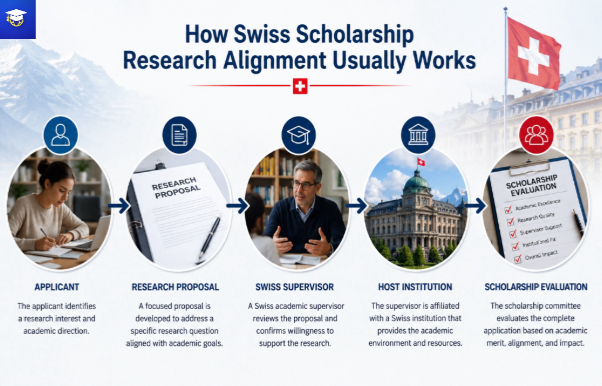
I have seen applicants spend months polishing a research proposal while ignoring the most decisive factor in the file: whether a Swiss professor actually wants to supervise the work.
The Swiss Government Excellence Scholarships place enormous weight on host supervision because the scholarship is tied directly to research integration inside Switzerland. A proposal without academic anchoring is treated as risky. The committee needs evidence that the project belongs inside a functioning Swiss research environment.
That is why generic supervisor emails fail so often.
Professors receive messages every week from international applicants saying things like:
“Dear Professor, I am interested in your research and would like you to supervise my Swiss scholarship application.”
That message usually goes nowhere because it tells the professor almost nothing. It does not show familiarity with their research direction. It does not explain the project properly. It does not explain why Switzerland is relevant. It often reads like a mass email sent to twenty academics at once.
The stronger applications usually emerge from narrower academic alignment. The applicant reads recent publications from a Swiss laboratory or department, identifies a meaningful overlap, adjusts the research direction if necessary, and then reaches out with a focused explanation of the proposed work.
Professors are not only evaluating intelligence. They are evaluating feasibility. Can this person realistically complete the project? Does the proposal connect with ongoing research? Does the applicant understand the field properly? Would supervision become a burden or an asset?
That changes how outreach emails should be written.
A good supervisor message is often concise. It introduces the applicant’s academic background, references a specific part of the professor’s work, explains the proposed research direction, and attaches a brief but serious concept note or proposal draft. The tone matters. Academic outreach should sound professional and grounded, not desperate or theatrical.
Applicants with weaker grades sometimes underestimate how much a strong supervisor relationship can strengthen perception of the file. Grades still matter, but the Swiss programme evaluates the overall academic trajectory and project coherence. A compelling research direction backed by a serious Swiss academic can shift how the application is viewed.
Students trying to strengthen imperfect academic records may also find value in broader scholarship positioning strategies discussed in this scholarship application strategy breakdown, especially around proposal quality and recommendation credibility.
Research Scholarships: What Selection Committees Actually Look For
The official evaluation criteria repeatedly point toward three core questions: the profile of the candidate, the quality of the research project or artistic work, and the future potential for international cooperation.
That final point is often overlooked.
The scholarship is not structured simply as financial aid. Switzerland treats it as part of its academic and research diplomacy ecosystem. The selection committee wants applicants who can contribute meaningfully to long-term intellectual exchange between Switzerland and their home countries or research communities.
That is why vague motivation letters perform badly.
A statement like “I want to study in Switzerland because of its excellent education system” carries almost no analytical value. Thousands of applicants can write the same sentence. Selection committees are trying to identify individuals whose work has direction, relevance and continuity.
The strongest research proposals usually share several characteristics:
- They define a focused research problem clearly.
- They explain why the research matters academically or socially.
- They show awareness of existing literature.
- They connect directly with Swiss institutional expertise.
- They outline realistic methods and timelines.
- They avoid exaggerated promises.
- They sound like research documents, not inspirational essays.
Many applicants make another mistake by trying to sound overly technical. Complexity alone does not impress scholarship committees. Clarity matters more. A proposal should demonstrate intellectual control over the subject, not hide behind difficult terminology.
For PhD applicants, there is another layer to manage carefully: the difference between scholarship approval and university admission.
Some applicants assume that winning the scholarship automatically guarantees institutional admission. That assumption creates serious problems. In many cases, admission procedures and scholarship procedures are connected but separate. Applicants may still need to satisfy departmental requirements, doctoral registration rules or institutional timelines independently.
That separation becomes even more important in highly competitive environments such as ETH Zurich or EPFL, where research groups often receive international interest far beyond available positions.
The Art Scholarships Are Competitive in a Different Way
The art scholarships follow a different rhythm from the research awards. Academic transcripts still matter, but artistic evidence becomes central.
A weak portfolio cannot be rescued by polished motivational language.
Swiss arts institutions pay close attention to originality, direction and seriousness of artistic practice. The portfolio has to show more than talent. It has to show development, consistency and readiness for advanced artistic training.
Applicants sometimes misunderstand what “initial Master’s degree” means under the art scholarship category. The programme is not designed for applicants repeatedly collecting degrees in similar artistic areas without progression. The scholarship is expected to support a meaningful stage in artistic education.
Country restrictions also matter far more here than many applicants realise. Unlike the broader research scholarships, the art scholarships are not available to all participating countries. Every applicant must check the official country list for the current cycle instead of relying on outdated blog posts or copied social media graphics.
Portfolio preparation also varies by discipline. A visual arts applicant may need carefully curated project documentation and exhibition evidence. A music applicant may need recordings, repertoire evidence or audition-related materials. Some institutions may require separate artistic admission processes before scholarship confirmation moves forward.
The strongest artistic files usually feel coherent. The committee can see the artistic direction clearly. The work connects with the institution selected. The motivation reflects artistic seriousness rather than generic excitement about Europe.
Switzerland’s arts environment adds another layer of attraction here. Conservatories, design schools and arts institutions in cities such as Zurich, Geneva, Lausanne and Basel operate inside a country with unusually strong public cultural infrastructure relative to its size. That exposure matters for emerging artists looking for international networks and institutional credibility.
Financial Support: What the Scholarship Pays for — and What It Does Not
The phrase “fully funded” is often used loosely online. In the case of the Swiss Government Excellence Scholarships, the funding is substantial, but applicants still need to understand its limits honestly.
For many scholarship categories, the monthly stipend has recently been around CHF 2,450 for research, doctoral and art scholarship holders. Postdoctoral scholarship holders typically receive a higher amount, often around CHF 3,500 monthly. These figures can change by cycle, so applicants should confirm them through the official Swiss scholarship documents before planning financially.
The scholarship also includes several additional support measures depending on nationality and scholarship category. These may include health insurance coverage for non-EU or non-EFTA applicants, a one-time housing allowance, public transport support through a Half-Fare travel card, and organised scholarship holder activities or excursions.
Some non-European scholarship recipients may also receive support connected to return travel arrangements. But applicants from EU or EFTA countries should not assume the same travel conditions apply to them.
The difficult part is Switzerland’s cost of living.
The scholarship amount sounds large in many currencies, but Switzerland is one of the most expensive countries in Europe. Rent alone can consume a major portion of the stipend in cities like Zurich or Geneva. Health-related expenses, transport, food and residence permit processes also add pressure.
That is why scholarship recipients who manage their finances carefully tend to adapt faster. Shared housing, student residences and canton-specific accommodation strategies become important quickly after arrival.
The scholarship is also not structured as family support funding. Applicants planning to relocate with dependents need to understand that the programme is designed around individual academic support. Family-related financial realities can become difficult without additional independent resources.
Applicants should also avoid assuming the scholarship automatically eliminates all tuition costs. Some Swiss institutions reduce or waive certain fees for scholarship holders, but tuition arrangements vary. Administrative semester fees can still exist. Those details should always be confirmed directly with the host institution.
Another point rarely discussed openly: conference participation, fieldwork expansion or additional research travel may require separate funding beyond the scholarship package. Applicants conducting research with expensive technical or international field components should think about this early rather than after arrival.
Most Applications Are Already Late Before the Official Deadline Arrives
The public deadline is not the real deadline for this scholarship.
That is one of the hardest realities applicants discover too late.
By the time the Swiss diplomatic representation in a country officially closes submissions in October, November or December, many strong candidates have already been preparing for months. Some began identifying supervisors in spring. Others started refining proposals early in the year after reading the previous cycle’s requirements.
The scholarship rewards preparation that starts quietly and early.
A rushed application is easy to detect. Weak supervisor alignment, inconsistent proposals, vague timelines and generic motivation letters tend to cluster together. The file may look complete technically, but academically it feels unstable.
The strongest applications usually develop in stages.
An applicant first identifies whether their field realistically fits the Swiss research environment. Then comes supervisor research, proposal drafting, institutional checks, recommendation planning, transcript preparation and document refinement. By the time the application officially opens, the serious work is often already underway.
The official scholarship call normally appears around August each year for the following academic cycle. Beginning with the 2026–2027 cycle, applications are submitted through the official ESKAS online portal rather than through the older embassy-based submission structure used in previous years. Deadlines, eligibility conditions and required documents can still vary by country category and scholarship type, so applicants should always verify the current instructions published through the official Swiss scholarship platform before applying. Results are usually communicated several months later, often around spring, with scholarship periods beginning around September.
Applicants who wait for the official opening announcement before preparing often compress too many difficult tasks into a short period. Finding a Swiss academic supervisor alone can take weeks or months. Professors may not respond immediately. Some will decline. Others may request proposal revisions before offering support.
That timing pressure becomes worse in highly competitive disciplines where research groups already receive large numbers of international requests.
Building the Application File Properly
The Swiss Government Excellence Scholarship application file is not designed to reward decorative writing. Every document has a practical function inside the evaluation process.
The curriculum vitae is expected to show academic continuity and seriousness. Inflated language usually weakens credibility. Scholarship committees are more interested in evidence than performance. Research experience, publications, laboratory work, exhibitions, conference participation, teaching involvement or specialised project work carry more weight than exaggerated self-description.
The motivation letter is another area where many applicants damage otherwise strong applications.
Committees do not need emotional storytelling about loving Switzerland since childhood. They need intellectual clarity. Why this project? Why this institution? Why now? Why Switzerland specifically? What academic or artistic trajectory does this scholarship support?
The strongest motivation letters sound controlled. The applicant understands their field, understands their limitations, and understands what the scholarship environment offers.
The research proposal carries even more pressure.
Swiss scholarship reviewers expect structure. The proposal usually needs a clearly defined research problem, objective, methodology, timeline and explanation of academic relevance. Strong proposals also show familiarity with existing scholarship in the field instead of pretending the applicant is inventing the subject from zero.
Weak proposals often reveal themselves quickly. Some are too broad to complete realistically. Others imitate research language without presenting a clear argument. Some applicants try to sound advanced by overloading the proposal with technical jargon that ultimately says very little.
A proposal does not need to sound dramatic. It needs to sound viable.
Recommendation letters matter differently here than in some scholarship systems. Generic recommendation letters with vague praise rarely strengthen a competitive file. The strongest recommendations usually contain concrete academic observations: research discipline, analytical ability, publication quality, laboratory performance, artistic consistency or intellectual independence.
For art applicants, the portfolio becomes the centre of the file. Poor curation damages perception quickly. A portfolio should not feel like a storage folder containing every piece of work produced over several years. Selection committees look for direction and artistic coherence.
The Application Checklist Serious Applicants Usually Build Early
| Preparation Area | What Strong Applicants Usually Do | Common Weakness |
|---|---|---|
| Supervisor Search | Read publications and contact professors early with targeted research alignment | Sending mass emails to unrelated academics |
| Research Proposal | Develop realistic scope with clear methods and timeline | Overly broad topics with unclear objectives |
| Recommendations | Request detailed academic references from people familiar with the work | Using generic recommendation templates |
| Portfolio Preparation | Curate work carefully around artistic direction and growth | Uploading excessive unrelated work |
| Document Verification | Prepare translations, signatures and official copies early | Last-minute incomplete files |
| Institution Research | Study departmental fit and institutional expectations | Choosing institutions based only on rankings |
One of the reasons this scholarship remains respected internationally is because the evaluation process forces applicants to think carefully about intellectual direction. The file cannot rely on motivation alone. The committee expects evidence of preparation.
That is also why some applicants who were successful in other scholarship competitions struggle here. They try to recycle the same motivational language across multiple applications. The Swiss programme usually exposes that quickly because the supervisor requirement and project evaluation force specificity.
What a Strong Supervisor Outreach Message Usually Looks Like
Most professors can identify a copied scholarship email almost immediately.
The problem is not only politeness. It is intellectual seriousness.
A useful outreach message normally does four things:
- Introduces the applicant’s academic background briefly.
- References a specific part of the professor’s research work.
- Explains the proposed research connection clearly.
- Shows awareness of the Swiss Government Excellence Scholarship structure.
Long emotional introductions usually weaken the message. So do exaggerated compliments. Professors are evaluating whether collaboration makes academic sense, not whether the applicant can perform admiration convincingly.
I have also noticed that many strong applicants underestimate how much timing affects supervisor responses. Sending outreach messages during major conference periods, examination periods or summer breaks can delay communication significantly. Some applicants interpret silence as rejection when the timing itself was poor.
A serious applicant also studies the professor’s recent work carefully before reaching out. Mentioning a publication from ten years ago while ignoring current projects can make the message feel disconnected from the supervisor’s actual research direction.
Applicants comparing international scholarship systems sometimes notice how different the Swiss model feels from state-sponsored programmes elsewhere. For example, some government-funded schemes place heavier emphasis on institutional placement structures or interview systems. That difference becomes clearer when compared with experiences discussed in this Türkiye Burslari interview and placement analysis.
The Swiss system places unusual weight on research integration itself. The applicant is expected to arrive already connected academically to the proposed host environment.
Language Expectations Are More Nuanced Than Applicants Think
The scholarship itself does not impose one universal language examination rule across every field and institution. That creates confusion online because applicants search for a single answer that does not really exist.
The actual expectation depends on several layers:
- The language used by the host institution.
- The language required by the supervisor or department.
- The language needed to conduct the research or artistic work properly.
- The institutional admission conditions tied to the programme itself.
Some doctoral or research environments operate comfortably in English, especially in scientific and technical disciplines. Others may expect proficiency in German, French or Italian depending on the canton, institution or field.
Art applicants face another dimension because performance, instruction or studio interaction may depend heavily on local language realities.
The strongest applicants do not treat language as an afterthought. Even where formal language certificates are not mandatory, the committee still evaluates whether the applicant can realistically function inside the proposed environment.
That becomes visible very quickly during proposal evaluation. Weakly written proposals, poor communication with supervisors or unclear academic expression can raise concerns even if no formal language test is required.
The Institutions Behind the Scholarship Matter More Than Rankings Alone
Applicants often focus heavily on institutional prestige while ignoring research compatibility.
That mistake creates weak applications.
Switzerland has globally recognised institutions such as ETH Zurich and EPFL, but the scholarship ecosystem extends beyond internationally famous names. Cantonal universities, universities of applied sciences and specialised research institutes also host scholarship recipients.
The better question is not “Which Swiss university ranks highest?”
The better question is whether the institution genuinely fits the project.
A candidate researching environmental systems may find stronger alignment with a specialised Swiss institute than with a globally famous department that only partially overlaps with the topic. An artist may benefit more from a conservatory whose faculty and artistic culture align directly with their work than from choosing a school based only on international visibility.
Selection committees notice when applicants choose institutions intelligently.
Strong files often demonstrate awareness of laboratories, archives, artistic communities, research groups, technical infrastructure or ongoing projects connected to the proposed work. Weak files speak vaguely about “world-class education” without demonstrating actual institutional understanding.
That difference affects credibility more than many applicants realise.
The Scholarship Does Not Remove the Realities of Living in Switzerland
Switzerland offers exceptional research conditions in many fields, but daily life there is expensive and highly structured.
Applicants attracted mainly by photographs of Alpine cities or European lifestyle branding often underestimate the practical side of relocation.
Housing can become stressful quickly in major cities. Student accommodation is competitive. Private rentals may require deposits that surprise international applicants unfamiliar with Swiss housing systems. Some scholarship recipients arrive expecting the monthly stipend to feel luxurious, only to realise that rent, transport and mandatory costs absorb much of the budget.
The scholarship support remains valuable because Switzerland’s research infrastructure is unusually strong relative to the country’s size. Laboratories, archives, libraries, artistic institutions and collaborative networks are often highly organised. But the lifestyle adjustment is real.
That adjustment also affects academic performance.
Applicants who prepare mentally for Swiss administrative systems, housing realities and cost management tend to settle faster. Those who expect the scholarship alone to solve every logistical challenge often struggle during the first months after arrival.
What Selection Committees Quietly Notice in Strong Applications
Scholarship committees rarely publish detailed scoring psychology publicly, but certain patterns become visible across strong applications over time.
The strongest files usually feel internally consistent.
The applicant’s academic background connects naturally to the proposed research direction. The research direction connects logically to the supervisor. The supervisor connects clearly to the institution. Nothing feels randomly assembled for the sake of funding.
Weak applications often contain invisible fractures.
The applicant may have excellent grades but propose work outside their demonstrated academic direction. Or the institution selected may not align properly with the methods described in the proposal. Sometimes the supervisor’s expertise only overlaps partially with the project itself.
Selection committees notice these inconsistencies because they are evaluating feasibility as much as intelligence.
Another pattern appears in how applicants describe themselves.
Overconfident applications can quietly damage credibility. Scholarship reviewers generally respond more positively to applicants who understand their field seriously than applicants trying to present themselves as future global saviours.
The strongest applications usually sound academically grounded rather than performative.
There is also a noticeable difference between applicants who understand Switzerland as a research environment and applicants who simply want to relocate to Europe. That difference becomes visible in proposal details, institutional choices and supervisor communication almost immediately.
The files that stand out most are rarely the loudest. They are usually the ones where the intellectual direction feels stable from beginning to end.
Why Some Brilliant Applicants Still Get Rejected
One of the biggest misconceptions around the Swiss Government Excellence Scholarships is the belief that academic intelligence alone guarantees competitiveness.
It does not.
Every cycle includes applicants with strong transcripts, impressive universities and serious technical ability who still fail to secure the scholarship. The difference usually appears in coherence rather than raw intelligence.
A file can contain excellent grades and still feel disconnected.
The proposal may not match the supervisor properly. The motivation letter may sound copied from another scholarship application. The research timeline may look unrealistic. The applicant may understand the field academically but fail to explain why Switzerland is genuinely necessary for the project.
The committee is evaluating the scholarship as an academic investment. A strong file makes the entire trajectory understandable from beginning to end.
Strong applications answer deeper questions naturally: why this research direction, why this institution, why this supervisor and why Switzerland specifically for this stage of the applicant’s work.
Weak applications often answer those questions separately. Strong applications connect them naturally.
I have also noticed another pattern among unsuccessful applicants: many underestimate how much the proposal itself shapes perception of academic maturity. A proposal filled with ambitious language but weak methodological thinking creates doubt quickly. Switzerland’s academic system is highly structured. Committees want to see evidence that the applicant understands research discipline, not only research ambition.
That becomes especially visible in doctoral and postdoctoral categories. A postdoctoral proposal, for example, is expected to reflect increasing intellectual independence. Reviewers are not simply looking for someone who follows instructions well. They are looking for someone capable of producing meaningful scholarly work inside an advanced research environment.
The Research Proposal Carries More Weight Than Most Applicants Expect
Applicants often obsess over formatting details while neglecting the intellectual quality of the proposal itself.
The proposal is where the committee sees how the applicant thinks.
A strong proposal usually feels controlled from the first page. The research problem is clear. The scope is realistic. The methods align with the question being asked. The timeline makes sense. The applicant understands the field well enough to define limits instead of pretending to solve everything at once.
Weak proposals usually fail in one of three ways.
Some are too broad. The applicant tries to tackle an entire global issue inside a short fellowship period. Others are technically dense but conceptually weak, using complex terminology without establishing a meaningful argument. A third category imitates academic writing stylistically but lacks real intellectual structure underneath.
The strongest proposals also explain why Switzerland matters specifically.
This part matters more than many applicants realise.
Committees expect applicants to justify the Swiss connection academically. That justification could involve laboratory infrastructure, archival access, institutional expertise, faculty collaboration, specialised artistic environments or technical resources unavailable elsewhere.
A generic sentence like “Switzerland has an excellent education system” does not answer that question properly.
Applicants should also pay attention to research feasibility. Scholarship committees are usually skeptical of projects that require unrealistic fieldwork budgets, undefined methodologies or timelines that collapse under basic scrutiny.
The proposal should sound like a document designed to be implemented, not admired.
Why Switzerland Rewards Narrow Research Questions More Than Grand Ideas
Applicants from some academic systems are trained to present research as broadly as possible. The proposal becomes filled with phrases about solving global crises, transforming entire sectors or reshaping international policy landscapes.
That approach often weakens Swiss scholarship applications.
Swiss academic environments usually respond more positively to research questions that are focused, technically manageable and methodologically disciplined. A proposal trying to answer one difficult question properly often appears stronger than a proposal trying to address five major global problems at once.
This difference becomes visible quickly in research design.
A candidate proposing a tightly structured study on alpine water governance systems, semiconductor material efficiency or AI auditing frameworks inside a defined institutional context may appear more convincing than someone presenting a sweeping global transformation agenda without realistic methodological limits.
The selection committee is not only asking whether the topic sounds important. They are asking whether the work can realistically be completed inside the proposed scholarship period and institutional environment.
That evaluation style surprises many applicants.
Some initially believe their proposal needs to sound larger to appear impressive. In reality, intellectual control usually carries more weight than scale. A carefully defined project signals research maturity. It shows the applicant understands academic constraints, methodological discipline and the realities of scholarly work.
This also explains why successful proposals often feel calmer than unsuccessful ones.
The strongest files usually avoid exaggerated promises. They define the research boundary clearly, explain the methods carefully and connect the work directly to the Swiss institutional setting supporting it.
What Life Looks Like After Winning the Scholarship
Many scholarship articles stop at acceptance letters. The more difficult reality begins after arrival.
The Swiss Government Excellence Scholarship creates access to a highly organised academic environment, but scholarship holders are still expected to function independently inside it.
Researchers quickly discover that Swiss academic culture often values preparation, punctuality and intellectual autonomy heavily. Supervisors may offer strong academic support while still expecting scholarship holders to manage their projects with significant responsibility.
The scholarship also carries administrative obligations. Scholarship recipients are generally expected to reside in the canton connected to their institution and maintain full-time academic engagement during the funding period. Residence permit procedures, insurance arrangements and local registration requirements become part of daily life early after arrival.
The transition can feel sharp for applicants arriving from academic systems structured differently.
Some scholars adapt immediately. Others struggle during the first months because they underestimated how demanding relocation itself can become.
The financial side remains another adjustment point. Even with scholarship support, budgeting matters constantly in Switzerland. Grocery costs, transportation, accommodation and health-related expenses accumulate quickly, especially in major urban areas.
That said, the academic advantages are difficult to ignore.
Swiss institutions operate inside one of Europe’s strongest research ecosystems. Laboratories are often well-equipped. Interdisciplinary collaboration is common. International academic networks are deeply integrated into many departments. For artists, exposure to Swiss cultural institutions and European creative networks can reshape career direction entirely.
The scholarship community itself also becomes important over time. Many recipients build lasting professional relationships through academic events, excursions and institutional interactions connected to the programme.
The Career Impact Is Often Longer Than the Scholarship Period
The scholarship is temporary. The institutional credibility attached to it is not.
Former scholarship holders frequently move into doctoral programmes, academic appointments, international research collaborations, museum work, cultural projects or policy-oriented research environments after the funding period ends.
The impact is not automatic, though.
The scholarship creates opportunity. What happens afterward depends heavily on how the recipient uses the research period.
Applicants who treat the scholarship as a short international experience often leave with less long-term benefit than applicants who approach it strategically from the beginning. Publication planning, research networking, conference participation, collaborative work and relationship-building matter enormously during the funded period.
For doctoral and postdoctoral researchers especially, the scholarship can strengthen future academic mobility significantly. Swiss institutional affiliation carries weight internationally in many research sectors, particularly in engineering, environmental sciences, physics, life sciences, international policy and advanced technical research.
Artists experience a different type of impact. Access to Swiss artistic environments can expand exhibition possibilities, performance opportunities and institutional visibility across Europe. Some recipients use the scholarship period to reposition their work internationally rather than simply complete a degree requirement.
The programme also reflects a broader Swiss philosophy toward international academic cooperation. The scholarship is not designed as isolated charity. It is intended to create long-term intellectual and cultural exchange between Switzerland and scholars abroad.
Common Mistakes That Damage Otherwise Strong Applications
After reviewing multiple successful and unsuccessful scholarship patterns over time, certain mistakes appear repeatedly.
The first is generic positioning.
Applicants often try to sound universally impressive instead of academically specific. The file becomes filled with broad statements about leadership, passion and global impact while failing to explain the actual project properly.
The second mistake is weak supervisor alignment.
Some applicants contact professors whose research overlaps only vaguely with the proposed topic. Others never properly study the host department before applying. Selection committees notice these inconsistencies quickly because they suggest weak preparation.
Another major problem is unrealistic project design.
A proposal trying to solve multiple national policy problems, conduct large-scale international fieldwork and publish major outputs within a short fellowship period usually creates concern rather than admiration.
Applicants also underestimate document quality.
Poor translations, inconsistent formatting, unclear timelines, missing signatures and weak recommendation letters damage perception immediately. The scholarship receives applications from candidates who prepare extremely carefully. Administrative weakness can quietly push a file downward even when the academic core is promising.
One of the more subtle mistakes involves copying scholarship language from online samples.
Selection committees read thousands of applications. Recycled motivational phrases become visible quickly. The strongest applications usually sound grounded in the applicant’s actual intellectual trajectory rather than internet scholarship culture.
Why the Scholarship Continues to Attract Global Competition
Part of the programme’s reputation comes from Switzerland itself.
The country combines high-level research infrastructure, political stability, international connectivity and strong institutional funding in a relatively compact academic environment. Few countries of similar size maintain such concentrated scientific and technical influence across multiple disciplines.
But prestige alone does not explain the scholarship’s competitiveness.
The structure of the programme attracts applicants already positioned seriously inside their fields. Research-focused scholarships tied directly to supervisor-backed projects naturally filter out many casual applicants early. By the time files reach final evaluation stages, committees are often comparing candidates who already possess strong academic profiles.
That competition becomes even sharper in fields linked to emerging scientific research, international governance, sustainability, engineering, biotechnology, advanced computing and specialised arts disciplines.
The scholarship also appeals to applicants looking beyond tuition funding.
Many international scholarships support classroom study broadly. The Swiss Government Excellence Scholarships operate closer to the research core itself. That difference changes the type of applicant attracted to the programme.
Applicants seeking alternatives across major international funding systems sometimes compare the Swiss programme with scholarship routes in Europe, Türkiye or China. Students exploring multiple fully funded pathways can also review broader opportunities through this Chinese scholarship acceptance analysis, especially when comparing institutional sponsorship structures and supervisor dynamics.
Questions Applicants Ask Repeatedly Every Year
Is the Swiss Government Excellence Scholarship fully funded?
The scholarship provides substantial financial support, including a monthly stipend and additional benefits depending on nationality and scholarship category. But applicants should still understand Switzerland’s high living costs realistically. Some institutional or personal costs may still exist.
Can I apply without a Swiss professor?
Research applicants generally need support from a Swiss academic supervisor. This is one of the central requirements of the scholarship. Applications without meaningful host supervision usually struggle immediately.
Is IELTS or TOEFL mandatory?
There is no single universal language rule covering every scholarship category or institution. Language expectations depend on the host institution, research environment and academic field. Applicants should verify the specific expectations tied to their proposed programme.
Can undergraduate students apply?
The scholarship is primarily designed for postgraduate researchers and artists pursuing advanced study. Undergraduate-only applicants generally do not fall within the core target structure of the programme.
Are art scholarships available to every country?
No. The art scholarship category is limited to applicants from selected countries. Every applicant must confirm eligibility through the official country list for the current scholarship cycle.
How competitive is the scholarship?
Extremely competitive. The programme attracts applicants from across the world, many with strong academic or artistic backgrounds. Supervisor alignment, proposal quality and intellectual clarity often become decisive factors.
Does the scholarship guarantee admission into a Swiss university?
Not automatically. Institutional admission and scholarship approval may involve separate processes depending on the institution and scholarship category.
The Applicants Who Usually Position Themselves Best
The strongest applicants rarely treat the scholarship as a random opportunity discovered weeks before the deadline.
They usually approach it as a serious academic project.
They read institutional research carefully. They refine their project gradually. They contact supervisors early. They revise proposals repeatedly. They understand the realities of Swiss academic culture before arriving.
Most importantly, they understand that the scholarship is not simply paying for education. It is funding a relationship between the applicant’s work and the Swiss academic environment.
That distinction changes how successful applications are built.
Official scholarship resources:
Swiss Government Excellence Scholarships – Official SBFI Page
Swiss Government Excellence Scholarships at a Glance
Applicants should always confirm deadlines, country eligibility, scholarship categories and document requirements through the official Swiss government sources before applying.
The applicants who tend to perform best are not always the loudest or most decorated on paper. They are usually the ones whose applications feel intellectually stable from beginning to end.
The proposal fits the supervisor.
The supervisor fits the institution.
The institution fits the project.
And the project itself fits the scholarship.
That alignment is difficult to fake. It is also the reason the Swiss Government Excellence Scholarships continue to hold serious academic credibility internationally.
Practical Timeline Serious Applicants Usually Follow
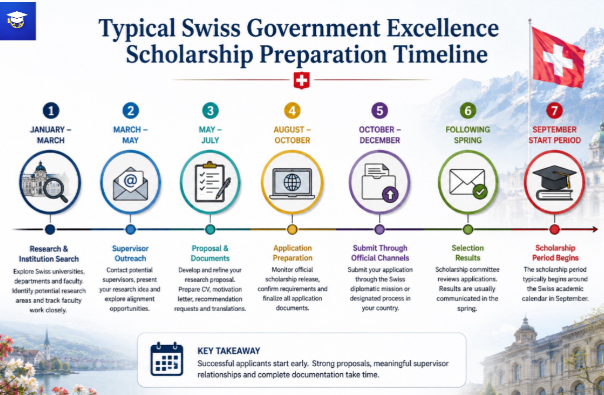
One reason many applications fail quietly is because applicants underestimate how long preparation actually takes.
The official deadline may sit months away, but the intellectual preparation usually begins much earlier. Applicants who wait until the scholarship portal opens often discover they are competing against people who already secured supervisor conversations, refined proposal drafts and gathered recommendation commitments long before the public announcement appeared.
A more realistic preparation timeline often looks like this:
| Period | What Serious Applicants Usually Do |
|---|---|
| January – March | Research Swiss institutions, identify departments, study faculty work and narrow research direction. |
| March – May | Begin contacting potential supervisors, revise project ideas and gather institutional information. |
| May – July | Develop proposal seriously, organise recommendations, prepare translations and refine CV. |
| August – October | Monitor official scholarship release, confirm country-specific deadlines and finalise application documents. |
| October – December | Submit through the official ESKAS online application portal according to the instructions for the applicant’s country and scholarship category. |
| Following Spring | Selection outcomes are normally communicated. |
| September Start Period | Scholarship period usually begins around the Swiss academic calendar. |
The timeline matters because the scholarship rewards depth. Strong proposals are rarely written in one weekend. Strong supervisor relationships almost never emerge from a single email.
What Switzerland Looks Like Academically From the Inside
Applicants often romanticise Switzerland before arriving.
Switzerland’s research reputation becomes easier to understand once scholarship holders begin working inside its institutional environment.
But what usually surprises scholarship holders most is how disciplined the academic culture can feel.
Meetings begin on time. Research timelines matter. Administrative procedures are structured carefully. Laboratories and departments often operate with strong expectations around independence and preparation.
For many scholars, this becomes one of the most valuable parts of the experience.
The scholarship places recipients inside environments where research is treated seriously as day-to-day work rather than occasional academic performance. That exposure can permanently reshape how applicants approach scholarship, publishing, collaboration and intellectual discipline after the programme ends.
Switzerland also creates unusual proximity between international institutions, scientific research, diplomacy and innovation sectors. In cities like Geneva, scholarship holders may find themselves close to global organisations, policy networks and multinational research collaborations that simply do not exist in many other academic systems.
That proximity changes opportunities.
A researcher focused on public health, climate governance, engineering, AI policy, environmental science or biotechnology may suddenly find access to conversations and institutional ecosystems that previously felt distant.
The scholarship itself does not guarantee career transformation. But it can place serious scholars inside environments where those transformations become far more possible.
Applicants Should Be Careful About Fake Scholarship Offers
The reputation of the Swiss Government Excellence Scholarships also attracts misinformation.
Every year, applicants encounter unofficial “agents,” fake emails, fabricated portals or social media pages claiming guaranteed placements or accelerated approval.
The official Swiss scholarship system does not operate through random paid agents promising selection.
Applications are handled through official Swiss diplomatic channels and publicly announced procedures tied to the State Secretariat for Education, Research and Innovation.
Applicants should be cautious when they see:
- Requests for unofficial processing fees.
- Claims of guaranteed scholarship approval.
- Unverified WhatsApp scholarship groups pretending to represent Swiss authorities.
- Fake “priority application” offers.
- Unofficial portals requesting sensitive personal information.
The safest approach is simple: verify every requirement directly through the official Swiss government scholarship pages.
Scholarship Preparation Is Usually More Important Than Motivation Alone
Many applicants focus heavily on motivation because motivational storytelling dominates online scholarship culture.
The Swiss Government Excellence Scholarships operate differently.
Preparation carries more weight than performance.
The committee expects evidence that the applicant already thinks like a researcher or serious artist before the scholarship begins. That expectation shapes everything from the proposal structure to supervisor communication.
This is why some applicants from lesser-known universities still perform strongly. Their files feel intellectually disciplined. Their projects are coherent. Their preparation is obvious.
Meanwhile, some applicants from highly prestigious institutions struggle because the application feels rushed or generic.
The scholarship is competitive, but it is not random.
Certain patterns appear repeatedly among successful candidates:
- Clear research or artistic direction.
- Strong institutional fit.
- Focused supervisor alignment.
- Realistic project scope.
- Carefully prepared documentation.
- Academic maturity in writing and communication.
That combination tends to matter more than exaggerated personal branding.
For Applicants Still Comparing International Scholarship Options
Not every applicant who wants to study in Switzerland will ultimately pursue the Swiss Government Excellence Scholarships. The structure is highly research-oriented and may not fit everyone’s academic path.
Applicants still exploring broader international funding routes can compare opportunities through this fully funded international scholarships resource, especially when evaluating differences between research-driven programmes and coursework-focused scholarships.
That comparison matters because scholarship systems operate very differently from one country to another.
Some prioritise government placement systems. Others emphasise institutional admissions. Some focus heavily on interviews. The Swiss Government Excellence Scholarships stand out because they place unusual emphasis on project quality and host academic integration.
What Serious Applicants Usually Understand Early
The Swiss Government Excellence Scholarships continue to attract global respect because they are difficult to approach casually.
The programme asks applicants to think carefully about intellectual direction long before submission. It expects academic seriousness, preparation and realistic project design. It also expects applicants to understand why Switzerland itself matters for the proposed work.
That standard filters applications aggressively.
But for researchers and artists whose work genuinely aligns with Swiss institutions, the scholarship can become more than funding. It can become entry into an international academic environment with long-term professional value.
The strongest applications rarely feel dramatic. They feel stable.
The research question makes sense.
The institution makes sense.
The supervisor makes sense.
The applicant’s trajectory makes sense.
That level of coherence is usually what separates memorable applications from forgettable ones.
Applicants preparing for the next cycle should start earlier than they think they need to. Read faculty work carefully. Refine the proposal repeatedly. Study the official requirements line by line. Approach supervisors thoughtfully instead of hurriedly.
Most importantly, treat the scholarship as an academic commitment rather than an online opportunity.
That mindset changes the quality of the application before the committee even opens the file.
Official Sources
Swiss Government Excellence Scholarships — Official Swiss Government Page
Swiss Government Excellence Scholarships at a Glance
Applicants should always verify deadlines, country eligibility, scholarship categories and document requirements through official Swiss government sources before applying.
Frequently Asked Questions About Swiss Government Excellence Scholarships (FAQ)
Is the Swiss Government Excellence Scholarship fully funded?
The scholarship provides significant financial support, including a monthly stipend and additional benefits depending on the scholarship category and the applicant’s nationality. But Switzerland is one of the most expensive countries in Europe, so applicants should still prepare realistically for housing and daily living costs.
How important is finding a Swiss academic supervisor?
For research applicants, supervisor support is one of the most important parts of the application. The scholarship is built around research integration inside a Swiss institution, so proposals without strong supervisor alignment usually struggle during evaluation.
Can applicants from every country apply for the art scholarships?
No. The art scholarship category is only available to applicants from selected countries. Every applicant should verify the official country eligibility list published for the current scholarship cycle before preparing an application.
Does winning the scholarship automatically guarantee admission into a Swiss university?
Not always. Depending on the institution and scholarship category, admission procedures and scholarship evaluation may operate separately. Applicants still need to satisfy institutional or departmental requirements independently.
What usually makes an application stand out?
The strongest applications usually feel academically coherent from beginning to end. The proposal fits the supervisor, the supervisor fits the institution, and the institution fits the research direction. Selection committees respond strongly to intellectual clarity and realistic project design.
When should applicants start preparing for the scholarship?
Serious applicants often begin preparing several months before the official application period opens. Supervisor outreach, proposal refinement and institutional research usually take far longer than applicants initially expect.
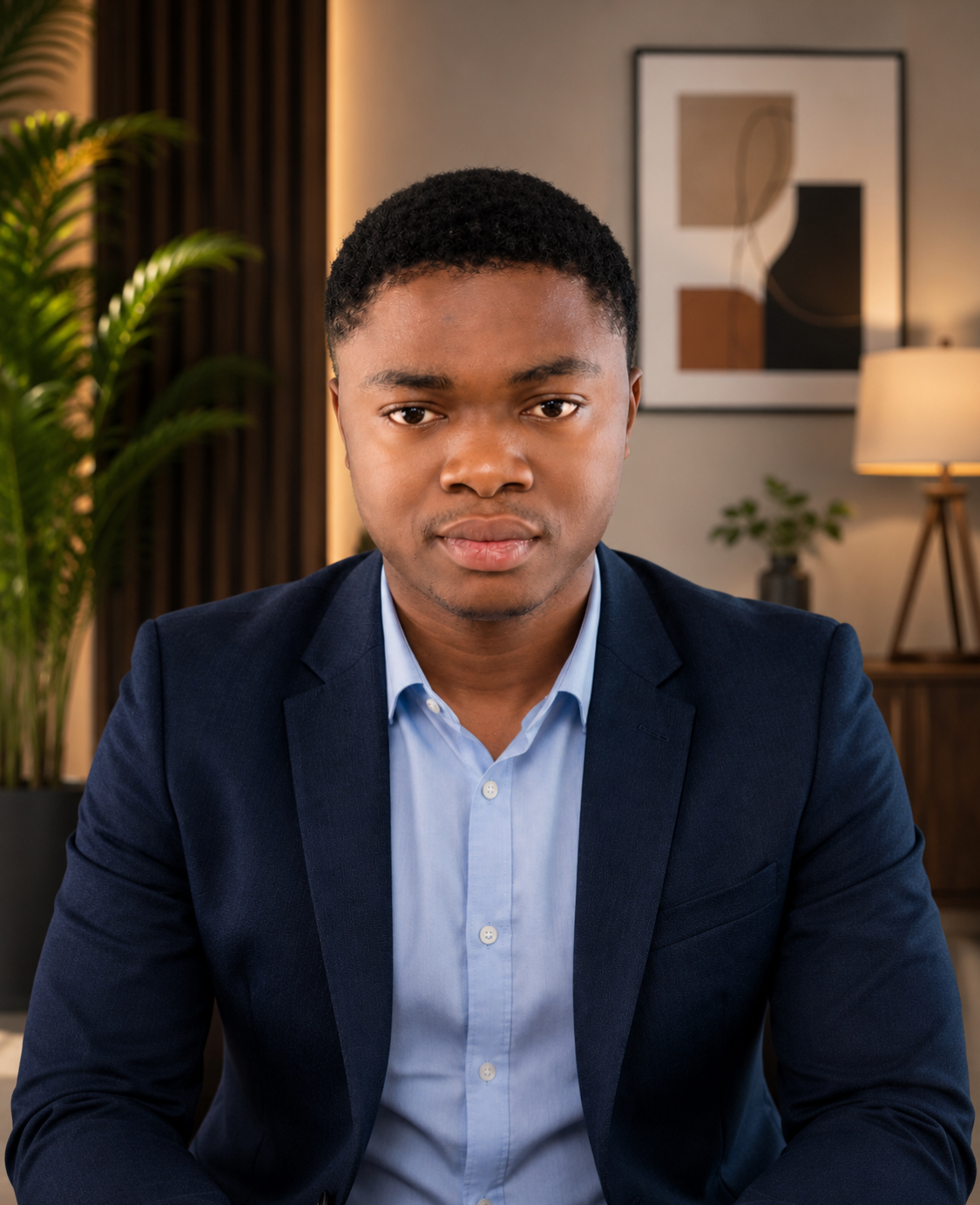
Founder of The Global Scholar Guide, focused on international scholarships, student visas, and practical study abroad guidance.