The Chinese Government Scholarship has become one of the most competitive fully funded opportunities available to international students. What often determines how far an application goes is not only academic performance, but how clearly the applicant has already positioned themselves within a specific university and research environment in China.
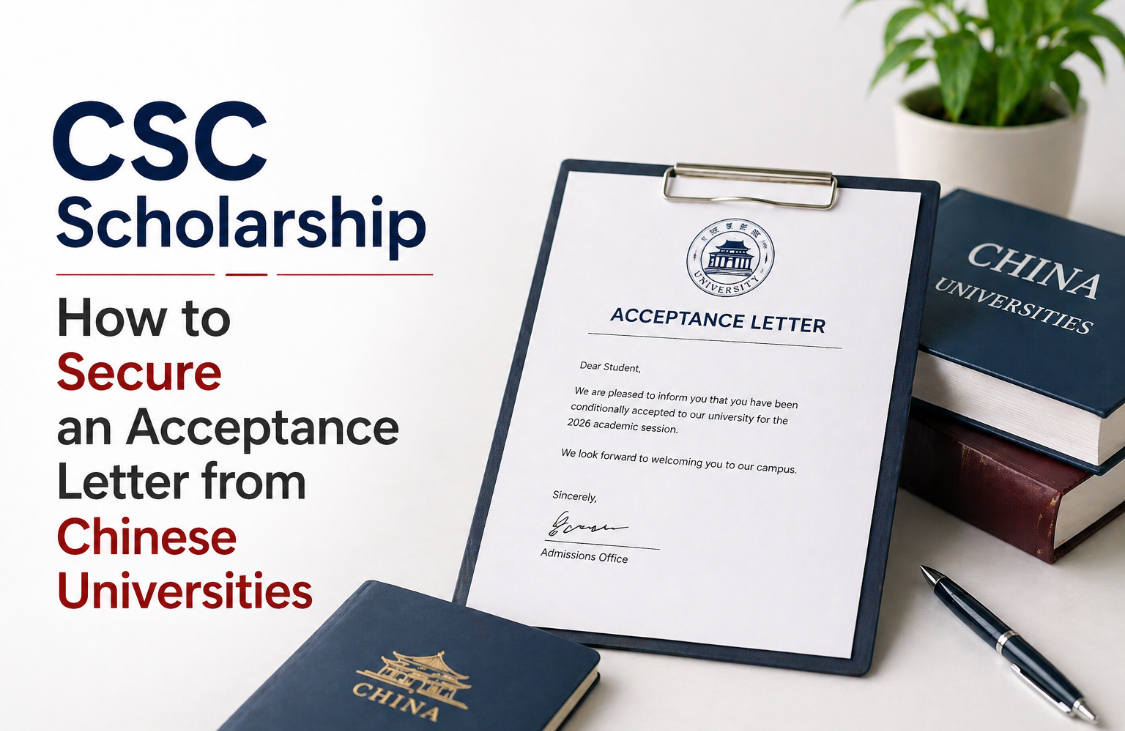
One document quietly sits at the center of that positioning — the acceptance letter. In practice, it appears under different names depending on the institution or context: supervisor acceptance letter, invitation letter, pre-admission notice, or pre-acceptance letter. While the wording varies, the purpose remains the same. It signals that a university or a professor has already shown interest in the applicant before the central scholarship decision is made.
Across recent cycles, particularly in postgraduate applications, candidates who secured some form of acceptance letter were often easier to place within universities. The reason is straightforward. The scholarship system does not operate in isolation. Universities are involved in screening, recommending, and ultimately hosting students. When a department or supervisor has already indicated willingness to accept a candidate, the process becomes more defined.
What many applicants miss is that the acceptance letter is not just a supporting document. It is early evidence that the application already fits somewhere.
There are two forms this acceptance can take, and understanding the distinction matters. A professor’s acceptance letter is usually informal, issued directly by a supervisor who agrees to guide the student if the scholarship is approved. An official pre-admission notice, on the other hand, comes from the university’s international office and often carries more weight because it reflects institutional approval rather than individual interest.
For many programs under the CSC framework, especially those processed through embassies or major universities, the official pre-admission document is strongly recommended and sometimes expected. In other cases, the professor’s letter acts as the first step, opening the door for the formal document to follow.
Response rates from professors in China are also part of the reality applicants must accept early. Even strong candidates often receive replies from only a small portion of the emails they send. That is not necessarily a reflection of their profile. It is a function of workload, alignment, timing, and the sheer volume of requests professors receive.
This is where strategy becomes more important than effort alone. A well-targeted approach, supported by clear documents and thoughtful communication, tends to produce better results than sending large volumes of generic emails.
For applicants who are also exploring broader funding opportunities, 📌 reviewing fully funded scholarship pathways can help place the CSC process within a wider context, especially when comparing competitiveness and documentation expectations.
Why acceptance letters carry weight in CSC applications
Within the CSC system, placement is not random. Applications are evaluated and then aligned with available programs, supervisors, and institutional capacity. An acceptance letter reduces uncertainty in that alignment.
From a university’s perspective, an applicant with a prior acceptance signal has already passed an informal layer of screening. From the scholarship’s perspective, it indicates that the applicant is not only qualified on paper but also fits within an existing academic environment.
That dual relevance explains why acceptance letters can influence outcomes without being formally mandatory in every case. They do not replace academic strength or documentation, but they reinforce both.
There is also a practical aspect. Universities often have internal priorities and quotas. When a professor has already expressed willingness to supervise a candidate, that candidate becomes easier to accommodate within those constraints.
In some programs, particularly at the postgraduate level, applicants without any prior contact may still be considered, but they are competing in a broader pool where alignment is less defined. That difference is not always visible at the application stage, but it becomes clearer during final placement.
An acceptance letter does not guarantee selection, but it often removes uncertainty from one of the most critical stages of the process.
The importance varies slightly by application type. Under embassy-track applications, pre-admission documents are often emphasized more strongly. Under university-track applications, the process may begin directly with the institution, making early contact even more relevant.
For doctoral programs, the role of the supervisor is particularly central. Research alignment, ongoing projects, and funding considerations make early engagement almost expected. At the master’s level, it remains important, though sometimes less strictly enforced depending on the university.
Understanding these nuances early helps applicants decide how much effort to invest in securing an acceptance letter and how to approach it strategically.
What needs to be in place before reaching out
Contacting professors too early, or without preparation, is one of the quiet reasons many emails go unanswered. The assumption is often that interest alone is enough to start a conversation. In reality, most professors look for signals that the applicant already understands where they are applying and why.
That understanding shows up in small details — how the research is described, how documents are structured, and whether the email reflects familiarity with the professor’s work. Without that, even strong academic profiles can be overlooked.
Choosing the right universities
The starting point is not individual professors, but institutions. The CSC system operates through a network of approved universities, many of which publish their own scholarship guidelines alongside the central application platform.
Rather than treating all universities equally, it helps to narrow the list based on field strength, language of instruction, and program structure. Some universities are highly competitive with limited supervisor availability, while others may offer more flexibility.
Using the official CSC application portal as a reference point, applicants can identify universities that actively participate in the scholarship scheme and align with their academic goals.
The goal at this stage is not to select one university, but to build a focused list. Most successful applicants work with a range of institutions rather than relying on a single option.
Identifying suitable professors
Once the universities are selected, the focus shifts to faculty members. This is where many applications either gain direction or lose it.
Looking through university department pages, recent publications, and research profiles provides a clearer sense of where alignment exists. Generic interest in a field is rarely enough. Professors tend to respond when they see that the applicant understands their specific work.
Referencing even one or two recent publications can change how an email is received. It shows that the applicant has taken time to engage with the research rather than sending a general request.
This step takes time, but it reduces the need to send large numbers of emails later. A smaller number of well-targeted contacts often produces better outcomes than broad, unfocused outreach.
Preparing the documents that support your request
Before sending any email, the supporting documents should already be complete. Professors rarely respond to requests that require additional follow-up just to provide basic information.
The essential documents include:
- Academic CV: Focused on education, research experience, and relevant skills
- Transcripts: Clear and organized, even if unofficial copies are used initially
- Research proposal or study plan: Even a draft version is important, especially for postgraduate applicants
- Passport copy: Often requested later, but useful to have ready
- Language test results: If available, though not always required at this stage
The difference between a strong and weak application at this stage is not volume, but clarity. Documents should be easy to read, clearly named, and directly relevant to the field being applied for.
Applicants who feel their academic record may not be as strong as others often benefit from strengthening the narrative around their experience. In such cases, 📌 reviewing strategies for securing scholarships with a lower GPA can help reshape how their profile is presented without overstating achievements.
Timing and why it affects response rates
Timing is rarely discussed in detail, but it influences outcomes more than many expect. Professors receive a higher volume of emails during certain periods, particularly close to scholarship deadlines.
Reaching out earlier, typically between September and December for the following academic year, allows more time for responses and follow-up. It also places the email in a less crowded window, where it is more likely to be read carefully.
Another factor is the academic calendar in China. Periods around major holidays, such as the Spring Festival, tend to slow down communication. Emails sent during these times may not receive timely responses, regardless of their quality.
Applicants who plan around these cycles tend to experience more consistent engagement.
Building a realistic outreach strategy
Even with strong preparation, not every email will receive a response. This is part of the process, not a reflection of the applicant’s capability.
Most applicants who successfully secure acceptance letters do so by combining quality with volume. They identify multiple professors across several universities, ensuring that their efforts are not dependent on a single reply.
A practical approach is to contact between 10 and 30 professors across a focused group of universities. This range accounts for low response rates while maintaining enough personalization to keep each email relevant.
Consistency in approach often matters more than the number of emails sent.
The goal is not to send as many emails as possible, but to create multiple opportunities for alignment. Each contact should feel intentional, not repeated.
How the outreach process actually works
Once the groundwork is in place, the process becomes more structured. What often separates applicants at this stage is not how many emails they send, but how clearly each step is handled from the first contact to the final request.
Professors are not reviewing applications in the same way a scholarship panel does. They are deciding, often within seconds, whether a request is worth their time. That decision is shaped by clarity, relevance, and how easy it is to understand the applicant’s intent.
Step 1: Build a focused contact list
Start with a manageable number of universities and expand within them. Rather than spreading attention across too many institutions, it is often more effective to identify 5 to 10 universities and explore multiple professors within each.
This allows for deeper alignment and reduces the risk of sending repetitive or generic messages. It also increases the likelihood that at least one department will respond positively.
Step 2: Customize each message
Even when contacting multiple professors, each email should reflect the specific research interests of the recipient. This does not require a long explanation, but it should be clear that the applicant has reviewed their work.
Referencing a recent publication or ongoing project is usually enough. The goal is not to summarize their research, but to show that the interest is intentional.
Step 3: Keep the message structured and concise
Most effective emails fall within a narrow range. They are neither too short to feel incomplete nor too long to lose attention. A clear structure tends to work best:
- Brief introduction
- Academic background
- Specific research alignment
- Reference to CSC scholarship
- Request for supervision or acceptance letter
- List of attached documents
The message should move logically without repeating points. Clarity matters more than detail at this stage.
Step 4: Follow up carefully
If no response is received, a single follow-up after 10 to 14 days is reasonable. More than one follow-up tends to reduce the effectiveness of the initial message.
Follow-ups should be brief and respectful, simply restating interest and attaching the original message if necessary.
Step 5: Request the right document
When a professor responds positively, the next step is to clarify the type of document needed. In most cases, applicants should request a supervision acceptance letter or a form of written confirmation that can support the CSC application.
Some professors will provide this directly. Others may refer the applicant to the university’s international office for an official pre-admission notice.
Understanding this distinction helps avoid confusion later in the process.
Email templates that tend to get responses
The structure of an email matters, but tone and clarity often determine whether it is read carefully. Below are examples that reflect how successful applicants typically present themselves. These are not scripts to copy directly, but patterns that can be adapted.
General template (Master’s or PhD)
Subject: Request for Supervision – CSC Scholarship Applicant in [Field]
Dear Professor [Last Name],
I hope this message finds you well. My name is [Your Name], and I am preparing an application for the Chinese Government Scholarship in [Field of Study]. I hold a degree in [Your Degree] from [University Name], where my work focused on [brief mention of relevant area].
I have reviewed your research on [specific topic or paper], particularly your work on [specific detail], and I believe it aligns closely with my academic interests. I am currently developing a study plan focused on [brief description of your research direction].
I would like to ask if you would be open to supervising my studies under the CSC program. If appropriate, I would be grateful for a supervision acceptance letter to support my application.
I have attached my CV and academic documents for your review. Please let me know if you require any additional information.
Thank you for your time and consideration.
Kind regards,
[Your Name]
PhD-focused variation
Subject: PhD Supervision Inquiry – CSC Scholarship Applicant
Dear Professor [Last Name],
I am writing to express my interest in pursuing doctoral research under your supervision. My academic background in [Field] has focused on [specific area], and my recent work includes [brief mention of project or thesis].
Your research on [specific topic] has been particularly relevant to my work, especially [mention a detail that shows understanding]. I am currently preparing a research proposal that builds on similar themes.
I intend to apply for the Chinese Government Scholarship and would like to inquire whether you would consider supporting my application with a supervision acceptance letter.
I have attached my CV, transcripts, and a draft research proposal for your review. I would appreciate any feedback you may have.
Thank you for your time.
Sincerely,
[Your Name]
Common mistakes that reduce response rates
- Sending the same email to multiple professors without changes
- Using overly long introductions without clear purpose
- Failing to mention any research alignment
- Attaching too many unrelated documents
- Using informal or demanding language
In most cases, the difference between a response and silence is not the applicant’s academic level. It is how clearly the email communicates relevance and intent.
Applicants who have worked through other highly competitive scholarship processes often recognize similar patterns in communication expectations. For example, 📌 structured storytelling and clarity in scholarship communication can also improve how outreach emails are written, even though the formats differ.
Why some emails get replies while others don’t
At this stage, many applicants begin to notice a pattern. Some emails receive responses within days, while others remain unanswered regardless of how many follow-ups are sent. The difference is rarely random.
Professors are balancing teaching, research, and administrative responsibilities. Their inboxes are often filled with similar requests. What stands out is not volume, but relevance and ease of understanding.
What influences response rates
- Research alignment: The closer the applicant’s focus matches ongoing work, the higher the chance of engagement
- Email clarity: Clear, concise messages are easier to review quickly
- Timing: Emails sent during active academic periods tend to perform better
- Professional tone: Respectful and structured communication reflects seriousness
- Attachment quality: Well-organized documents increase credibility
There is also a cultural layer that is often overlooked. In many Chinese academic settings, hierarchy and formality are taken seriously. Addressing professors correctly, maintaining a respectful tone, and avoiding overly casual language all contribute to how a message is received.
In most cases, a professor decides whether to engage within the first few lines of an email.
Ways to improve your chances of getting a reply
While no approach guarantees a response, certain adjustments consistently improve outcomes:
- Reference one or two specific research outputs instead of speaking generally
- Keep the email within a readable length (usually under 250 words)
- Send messages during weekdays when academic activity is higher
- Attach only essential documents with clear file names
- Maintain a professional but approachable tone
Another factor is persistence, but it needs to be measured. Contacting multiple professors across different universities creates more opportunities without relying on repeated follow-ups to the same person.
What a strong acceptance letter actually contains
Once a professor agrees to support an application, the next step is receiving a written confirmation. The format varies, but strong acceptance letters tend to include certain elements consistently.
Understanding these elements helps applicants assess whether the letter they receive is sufficient for CSC purposes or whether further steps are needed.
Key elements of an effective acceptance letter:
- Full name and academic title of the professor
- University and department affiliation
- Applicant’s full name
- Clear statement of willingness to supervise
- Program level (Master’s or PhD)
- Proposed field or research area
- Duration or expected start period
- Condition (often “subject to CSC approval”)
- Date and signature (or official stamp where applicable)
Some letters are brief, while others include more detailed descriptions of the research relationship. What matters most is clarity. The document should leave no doubt that the professor is willing to supervise the applicant if the scholarship is granted.
In stronger cases, applicants are guided toward obtaining an official pre-admission notice from the university. This document carries institutional weight and is often preferred when available.
How the letter is typically presented
Acceptance letters are usually issued as PDF documents on official letterhead or with identifiable academic formatting. In some cases, the communication may begin as an email confirmation, which is later formalized into a document.
Applicants should always ensure that the letter is readable, complete, and clearly identifies both the professor and the institution. If any details are missing, it is reasonable to request a revised version before submission.
A vague or incomplete letter can weaken an otherwise strong application.
What to do after receiving an acceptance letter
Receiving a positive response is only part of the process. How the letter is used and integrated into the application also matters.
Review and verify the document
Before using the letter, applicants should check all details carefully. Names, program information, and institutional affiliations should match the rest of the application.
If the letter includes conditions, those should be understood clearly. Many letters are issued on the assumption that the applicant will secure the CSC scholarship, which is standard practice.
Integrate it into your application
The acceptance letter should be uploaded where required within the CSC system. It can also be referenced within the study plan to reinforce alignment with the chosen research direction.
This creates a consistent narrative across documents. The study plan explains the intention, while the acceptance letter confirms that the intention has already been recognized by a supervisor.
Handling multiple acceptance letters
In some cases, applicants receive more than one positive response. This is not uncommon when outreach is well-targeted.
Rather than submitting all letters without consideration, it is often better to prioritize the one that offers the strongest alignment in terms of research, institution, and clarity of support.
Quality tends to matter more than quantity at this stage.
When responses don’t come and how to adjust
Silence is part of the process. It does not necessarily indicate rejection. In many cases, it reflects timing, workload, or lack of immediate availability.
When responses are limited, the focus should shift from waiting to refining the approach. This may involve adjusting how research alignment is presented, revising the email structure, or expanding the list of target professors.
Some applicants also explore alternative entry points, such as contacting university international offices directly for pre-admission processes where applicable.
What matters is maintaining a structured approach without turning persistence into repetition. Each adjustment should improve clarity rather than simply increase volume.
For applicants comparing different international pathways, 📌 reviewing structured European scholarship programs can offer a useful contrast in how centralized and decentralized systems handle placement and supervision.
When things stall and how to move forward
There is a point in the process where effort does not immediately translate into results. Emails have been sent, documents are ready, but responses are limited. This stage is common, especially for applicants targeting competitive universities or highly sought-after research areas.
The instinct is often to increase volume — send more emails, follow up more frequently, or widen the search without clear direction. That approach can work, but only when combined with refinement.
Refining your outreach instead of repeating it
When responses are low, the first step is to look at alignment rather than effort. Are the selected professors working in areas that clearly match the proposed research? Is the email making that connection obvious in the first few lines?
Small adjustments can change outcomes. Rewriting a paragraph to focus more directly on research overlap, restructuring the introduction to make it clearer, or simplifying the message can make it easier for a professor to respond quickly.
Another adjustment is narrowing focus. Instead of contacting a broader list of professors with varying relevance, concentrating on those whose work closely aligns with the proposal tends to produce better results.
Language and communication barriers
While many professors in China are comfortable communicating in English, there are cases where responses are brief or delayed due to language differences. This does not necessarily indicate lack of interest.
Keeping emails simple, direct, and free of unnecessary complexity helps reduce this barrier. Avoiding overly long sentences or technical language that is not essential to the request can make communication smoother.
When to shift approach
If repeated outreach does not produce results, it may be necessary to consider alternative entry points. Some universities provide structured pre-admission processes through their international offices, allowing applicants to submit documents directly without prior supervisor contact.
This approach varies by institution, and it requires careful review of each university’s CSC guidelines. It does not replace the value of a supervisor’s acceptance, but it can serve as an alternative pathway when direct contact proves difficult.
What makes an application stand out beyond the letter
There is a tendency to treat the acceptance letter as the final objective. In practice, it is one part of a broader structure that needs to remain consistent from start to finish.
Applications that stand out tend to have a clear internal logic. The academic background leads naturally into the proposed field of study. The research plan builds on that background. The acceptance letter confirms that a supervisor sees value in that direction.
When each part of the application reinforces the others, the acceptance letter becomes stronger because it fits into a complete narrative.
This is where many applications differ. Some present strong documents individually, but they do not connect clearly. Others are simpler, but everything aligns. The latter tends to be easier to evaluate and support.
Why some acceptance letters carry more weight than others
Not all acceptance letters function the same way once submitted. Some reflect a quick agreement from a professor, while others are backed by a department that has already reviewed the applicant informally.
The difference is subtle but important. Letters that reference a clear research fit, include specific program details, or come with departmental awareness tend to align more easily with internal university decisions.
In practice, stronger letters do not just confirm interest. They show that the applicant has already found a place within the academic structure.
This is why applicants who go beyond generic outreach—by aligning their proposal with actual research directions—often see smoother progression after submission.
Looking at the process from a different angle
Beyond the steps and templates, there is a broader way to understand the acceptance letter process. It is not only about requesting supervision. It is about positioning the application within an academic environment before formal selection begins.
From that perspective, the outreach phase becomes an early stage of placement rather than a separate task. The applicant is not only asking for support, but also identifying where their work fits and how it connects to existing research.
This shift in perspective often changes how applicants approach the process. Instead of focusing only on sending emails, they focus on building alignment — academically, professionally, and institutionally.
It also explains why some applicants receive positive responses quickly. Their profiles, research direction, and communication are already aligned with the expectations of the department they are contacting.
Final perspective
Securing an acceptance letter for the CSC scholarship is rarely a single-step process. It develops through preparation, targeted outreach, and consistent refinement.
The process rewards clarity more than volume. Applicants who understand their direction, communicate it effectively, and align it with the work of specific professors tend to move forward more steadily.
There is no fixed formula that guarantees a response, but there is a pattern behind successful applications. Early preparation, careful research, and structured communication appear consistently across those who secure acceptance letters.
Starting early remains one of the simplest advantages. It allows time to adjust, follow up, and explore alternative options without pressure.
The acceptance letter is not the starting point of the application. It is the result of how well the preparation and outreach have been handled.
References and official sources
- CSC Official Portal (Campus China) – Main platform for CSC applications and updates
- CSC Application Overview – General process insights including pre-admission context
- Email Samples for Contacting Professors – Example formats for outreach
Practices vary across universities. Applicants are encouraged to verify requirements directly on the official CSC portal and the websites of their target institutions before proceeding.

Founder of The Global Scholar Guide, focused on international scholarships, student visas, and practical study abroad guidance.