
Last updated: May 2026. Details in this article reflect current public information from the Dutch Immigration and Naturalisation Service (IND), including the 2026 study income norm, student residence permit fee, MVV process, and TB testing rules. Because Dutch immigration rules can change by year, nationality, institution, and permit type, students should verify their personal situation directly through the official IND student residence permit page and their university’s international office before submitting documents.
The Netherlands student visa process looks simple until the terminology starts to matter. A student may hear “MVV,” “residence permit,” “TEV,” “VVR,” “IND sponsor,” and “TB test” in the same admission email, then assume they are separate applications. They are connected, but they are not the same thing.
For many non-EU students, the MVV is the entry visa placed in the passport before travelling to the Netherlands. The residence permit is the document that allows the student to remain in the country for the study period. In Dutch immigration language, the MVV is the Machtiging tot Voorlopig Verblijf, while the student residence permit is the regular residence permit for study. In many student cases, both are handled together through the TEV procedure, usually by the university or university of applied sciences acting as the recognised sponsor.
That sponsor role is one of the biggest differences between the Netherlands and many other study destinations. A student does not normally walk into the IND system alone and file a standard student visa application. The recognised educational institution checks the admission, collects documents, confirms the financial proof, and submits the application to the IND. If the student needs an MVV, the institution usually applies for the MVV and residence permit together.
The process is strict, but not mysterious. The IND wants to see a recognised study programme, sufficient funds, valid identity documents, health insurance arrangements, and, for some nationalities, a signed declaration that the student will undergo a tuberculosis test after arrival. A weak file does not usually fail because the student misunderstood one big rule. It fails because small compliance points were treated casually: old bank documents, missing sponsor evidence, late university uploads, an ignored TB declaration, or a student assuming the MVV alone covers the full stay.
2026 financial benchmark: For higher professional education (hbo) or university study, the IND study norm is €1,130.77 per month in 2026. For a 12-month budget, that means about €13,569.24 for living costs alone. Tuition, visa fees, housing deposits, insurance, and travel costs sit outside that living-cost figure.
The Netherlands also separates arrival from compliance. Getting the MVV sticker is not the end. After arrival, a student still needs to register with the municipality, receive a BSN, collect or activate the residence permit card, arrange insurance properly, open a bank account, confirm enrolment, and complete the TB test if required. Those steps are not decorative. They affect banking, housing contracts, employment rights, insurance access, and the student’s ability to keep the permit valid.
The TB test deserves special attention because many students only notice it after landing. The requirement depends mainly on nationality and exemption status. Students from countries listed in the IND exemption appendix do not need the test. Students who are not exempt must complete the process through the Municipal Health Service, known as the GGD, within the required period after receiving the residence permit. Missing that obligation can put the permit at risk.
For 2026 applicants, the safest way to approach the Netherlands student visa process is to treat it as a chain rather than a single approval. Admission triggers sponsorship. Sponsorship triggers the IND application. The IND decision leads to MVV collection where needed. Arrival triggers registration, residence permit collection, insurance, and TB compliance. Each stage depends on the one before it.
Important distinction: EU/EEA and Swiss students do not need an MVV or Dutch student residence permit for study in the same way non-EU students do. Most non-EU students staying longer than 90 days need a residence permit, and many also need an MVV before travel, depending on nationality.
Netherlands Student Visa MVV and Residence Permit: What the Terms Mean
The MVV is best understood as permission to enter the Netherlands for a long stay. It is not the full student residence status by itself. Students who need an MVV collect it from a Dutch embassy or consulate after the IND approves the application. The sticker allows travel to the Netherlands, where the residence permit card becomes the main document for legal stay.
The residence permit is the document that matters after arrival. For higher education students, the IND states that the permit is issued for the duration of the study plus an additional three months, up to a maximum of five years. That extra period does not mean the student can ignore university rules. The permit remains tied to study conditions, recognised sponsorship, sufficient progress, and continued compliance.
The TEV procedure is the combined route used when a student needs both an MVV and a residence permit. It keeps the process from becoming two disconnected applications. The recognised educational institution submits the application to the IND, pays or collects the application fee depending on its internal process, and communicates the decision to the student.
The term VVR is often used informally to refer to the regular residence permit. Students may see it in university emails, older web pages, or forum discussions. The practical point is simple: the MVV gets many students into the Netherlands; the residence permit keeps them legally there.
Who Needs an MVV for Study in the Netherlands?
Nationality decides much of the MVV question. Students from EU/EEA countries and Switzerland do not need an MVV. Some non-EU nationalities are also exempt from the MVV requirement, although they may still need a residence permit if they are staying longer than 90 days for study.
The IND’s general MVV information separates students into two broad groups: those who need a provisional residence permit before travel, and those who can enter without an MVV but still need the residence permit process for long-term study. This distinction matters because students sometimes confuse visa-free entry with study residence rights. A passport that allows short stays in the Schengen Area does not automatically give the right to live in the Netherlands as a student.
| Student Category | MVV Needed? | Residence Permit Needed? |
|---|---|---|
| EU/EEA or Swiss student | No | No standard student residence permit through IND |
| Non-EU student from MVV-required country | Yes | Yes |
| Non-EU student from MVV-exempt country | No | Yes, if staying for long-term study |
| Short course student staying 90 days or less | Depends on nationality and Schengen rules | Usually no long-stay student permit |
Common MVV-exempt non-EU nationalities include countries such as Australia, Canada, Japan, New Zealand, South Korea, the United Kingdom, and the United States, but students should not rely on memory or old lists. Nationality exemptions belong in the “verify before submitting” category because mistakes here cause wrong timelines. A student who needs an MVV cannot simply arrive and fix the process later without consequences.
The programme itself also matters. The student must be admitted to a full-time programme at a recognised educational institution. For university and hbo study, the institution must be recognised by the IND as a sponsor. A private course or non-recognised provider does not create the same immigration route.
Conditional admission can still work in some situations, especially where the university accepts the student subject to final documents or payment steps. But the sponsor institution decides what it is willing to submit to the IND. If the university says the admission file is incomplete, the visa process does not move because the student wants it to move.
Students comparing European systems often notice that the Dutch sponsor-led model feels different from the French post-arrival validation route. For a useful comparison, the France VLS-TS and OFII validation process shows how another European country handles long-stay student compliance after entry.
Financial Proof for Netherlands Student Visa Applications in 2026
The financial requirement is where many Netherlands student visa applications become unstable. Not because students lack funds, but because the proof itself does not survive scrutiny. Dutch universities and the IND are not only checking whether money exists. They are checking whether the money is traceable, available, recent, and believable within the student’s situation.
For 2026, the IND study norm for higher education students sits at €1,130.77 per month. Multiplied across 12 months, the required living-cost benchmark reaches roughly €13,569.24. That amount covers living expenses only. Tuition fees remain separate. Students often misunderstand this and assume the living-cost proof already includes tuition obligations. It does not.
A student entering a Dutch research university for a two-year Master’s programme may therefore face a first-year financial structure that looks closer to this:
| Expense Category | Estimated Range (2026) |
|---|---|
| Living-cost proof | ~€13,569 |
| Tuition fees | €8,000–€25,000+ |
| IND fee | ~€254 |
| Housing deposit | 1–2 months rent |
| Health insurance | €40–€150 monthly depending on policy |
| TB test (if required) | ~€50–€100 |
| Flight and arrival costs | Varies by country |
Students who only prepare for the IND minimum often run into pressure immediately after arrival. Amsterdam, Utrecht, Rotterdam, Leiden, and Delft do not behave like low-cost student cities anymore. Housing scarcity alone has changed the financial reality for international students. In some cities, students spend months trying to secure permanent accommodation while paying temporary rates that are far above standard student budgets.
The proof methods themselves matter just as much as the amount.
Many Dutch universities prefer the blocked account route. The student transfers the required living-cost amount to the university or designated provider, and the funds are later released monthly after arrival. Universities like this system because it reduces uncertainty. The institution can tell the IND directly that the financial requirement has already been secured.
Other students rely on personal bank statements, scholarships, sponsor support, or education loans. Those methods can work, but weak documentation causes problems quickly.
A common mistake: students submit bank statements showing large recent deposits without explanation. Universities and immigration officers notice this immediately. If the money appeared suddenly, they may ask where it came from, whether it is borrowed temporarily, or whether the student actually controls the funds.
Another detail students miss regularly: the IND requires bank statements or internet banking printouts used as financial proof to be no older than 3 months at the time of submission. The documents should clearly show the account holder’s name, account number, statement date, available balance, and identifiable bank details. Old statements or incomplete screenshots regularly trigger additional document requests from universities.
Sponsor-based applications also fail more often than students expect. Parents or relatives can support the student financially, but the documents must align properly. That usually means sponsor letters, proof of relationship, sponsor identity documents, bank statements, and evidence showing the sponsor’s financial position is genuine and sustainable.
The Netherlands is stricter about document credibility than many applicants assume. A statement that looks “rich enough” is not automatically acceptable. If names do not match, dates conflict, translations are missing, or account movement looks artificial, the file weakens.
Students coming from countries where document verification scrutiny has increased — especially applicants from India, China, or Vietnam — should also pay close attention to academic document authentication expectations. Some students exploring European study routes may encounter APS-related verification processes before admission or visa stages. Those preparing broader European applications may find the APS certificate explanation for Germany useful for understanding how document validation systems increasingly affect international study mobility.
Health Insurance and Dutch Student Residence Compliance
Insurance causes confusion because students arrive with very different assumptions about what “student insurance” actually means in the Netherlands.
Some students believe travel insurance is enough for the full stay. Others assume university enrolment automatically creates full medical coverage. Neither assumption is safe.
Dutch universities usually provide instructions before arrival, but the responsibility still sits with the student. The Netherlands distinguishes between private international insurance policies and Dutch public health insurance obligations. Which system applies depends partly on work status and the type of coverage the student already holds.
Students who take part-time jobs during study sometimes trigger a requirement to move into the Dutch basic health insurance system. This catches many international students off guard because the change affects costs, administration, and eligibility rules.
The university’s international office normally explains the available options, but students should not wait until after arrival to understand them. Hospitals, GP registration, prescriptions, emergency care, and municipality procedures become much harder when insurance documentation is incomplete.
The insurance issue becomes even more serious during housing registration or employment paperwork. Some employers ask for BSN and insurance information immediately. Students who delay setup create avoidable problems during the first weeks in the Netherlands.
Students comparing European systems may notice insurance structures differ sharply by country. Germany, for example, operates with public student insurance systems that are more formalised and provider-based. Students exploring both countries may find the comparison in TK vs AOK vs private German health insurance useful for understanding how European student insurance obligations can vary dramatically.
TB Testing Requirements for International Students in the Netherlands
The tuberculosis test is one of the most misunderstood parts of the Dutch student residence process because many students only discover the obligation after receiving approval.
The Dutch government does not require the TB test from every international student. The obligation depends mainly on nationality and residence history. Students from countries listed in the IND exemption appendix do not need the test. Students from non-exempt countries usually sign a declaration agreeing to complete the examination after arrival.
The timing matters. The TB test is not normally completed before travel. It happens after arrival in the Netherlands, usually through the GGD — the Municipal Health Service.
The process itself is usually straightforward. The student books an appointment, brings identification and referral documentation, and completes the examination. In many cases this includes a chest X-ray. Some municipalities handle appointments efficiently. Others have waiting periods, especially during major September and February intake seasons.
One thing students underestimate: missing the TB deadline is not treated as a harmless administrative delay. The TB declaration forms part of the residence permit conditions for students who are not exempt.
Students often assume India automatically falls into the exempt category because of the number of Indian students already studying in Europe. That assumption is dangerous. TB exemption status must always be checked against the latest IND exemption appendix because the Dutch government updates the list periodically.
The same applies to students from countries with changing public-health classifications. A nationality that was exempt in one period may not remain exempt indefinitely.
The IND exemption appendix valid from 30 May 2025 includes many exempt countries across Europe, North America, Asia, and other regions. Countries such as Australia, Canada, Japan, New Zealand, the United Kingdom, and the United States appear on the exempt side. Students should still confirm directly through the latest IND document before relying on older forum discussions or social media advice.
Students who are exempt normally do not need the examination after arrival. Students who are not exempt should treat the appointment as part of the first-month settlement process alongside municipality registration, residence permit collection, and banking setup.
How Dutch Universities Actually Handle the MVV Process
Many students imagine the Dutch immigration process as a direct embassy application similar to standard visa systems elsewhere. For recognised higher education institutions, that is usually not how the process works.
The university becomes the central administrative actor.
After admission, the institution sends immigration instructions through its international office. Students upload passports, financial proof, antecedents forms, insurance declarations, TB declarations where relevant, and other required documents into the university system first. The university checks the file before forwarding it to the IND.
This creates two layers of review: institutional review and immigration review.
If the university believes the file is incomplete, the IND application may never even begin. Students sometimes blame the IND for delays that actually started because required university uploads were late or inconsistent.
The timeline becomes especially tight during August intake periods. Universities processing thousands of international arrivals often set internal deadlines weeks before official immigration deadlines. Students who miss those internal cut-offs risk losing enough processing time that travel becomes impossible before semester start.
Biometrics add another layer. Depending on nationality and local arrangements, students may complete biometrics at a Dutch embassy, consulate, or VFS location. Some residence permit cards are prepared before arrival. Others are collected after arrival from an IND desk in the Netherlands.
The system feels highly organised when everything aligns. When documents arrive late, housing collapses, finances change suddenly, or students misunderstand nationality rules, the process becomes stressful very quickly.
Arrival in the Netherlands: The First 30 Days Decide More Than Most Students Realise
Students usually focus so heavily on receiving the MVV approval that they treat arrival as the easy part. It rarely is.
The Dutch system expects international students to move through several administrative layers almost immediately after entering the country. A delay in one area starts affecting the others. Municipality registration affects the BSN. The BSN affects banking and employment paperwork. Housing problems affect registration. Insurance affects medical access. TB obligations sit quietly in the background waiting for students who forget them.
The first critical step is usually municipality registration. Students staying longer than four months must register with the local municipality where they live. This is not optional bureaucracy. Registration creates the student’s BSN — the citizen service number used for banking, insurance, salaries, taxes, healthcare, and government administration.
Students who fail to secure valid housing documents often struggle here. Dutch municipalities usually require proof of address before issuing registration confirmation. A student living unofficially in temporary housing, short-term hotels, or sublets without landlord permission may suddenly discover they cannot register properly.
Housing pressure has become one of the biggest hidden immigration risks for international students in the Netherlands. Universities now openly warn students not to travel without accommodation because registration problems quickly spill into banking, permit activation, and insurance access.
After municipality registration comes the residence permit collection stage. Depending on the university and city, students either collect the residence permit card directly from the university during organised arrival sessions or book appointments with the IND.
The card matters more than many students realise. The MVV sticker itself is temporary entry authorisation. The residence permit becomes the actual long-term immigration document. Students who delay collection sometimes run into complications opening bank accounts, proving legal residence, or handling employer paperwork.
Opening a Dutch bank account sounds simple until a student arrives without a BSN, proof of address, or valid permit documents. Banks differ in flexibility, but Dutch bureaucracy tends to connect everything together. A missing document in one system creates friction elsewhere.
Students also underestimate how expensive the first month can become. Housing deposits, transport cards, temporary accommodation, groceries, registration fees, bike purchases, cookware, SIM cards, and emergency costs hit before most students settle into stable budgeting patterns.
I have seen students arrive believing the IND living-cost norm automatically translates into comfortable city life. It does not. Amsterdam especially punishes unrealistic budgeting very quickly. Smaller university cities like Enschede, Groningen, Nijmegen, or Tilburg usually create less financial pressure, but even there, the housing market has tightened heavily.
The Netherlands Student Visa Timeline Most Universities Do Not Explain Clearly Enough
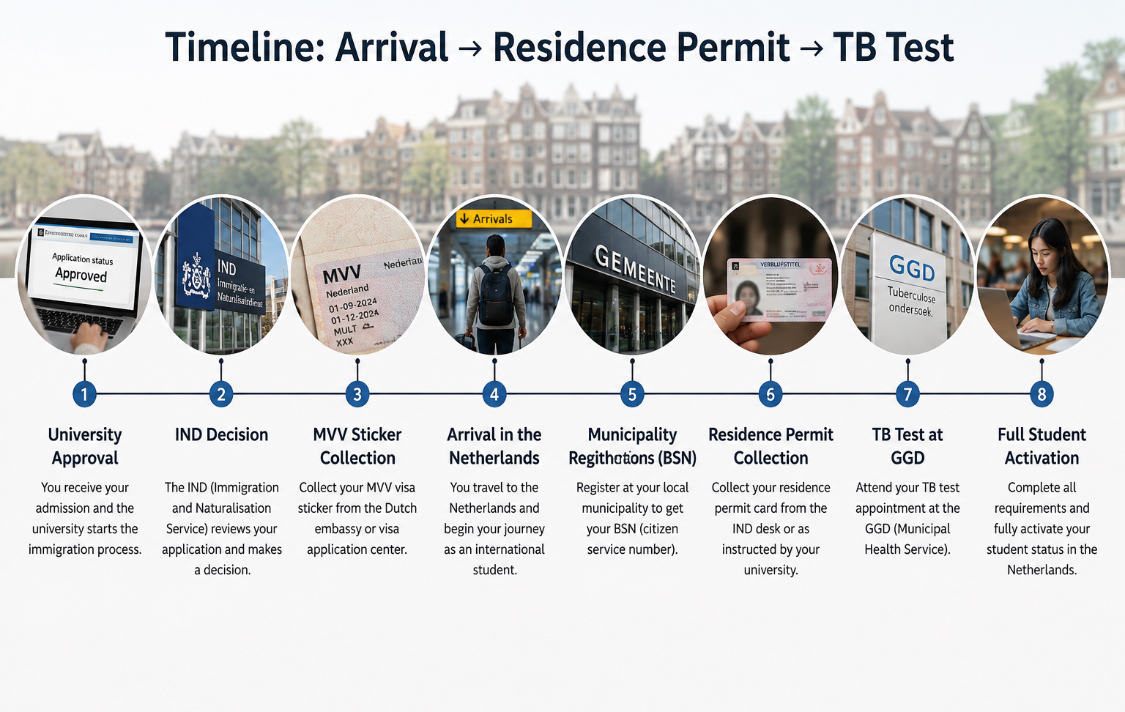
Students often ask how long the Dutch student visa process takes, but there is no single answer because the process moves through several institutions at once.
The timeline usually starts long before the IND receives anything.
A student first applies to the university, receives admission, completes tuition or deposit obligations where required, uploads immigration documents to the institution, waits for internal review, then waits for the university to submit the file to the IND.
Only after that stage does the official immigration processing begin.
| Stage | Typical Timeline |
|---|---|
| University admission review | Several weeks to months |
| Immigration document upload | Usually 1–4 weeks depending on student response |
| University submission to IND | After full file approval |
| IND decision period | Several weeks to roughly two months depending on intake period and document review |
| MVV appointment and passport submission | Varies by embassy or VFS availability |
| Travel to Netherlands | After MVV collection |
| Municipality registration and BSN | Usually within first days or weeks |
| TB test if required | Within required post-arrival window |
The students who suffer most from delays are usually those who start too late. Universities repeatedly advise international students to begin immigration preparation immediately after admission because embassy capacity becomes unpredictable near major intake periods.
July and August are especially difficult. Appointment shortages appear. Housing disappears. International offices become overloaded. Courier delays suddenly matter. Students who ignored early emails then start panicking because flights are approaching.
The Dutch system rewards students who respond quickly and document carefully. It punishes reactive preparation.
What Happens During the TB Test Appointment?
Students often imagine the TB examination as a complex hospital process. In reality, most appointments are routine and fast.
The student books an appointment with the local GGD after arrival. Depending on the municipality, the booking may happen online, by email, or through university assistance programmes.
The student usually brings:
- Passport
- Residence permit or IND documentation
- TB referral or declaration documents
- Appointment confirmation
- Payment method
Many examinations involve a chest X-ray. The process itself often takes less time than students expect. Problems arise more from scheduling delays or students forgetting the obligation entirely.
If further medical investigation becomes necessary, the GGD explains the next steps directly. Most students complete the examination without complications.
The psychological pressure around the TB test often comes from misunderstanding rather than the procedure itself. Students read dramatic online discussions and assume every appointment leads to extensive medical intervention. That is not the normal experience.
The real risk comes from ignoring the process.
Study Progress Rules and Why Some Students Lose Their Residence Permit
Dutch student residence permits are tied directly to academic performance.
Some students arrive assuming the permit behaves like a fixed multi-year authorisation regardless of study behaviour. Dutch immigration policy does not work that way for international students.
Recognised sponsor institutions are expected to monitor study progress. Universities report situations where students stop studying seriously, withdraw, disappear academically, or fail to meet minimum progress expectations.
The well-known benchmark in many Dutch higher education systems is the 50% study progress requirement. In practical terms, students are generally expected to earn at least half of the required credits for each academic year in order to maintain residence status support.
The immigration risk usually appears slowly. Students struggling academically sometimes ignore warning emails for months because they assume academic failure and residence status are separate problems. They are connected.
Universities can make exceptions in situations involving serious personal circumstances, illness, or recognised hardship, but students should never assume those exceptions apply automatically.
Changing programmes without informing the institution properly also creates complications. A residence permit linked to one recognised sponsor does not automatically transfer cleanly if a student changes universities or abandons the programme entirely.
Students who decide to stop studying often discover too late that the residence permit basis disappears with the study relationship itself.
Working While Studying in the Netherlands
The Netherlands allows international students to work, but the rules are tighter than many students expect.
Non-EU students with Dutch study residence permits are generally limited to:
- Up to 16 working hours per week during the academic year, or
- Full-time seasonal work during summer months
Students regularly misunderstand this rule because some employers also misunderstand it. The existence of a BSN and residence permit does not automatically mean unlimited employment rights.
Employer paperwork matters as well. Depending on the situation, employers may still require work authorisation arrangements.
The problem is not usually students intentionally violating immigration conditions. It is students casually accepting extra shifts without tracking cumulative hours across jobs.
The Dutch labour market also creates a strange contrast for international students. The country often appears internationally as highly English-friendly, which is true in many university cities. But outside certain sectors, Dutch language limitations still reduce job access significantly.
Students depending entirely on future part-time income to survive financially often place themselves under pressure very quickly, especially in expensive cities.
The safest approach is to arrive already financially stable rather than treating future employment as guaranteed rescue income.
Municipality Registration Problems International Students Rarely Expect
The municipality registration stage looks administrative on paper. In reality, it becomes one of the biggest stress points for international arrivals.
The Dutch housing market is the main reason.
Students arriving without stable accommodation sometimes discover they cannot register at the address where they are staying. Some landlords refuse registration entirely. Others illegally overcrowd properties. Some temporary housing providers allow short stays but not municipal registration.
This creates a chain reaction:
- No valid registration
- No BSN
- Banking difficulties
- Insurance complications
- Employer paperwork problems
- Tax and healthcare administration delays
Universities increasingly warn students not to travel without confirmed housing for exactly this reason.
The housing situation has become severe enough that some Dutch institutions openly state they cannot guarantee accommodation for all international students anymore.
Students who secure university-managed housing early usually avoid much of this pressure. Those entering the private housing market late often face aggressive competition, scams, inflated pricing, or illegal rental practices.
Financial Proof Problems That Quietly Destroy Applications
Most Dutch student visa refusals are not dramatic. They happen because documents stop making sense when immigration officers compare them together.
The financial section causes more trouble than students expect because many applicants underestimate how closely the IND and universities examine funding evidence.
Large unexplained deposits are one of the biggest problems.
A student submits six months of bank statements showing a modest account balance, then suddenly deposits €15,000 three days before the statement closing date. Immigration reviewers immediately start asking questions the student never prepared for:
- Where did the money come from?
- Is the money genuinely available for study?
- Is it borrowed temporarily?
- Can the sponsor actually sustain support?
Students sometimes assume showing the final amount alone is enough. Dutch immigration procedures do not work that way. The financial story needs to look coherent from beginning to end.
Parent sponsorship also creates problems when documentation becomes inconsistent. A sponsor claims to support the student fully, but the income documents do not realistically support the declared amount. Or the relationship proof is weak. Or the sponsor’s bank account suddenly receives unexplained transfers shortly before submission.
Universities increasingly screen these problems before even forwarding applications to the IND because rejected immigration files affect institutional credibility as recognised sponsors.
One mistake students make repeatedly: treating the required living-cost amount as the total first-year budget. It is not. Tuition, housing deposits, insurance, flights, municipal costs, transport, books, and emergency expenses sit outside the IND maintenance requirement.
Education loans are usually acceptable when properly documented, but students still need clear approval letters and disbursement evidence. Scholarship letters also need to state exact funding amounts and duration clearly.
The safest applications tend to look boring financially. Stable account history. Clear income flow. Logical sponsor profile. No sudden financial drama.
How Dutch Universities Monitor International Students After Arrival
Many students think immigration scrutiny ends after permit approval. In reality, the university becomes part of the monitoring system once the student arrives.
Dutch institutions recognised as sponsors by the IND carry reporting responsibilities. That status comes with obligations.
If a student drops out, disappears academically, stops attending, fails progress requirements, or withdraws from the programme, the university may be required to notify immigration authorities.
Students sometimes misread the Dutch system because the country feels relatively open and relaxed socially. Immigration administration itself is not relaxed.
The recognised sponsor framework gives universities significant responsibility in maintaining compliance.
This becomes especially relevant for students struggling academically during the first year. Dutch higher education often feels very different from what many international students experienced previously. Independent study expectations are higher. Assessment structures feel less forgiving. Group work dynamics differ. Critical discussion in classrooms feels unfamiliar for some students.
International students sometimes isolate themselves academically after early failures instead of contacting programme coordinators or international offices. That silence usually makes the situation worse.
The students who recover successfully are often the ones who seek support early rather than pretending everything is stable.
Why Dutch Universities Take Immigration Compliance More Seriously Than Many Students Expect
Students sometimes misunderstand the relationship between Dutch universities and immigration enforcement.
In the Netherlands, universities approved as recognised sponsors under IND rules do not simply admit international students academically and step away from the immigration process afterward.
They carry legal responsibilities tied directly to the residence status of non-EU students.
That changes how international offices behave.
A university that repeatedly submits weak immigration files, ignores compliance problems, or fails to report serious student-status changes can create problems for its recognised sponsor standing with the IND.
This is one reason Dutch universities sometimes appear unusually strict about deadlines, financial documents, enrollment confirmations, attendance concerns, municipal registration, or study progress tracking.
Students occasionally interpret repeated document requests as unnecessary bureaucracy or institutional distrust. In reality, universities are often protecting themselves legally while trying to protect the student’s immigration position at the same time.
The pressure becomes strongest during the first academic year.
If a student withdraws from studies, disappears academically, loses immigration eligibility, or stops meeting permit conditions, the university may need to notify Dutch immigration authorities formally.
That reporting structure surprises many students because Dutch campus life itself often feels informal socially. Underneath that atmosphere sits a highly structured immigration compliance system.
One detail many students only realise later: university international offices are not only student-support departments. In immigration terms, they also operate as compliance actors inside the Dutch residence permit system.
The Real Cost of Studying in the Netherlands in 2026
Online discussions about Dutch student life usually underestimate total first-year spending badly.
The IND financial requirement is only one part of the reality.
A realistic first-year estimate for many non-EU students now looks closer to this:
| Expense Category | Estimated Range |
|---|---|
| Tuition fees | €8,000 – €20,000+ |
| IND living-cost proof | ~€13,500+ |
| Housing deposit | €500 – €2,000+ |
| Health insurance | €500 – €1,500 yearly |
| Flight costs | Varies by region |
| Municipal + setup costs | €200 – €600+ |
| Books, transport, setup purchases | €500 – €2,000+ |
Amsterdam regularly becomes the financial breaking point for students who planned around theoretical budgets instead of real housing conditions.
Smaller university cities usually reduce pressure significantly. Groningen, Eindhoven, Wageningen, Enschede, and Tilburg often remain more manageable financially than Amsterdam or Utrecht.
That does not mean cheap.
The Netherlands remains one of Europe’s more expensive international education destinations once housing enters the calculation seriously.
Students exploring multiple European destinations often notice the contrast quickly. Germany may have lower tuition pressure in many cases, but health insurance systems there create their own complexity. Students comparing European systems sometimes find it useful to read broader breakdowns such as this comparison of German student health insurance options, especially when evaluating total long-term living costs across countries.
Why Housing Problems Sometimes Become Immigration Problems in the Netherlands
Many international students arrive in the Netherlands believing housing is mainly a financial problem.
Very quickly, they discover it can become an immigration and administrative problem too.
Dutch systems rely heavily on official address registration.
Without a valid registered address, students can face complications obtaining their BSN number, opening bank accounts, arranging insurance properly, receiving official correspondence, or completing municipal procedures smoothly.
This creates pressure immediately after arrival, especially in cities where student housing shortages have become severe.
Amsterdam, Utrecht, Delft, Rotterdam, and Eindhoven regularly experience major housing competition during intake periods. Students arriving late sometimes end up moving repeatedly between temporary accommodations before securing stable registration.
Universities increasingly warn international students not to travel without confirmed accommodation because the housing situation has become difficult enough to affect student stability directly.
Subletting arrangements also create problems.
Some students accept unofficial rental agreements without understanding that certain landlords do not allow municipal registration at the property. The student later discovers they cannot register legally at the address despite already paying rent.
That single issue can trigger a chain reaction affecting BSN registration, insurance administration, banking access, and communication with Dutch authorities.
One practical rule worth taking seriously: students should confirm registration eligibility at a property before paying deposits, not after arrival.
Housing pressure in the Netherlands is no longer a side issue attached to student immigration. For many international students, it has become one of the defining parts of the first-year experience.
MVV Refusals: What Usually Goes Wrong
Dutch student immigration refusals rarely happen because a student lacks ambition. Most refusals happen because the application stopped looking reliable somewhere along the process.
Incomplete documents are common.
Inconsistent financial evidence is common.
Weak academic progression creates problems too. A student applying for a master’s programme unrelated to previous study without explaining the transition clearly may attract extra scrutiny.
Universities themselves sometimes slow or reject immigration progression before IND refusal even happens. If a file appears unstable internally, institutions may ask for clarification repeatedly rather than forwarding weak documentation immediately.
Students also create avoidable problems by ignoring email communication windows. Dutch universities tend to move quickly once immigration processing begins. Missing one requested upload deadline can suddenly push a student into the next intake period entirely.
Another issue appears with fraudulent consultants or document manipulation.
The Netherlands does not operate casually regarding document verification. Inconsistent educational records, altered financial documents, fake sponsorship evidence, or misleading information can create long-term immigration consequences beyond simple refusal.
Students sometimes panic after receiving additional document requests from the university or IND. That request alone does not mean refusal is coming. It often means the file simply needs clarification before approval can move forward.
Where genuine refusal happens, appeal options may exist depending on the case, but appeals usually become difficult when the original problem involved unreliable documentation or financial inconsistencies.
The Netherlands vs France vs UK Student Residence Systems
Students applying across Europe often assume the immigration systems behave similarly because the destinations sit within the same region. They do not.
The Dutch model places unusually strong emphasis on the recognised sponsor structure. Universities operate as active immigration partners with reporting obligations tied directly to student compliance.
France handles student residence procedures differently. Students entering France under the VLS-TS structure often deal with OFII or online validation obligations after arrival rather than the exact Dutch sponsor-based system. Students comparing both systems may notice how administrative responsibilities shift between the state and the institution. The differences become clearer when looking closely at the French VLS-TS and OFII validation process.
The UK system again behaves differently. Immigration permission often exists more independently from university sponsor monitoring structures once permission is granted, although institutions still maintain reporting obligations under student sponsorship rules.
The Netherlands sits somewhere in between: academically open in atmosphere, but structurally strict underneath.
Students who misunderstand that balance sometimes experience culture shock after arrival.
How the Orientation Year Residence Permit Changes the Long-Term Equation
One reason many international students tolerate the Netherlands’ difficult housing market and high living costs is the post-study residence pathway.
The Dutch Orientation Year residence permit allows eligible graduates to remain in the Netherlands after completing studies in order to search for work or start business activity.
That changes how many students evaluate the original study permit process entirely.
The student residence permit stops being only an education document. It becomes the first stage in a possible longer-term migration pathway.
The Dutch labour market still creates challenges for international graduates, especially outside highly skilled sectors or without Dutch language ability. But for engineering, technology, data science, logistics, finance, semiconductor research, and certain technical industries, the Netherlands continues attracting international graduates strongly.
Students already comparing long-term post-study options across countries often evaluate the Netherlands alongside systems like the UK Graduate Route. The structures differ significantly, especially regarding labour market dynamics and long-term residence transition possibilities. Students researching both routes sometimes compare them directly against pathways discussed in the UK Graduate Route visa process.
The important point is this:
Students increasingly choose study destinations based not only on the degree itself, but on what the immigration system allows after graduation.
The Netherlands understands that competition very well.
Why the APS Conversation Is Starting to Matter More in Europe Generally
European immigration systems are becoming more document-sensitive overall.
The Netherlands does not currently operate the exact APS verification framework associated with Germany, but students from countries where educational document scrutiny has increased internationally should still pay attention to how verification standards are evolving across Europe.
Germany’s APS system already reshaped preparation requirements for many students from India, China, and Vietnam. The broader direction behind those systems matters because European institutions increasingly prioritise document authenticity and educational traceability.
Students unfamiliar with how APS functions can see the larger verification trend through explanations such as this breakdown of the APS certificate process for Germany.
The larger pattern is obvious now:
European student immigration systems are becoming more digital, more interconnected, and less tolerant of weak documentation.
What Usually Separates Students Who Settle Well From Those Who Struggle
After watching how international students move through the Dutch system over the years, one pattern keeps repeating itself.
The students who adapt fastest are rarely the ones who arrive with the most confidence. They are usually the ones who prepared realistically before landing.
They already understand that Dutch administration moves quietly but seriously.
They know housing problems can become immigration problems if municipal registration fails.
They understand that ignoring letters from the IND, municipality, university, or health insurance providers creates bigger issues later.
They budget conservatively instead of assuming part-time work will solve financial pressure immediately.
The students who struggle most often arrive believing the difficult part ended once the visa was approved.
That assumption causes problems fast.
The Dutch system expects international students to operate independently almost immediately after arrival. Deadlines matter. Address registration matters. Insurance matters. Study progress matters. Immigration compliance keeps running quietly in the background even when student life feels socially relaxed on the surface.
One practical observation: students who keep digital and printed copies of every immigration document, municipal registration paper, TB appointment record, insurance confirmation, and university communication usually avoid unnecessary stress later.
Netherlands Student Visa Checklist Before Departure
| Task | Status Before Travel |
|---|---|
| MVV approval received | Completed |
| Passport validity checked | Completed |
| Housing secured or temporary accommodation arranged | Completed |
| Financial documents saved digitally and physically | Completed |
| University arrival instructions reviewed | Completed |
| Health insurance instructions confirmed | Completed |
| Municipality registration appointment prepared | Completed |
| TB test requirement checked | Completed |
| Emergency financial buffer available | Strongly recommended |
Questions International Students Keep Asking About MVV, Residence Permits, and TB Testing
Do I still need an MVV if I already have a Schengen visa?
Usually yes. A short-stay Schengen visa does not replace the Dutch MVV and residence permit process for long-term study exceeding 90 days.
Can my parents sponsor my financial proof for the Netherlands student visa?
Yes. Parent sponsorship is commonly accepted, but supporting documents must clearly prove the relationship, source of income, and availability of funds. Unexplained deposits often create problems during review.
What happens if I miss the TB test deadline?
Missing the TB testing deadline can create serious immigration problems, including risks to residence permit validity. Students required to complete TB screening should arrange the appointment as early as possible after arrival.
Do all international students need TB testing in the Netherlands?
No. The requirement depends mainly on nationality and residency background. Many countries are exempt under current Dutch public health rules. Students should always verify the latest exemption list directly through IND documents before travel.
Can international students work while studying in the Netherlands?
Yes, but restrictions apply. Non-EU students are generally limited to 16 working hours per week during the academic year or full-time seasonal work during summer months under Dutch labour rules.
What happens if my study progress falls below university requirements?
Dutch universities monitor academic progress for immigration compliance purposes. Serious or repeated failure to meet study progress requirements can affect future residence permit extensions.
Can I stay in the Netherlands after graduation?
Many graduates apply for the Dutch Orientation Year residence permit, which allows eligible international graduates to remain in the Netherlands temporarily while searching for employment or starting business activity.
How long does the MVV and residence permit process usually take?
Processing times vary by season, university workload, embassy scheduling, and document quality. Students applying late in peak admission periods often experience longer waiting times.
Something Many Students Realise Too Late
The Netherlands rewards preparation quietly.
Students often arrive expecting the difficult part to be getting accepted academically. Then they discover the real pressure sits inside timing, administration, housing, registration, budgeting, and compliance.
The immigration process itself is not designed to feel hostile. But it assumes students will behave responsibly without constant supervision.
That difference matters.
Some countries operate immigration systems where students can recover easily from missed deadlines or administrative mistakes. Dutch systems tend to become stricter once timelines are ignored repeatedly.
I would personally treat the first three months after arrival as the most important administrative phase of the entire degree.
That period shapes almost everything afterward:
- BSN registration
- Residence permit activation
- Housing stability
- Insurance setup
- Banking access
- TB compliance
- University enrollment confirmation
Students who stabilise those areas early usually settle academically much faster afterward.
Students who delay them often spend months trying to repair avoidable problems while classes continue moving forward.
Information note: Immigration rules, IND income requirements, TB exemption lists, application fees, and university sponsorship procedures can change. Always verify personal eligibility and latest requirements directly through official Dutch Immigration and Naturalisation Service (IND) resources and your university’s international office before submitting applications or travelling.
Last updated: 2026. Financial requirements, TB exemption lists, and IND processing policies referenced in this article reflect publicly available Dutch immigration information at the time of writing.

Lead Content Strategist at The Global Scholar Guide, specializing in scholarship research, relocation guidance, and international education content.