The F-1 visa remains the main route for international students entering the United States for full-time academic study in 2026. For many applicants, the stressful part is not only getting admitted to a U.S. school. It is proving, in a short visa interview, that the study plan is genuine, the funding is clear, and the intention to return home is credible.
Two areas deserve special attention before that interview: the SEVIS I-901 fee and the conversation with the consular officer. The SEVIS fee is not a small administrative detail. It connects the student’s Form I-20 record to the U.S. government’s student tracking system, and the receipt is one of the documents applicants are expected to bring to the visa interview. The interview then tests whether the documents, funding story, academic plan, and personal circumstances all make sense together.
As of 2026, the I-901 SEVIS fee for F-1 students is $350, while the separate nonimmigrant visa application fee, often called the MRV fee, is $185. Students should still confirm fee amounts on official U.S. government websites before paying, because visa fees can change and embassy systems may apply country-specific payment procedures.
Key point: For most F-1 applicants, the core government fees before the interview are the $350 SEVIS I-901 fee and the $185 visa application fee. They are separate payments, made through different systems.
Understanding the F-1 Student Visa in 2026
The F-1 visa is for students who plan to study full-time at an academic institution in the United States. That includes universities, colleges, seminaries, conservatories, high schools, private elementary schools, and language training programs approved under the Student and Exchange Visitor Program. The school must be SEVP-certified before it can issue the Form I-20 that starts the visa process.
The U.S. Department of State describes the student visa route as the category used by people accepted for study in the United States, while the Department of Homeland Security maintains the SEVP system that schools use to create and manage student records. In practical terms, the applicant does not begin the F-1 visa process from a blank page. It begins after admission, when the school issues a Form I-20 with the student’s SEVIS ID, program details, estimated cost, and reporting information.
A strong F-1 file normally has four pillars. First, the student must have been accepted by an SEVP-certified institution. Second, the financial evidence must show that tuition, living costs, and other estimated expenses can be covered. Third, the student should be able to explain the academic plan clearly. Fourth, because the F-1 is a nonimmigrant visa, the applicant must satisfy the officer that the stay is temporary and tied to study, not permanent relocation.
That last point is where many interviews become difficult. Under U.S. visa law, many nonimmigrant applicants are assessed against the presumption of immigrant intent. A student can have excellent admission documents and still be refused if the officer is not convinced about the applicant’s purpose, funding, or reasons to return after the program.
The basic F-1 process flow
The process is not complicated on paper, but mistakes usually happen when applicants treat the steps as interchangeable. They are not. The SEVIS fee cannot be paid correctly without the I-20. The interview cannot be approached seriously without understanding the DS-160, the I-20, and the funding record.
Typical F-1 sequence in 2026:
- Receive admission from an SEVP-certified school.
- Collect the Form I-20 from the school.
- Pay the $350 SEVIS I-901 fee using the SEVIS ID on the I-20.
- Complete the DS-160 visa application form.
- Pay the $185 visa application fee through the embassy-approved payment system.
- Schedule biometrics and the visa interview, depending on local embassy procedures.
- Attend the interview with documents organized and answers ready.
The order matters because the F-1 interview is not only about paperwork. It is about whether the paperwork supports a believable student profile. A student who cannot explain the program, the funding source, or the reason for choosing the United States may struggle even if every document is present.
There is also a timing issue. Visa appointment availability varies by country, and embassy procedures can change. The safest approach is to begin once the I-20 is issued, pay the required fees through official channels, and avoid waiting until the last moment to prepare for the interview.
SEVIS fee requirements for F-1 students in 2026
The SEVIS I-901 fee is one of the most important payments in the F-1 visa process. It is paid to support the Student and Exchange Visitor Program and the Student and Exchange Visitor Information System, the database used to maintain records of international students and exchange visitors in the United States. For F-1 students, the fee is tied to the SEVIS ID printed on the Form I-20.
As of 2026, the SEVIS I-901 fee for F-1 applicants is $350. This is separate from the visa application fee paid through the U.S. embassy or consulate appointment system. The SEVIS fee goes through the official I-901 payment channel, while the visa application fee is handled under the Department of State’s visa fee process.
| Fee | Amount in 2026 | Paid To | Purpose |
|---|---|---|---|
| I-901 SEVIS Fee | $350 | Department of Homeland Security system | Supports SEVP and connects the student’s SEVIS record to the visa process |
| Visa Application Fee | $185 | U.S. Department of State visa appointment system | Pays for processing the nonimmigrant visa application |
The two fees are often mentioned together because both are usually required before the interview, but they should never be confused. Paying the visa application fee does not mean the SEVIS fee has been paid. Paying the SEVIS fee does not schedule the visa interview. Each payment has its own system, receipt, and purpose.
Who must pay the SEVIS fee?
Most initial F-1 students must pay the I-901 SEVIS fee before attending the visa interview. This usually applies to students entering the United States for the first time on a new F-1 record. It can also apply in certain cases involving status changes or reinstatement, depending on the student’s situation.
F-2 dependents do not pay a separate SEVIS I-901 fee. They may have their own visa application requirements, but the I-901 fee is attached to the principal F-1 student’s SEVIS record. Families sometimes make the mistake of trying to pay separate SEVIS fees for dependents, which can create confusion and unnecessary expense.
The safest rule is simple: use the SEVIS ID on the Form I-20, pay through the official FMJfee payment portal, and keep the receipt with the visa documents. Students should avoid unofficial websites, agents asking for unnecessary extra charges, or payment links shared in social media groups.
When to pay the SEVIS fee and why timing matters
The SEVIS I-901 fee is paid after the Form I-20 has been issued, not before. This detail seems obvious, yet it is one of the most common sources of error. The payment is tied to the SEVIS ID printed on the I-20. Without that ID, the system cannot connect the payment to the student’s record.
In practical terms, the correct sequence is straightforward: receive the I-20, confirm that all details on it are accurate, and then proceed to pay the $350 SEVIS fee. The payment should be completed before scheduling or attending the visa interview. In many cases, the embassy system may allow interview scheduling before the SEVIS payment is verified, but the receipt is still expected at the interview itself.
There is also a timing buffer that applicants should not ignore. Payment confirmation is usually immediate for card transactions, but system delays can happen. A safe approach is to pay the SEVIS fee several days before the interview date, print the receipt immediately, and keep both digital and physical copies.
Do not walk into a visa interview without a printed SEVIS I-901 receipt. Even if the payment was made, failure to present proof can create unnecessary complications.
How to pay the SEVIS I-901 fee step by step
The payment process is handled through the official SEVIS I-901 system. According to the U.S. Department of Homeland Security’s student portal, the payment must be completed using the exact SEVIS ID issued on the Form I-20. Errors at this stage can follow the application into the interview.
SEVIS I-901 payment steps:
- Visit the official SEVIS payment portal.
- Select the option to pay the I-901 SEVIS fee for F-1 students.
- Enter your SEVIS ID exactly as it appears on the Form I-20.
- Fill in your personal details as shown on your passport and I-20.
- Choose a payment method (credit card, debit card, or approved alternatives such as Western Union in eligible countries).
- Complete the payment and generate the receipt immediately.
- Print the receipt and save a digital copy for backup.
Most applicants use card payments because they are faster and easier to confirm. Alternative methods may be available depending on location, but they often take longer to process. For applicants working with tight interview timelines, immediate payment confirmation is usually the safer route.
The official guidance on paying the SEVIS fee emphasizes accuracy over speed. Even a small mistake in the SEVIS ID or visa category selection can lead to a mismatch between the payment and the application record, which can be difficult to correct quickly.
Common SEVIS payment mistakes that affect visa outcomes
Payment errors are rarely discussed in detail, yet they appear more often than expected during visa preparation. Some of these mistakes seem minor at the time but become serious when documents are reviewed at the interview stage.
- Using the wrong SEVIS ID: This usually happens when students have multiple I-20s from different schools or programs and pay using an outdated form.
- Selecting the wrong visa category: Paying under J-1 or another category instead of F-1 creates a mismatch that must be corrected before the interview.
- Paying too late: Waiting until the last day increases the risk of system delays or missing documentation.
- Not printing the receipt: Relying on digital access alone can be risky if there are technical issues at the embassy.
- Using unofficial agents or platforms: Payments should only be made through the official SEVIS system to avoid fraud or incorrect processing.
One consistent pattern: Most SEVIS-related problems do not come from the system itself. They come from small errors made during payment that are only discovered at the interview stage.
Proof of SEVIS payment and what officers expect
The SEVIS I-901 receipt is not optional documentation. It is part of the standard set of documents reviewed during the visa interview. While not every officer will explicitly ask for it, applicants are expected to have it available alongside the I-20, DS-160 confirmation, and other required materials.
The receipt shows that the $350 SEVIS fee has been paid for the correct SEVIS ID. It links the applicant’s visa process to the official student record system. Without that connection, the application may be considered incomplete, even if all other documents are in place.
Students should treat the receipt the same way they treat their passport or I-20. It should be printed clearly, stored safely, and included in the document folder presented at the interview. Some applicants also carry an extra copy as backup.
Preparing for the F-1 visa interview in 2026
The F-1 visa interview is often shorter than expected, but its impact is significant. Most interviews last only a few minutes. Within that time, the consular officer is expected to assess whether the applicant qualifies under U.S. immigration law, whether the academic plan is credible, and whether the financial situation supports the stated intention to study.
According to the U.S. Department of State, the interview is a key step in determining visa eligibility. It is conducted in person at a U.S. embassy or consulate, and the questions are usually direct. The officer is not trying to conduct a detailed academic review. The goal is to confirm that the applicant’s story is consistent, realistic, and supported by evidence.
Many applicants assume the interview is about giving long, impressive answers. In reality, shorter and clearer responses tend to be more effective. Officers are trained to identify inconsistencies quickly. A complicated answer that drifts away from the question can create more doubt than a simple, direct explanation.
The interview is not a test of how much you can say. It is a test of whether what you say makes sense.
What the interview typically looks like
The format is structured but not formal in the traditional sense. Applicants stand or sit at a counter, present documents when requested, and respond to questions asked by the officer. Family members or sponsors are usually not allowed to participate in the conversation.
Most interviews are conducted in English, especially for academic programs taught in English. In some cases, local language support may be available, but applicants should be prepared to explain their academic plans clearly in English if required by their program.
The interaction is usually fast-paced. Questions may come one after another with little pause. This can feel intense, especially for first-time applicants, but it is a normal part of the process. The officer is working within time constraints and is trained to make decisions efficiently.
Documents to bring and how to organize them
Applicants are expected to bring original documents, not just copies. Organization matters. A well-arranged file makes it easier to respond quickly when documents are requested and shows that the applicant is prepared.
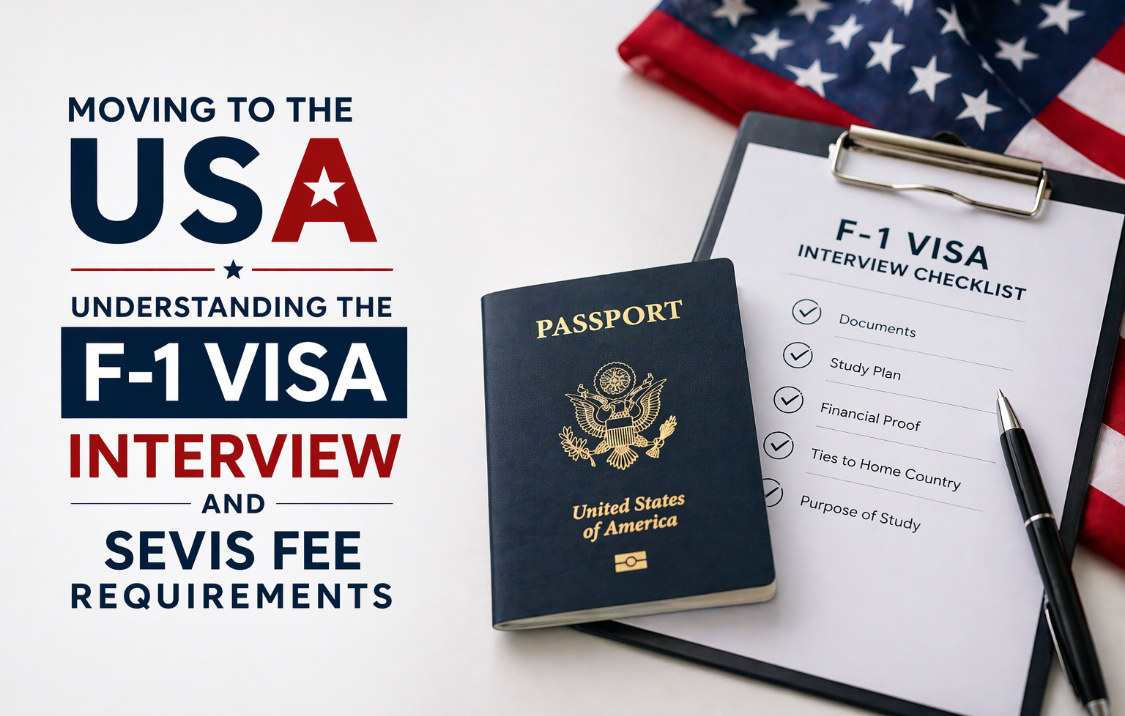
Core documents for the F-1 interview:
- Passport (valid for at least six months beyond intended stay)
- Form I-20 (signed by both the school and the student)
- SEVIS I-901 fee receipt ($350 payment confirmation)
- DS-160 confirmation page
- Visa appointment confirmation
- Financial evidence (bank statements, sponsor letters, scholarship details)
- Academic records (transcripts, certificates, test scores if applicable)
Additional documents may be useful depending on the applicant’s situation, such as employment letters, property records, or other evidence of ties to the home country. These are not always requested, but they can support answers given during the interview.
For students who have reviewed document preparation strategies across different visa systems, it becomes clear that organization and clarity are universal requirements. In some countries, structured financial proof like blocked accounts is mandatory, while in the U.S. system, the focus is more on demonstrating that funds are available and credible. That difference often changes how applicants prepare their financial documents, and those who understand it early tend to present stronger files.
For a deeper look at how financial documentation is structured across student visa systems, see
this breakdown of funding proof methods.
What visa officers are really assessing during your F-1 interview
Most applicants prepare for questions. Fewer prepare for what those questions are meant to reveal. A visa officer is not trying to test intelligence or memorization. The task is narrower and more direct: determine whether the applicant qualifies under U.S. law as a genuine student with a temporary purpose.
That means three things are always in focus, even when they are not stated openly. First, whether the academic plan is real and makes sense. Second, whether the funding is clear and accessible. Third, whether the applicant’s situation suggests a reason to return home after studies.
The difficulty is not in understanding these factors. It is in presenting them without contradiction. Many refusals do not come from one wrong answer. They come from answers that do not align with each other or with the documents already submitted.
Consistency is often more important than complexity. A simple answer that matches your documents is stronger than a detailed answer that raises new questions.
How visa officers make decisions in a matter of minutes
F-1 visa interviews are short, but the decisions behind them are not random. Officers are trained to assess patterns quickly, using both the documents in front of them and the way the applicant responds under pressure. What appears to be a brief conversation is actually a structured evaluation happening in real time.
Each application already arrives with a background. The DS-160 form, the Form I-20, and the SEVIS record create an initial profile before the interview begins. The officer is not starting from zero. The conversation is used to confirm whether that profile holds together when the applicant speaks about it.
Time is limited, so decisions are rarely built on long explanations. Officers tend to focus on a few core signals. Is the study plan clear and consistent? Does the funding make sense without gaps? Do the answers align with what has already been submitted? When those elements fit together, the decision process becomes straightforward.
In most cases, the decision is not about finding a perfect answer. It is about confirming a consistent story.
What makes this stage difficult for applicants is that inconsistency shows quickly. A hesitation about funding, a mismatch between the stated program and the explanation, or uncertainty about future plans can shift the direction of the interview within seconds. The officer does not need to ask many questions once that shift happens.
On the other hand, when the answers are clear and match the documents, the conversation often moves faster. There is less need for follow-up, and the interview feels more like a confirmation than a test. That difference is subtle, but it is usually where outcomes are shaped.
Understanding this changes how preparation should be approached. It is not about adding more information. It is about making sure that what is already there can be explained without confusion.
Common F-1 interview questions with realistic answers
The questions themselves are not new. They repeat across countries and visa cycles with small variations. What changes is how applicants respond. The examples below are not scripts to memorize. They show the level of clarity expected and the type of detail that tends to work in real interviews.
Study plans and academic direction
Question: Why do you want to study in the United States?
What the officer is assessing: Whether the decision is based on academic reasons or vague preference.
Sample answer: I chose the United States because my program offers a combination of coursework and research opportunities that are not structured the same way in my home country. In my field, access to practical labs and industry-linked projects is important, and the program I was admitted to includes both. That aligns with how I want to build my skills.
Question: Why did you choose this university?
What the officer is assessing: Whether the choice is informed or generic.
Sample answer: I selected this university because of its curriculum in data systems, particularly the modules on distributed computing and applied analytics. I also reviewed the faculty research areas, and they match the direction I want to pursue after my undergraduate studies. That combination made it a stronger fit than the other options I considered.
Question: What exactly will you study?
What the officer is assessing: Clarity about the academic path.
Sample answer: I will be studying computer engineering, with a focus on systems design and data infrastructure. My interest is in how large-scale systems are built and maintained, especially in environments where reliability and efficiency are critical.
Funding and financial clarity
Question: How will you pay for your studies?
What the officer is assessing: Whether funding is genuine, sufficient, and available.
Sample answer: My studies are funded through a combination of family support and personal savings. My parents are covering tuition, and I have provided their bank statements and employment records. I also have savings that will cover part of my living expenses during the first year.
Question: What does your sponsor do?
What the officer is assessing: Source and reliability of funds.
Sample answer: My sponsor is my father. He runs a logistics business, and his financial records show consistent income over the past few years. The documents I submitted include bank statements and business registration details.
Funding questions are rarely about the total amount alone. They are about credibility. The officer is looking for a clear connection between the source of funds and the ability to support the student throughout the program.
Future plans and ties to home country
Question: What are your plans after graduation?
What the officer is assessing: Non-immigrant intent.
Sample answer: After graduation, I plan to return home and work in the technology sector. There is growing demand for skills in systems design, and I intend to apply what I learn in roles that focus on infrastructure development. My long-term goal is to build experience locally and eventually contribute to larger regional projects.
Question: Why can’t you study this in your home country?
What the officer is assessing: Whether studying abroad is justified.
Sample answer: While similar programs exist at home, the structure and resources differ. The program I selected offers more direct exposure to large-scale systems and practical projects, which are not as developed in my current academic environment. That difference is important for the direction I want to take.
Question: Do you have relatives in the United States?
What the officer is assessing: Possible immigration intent or undisclosed ties.
Sample answer: Yes, I have an uncle in the United States. However, my application and study plans are independent of him. My focus is on completing my program and returning home after graduation.
Notice the pattern: the answers are direct, specific, and connected to the documents. They do not try to impress. They try to explain.
How to approach your own answers
Strong answers are usually built on what is already in the application. The Form I-20, the DS-160, and the financial documents should all point in the same direction. The interview is simply where that direction is confirmed.
Practicing aloud can help, but over-rehearsal often creates problems. Answers that sound memorized tend to lose flexibility. When a follow-up question is asked, the applicant may struggle to adjust. A better approach is to understand the key points and speak naturally around them.
It also helps to review your own documents before the interview. Many applicants forget details they submitted earlier. When answers do not match those details, even small differences can create doubt.
Students who want a more structured approach to organizing application documents can review
this document preparation framework.
The part of the interview most applicants underestimate
There is a moment in most interviews that is easy to miss. It is not tied to a specific question. It happens when the officer forms an overall impression. That impression is built from tone, clarity, and consistency across all answers.
Applicants sometimes focus on individual questions as if each one is separate. The officer does not see them that way. The answers are combined into a single picture. If that picture feels stable and believable, the interview tends to move smoothly. If it feels uncertain, even correct answers may not carry enough weight.
This is why preparation is not just about knowing what to say. It is about ensuring that everything you say fits together without forcing it. The strongest interviews are not the most impressive. They are the most coherent.
Why F-1 visa applications are refused and what actually causes it
Visa refusals are often explained in a single line at the embassy window, but the reasoning behind them is rarely that simple. Most F-1 refusals fall under the same legal provision, yet the underlying issues differ from one case to another. Understanding those patterns matters more than memorizing the law itself.
In many cases, the decision is not based on one mistake. It is based on a combination of small signals that, taken together, make the application feel uncertain. That uncertainty is what applicants need to reduce, not eliminate with rehearsed answers, but address through clarity and consistency.
A refusal is rarely about one wrong answer. It is about an application that does not fully convince.
Failure to demonstrate non-immigrant intent
This is the most common reason for refusal. Under U.S. visa law, many applicants are assessed against the assumption that they may intend to remain permanently. The burden is on the applicant to show that the purpose of travel is temporary and tied to study.
What weakens an application at this stage is not ambition. It is lack of direction. When future plans are vague or disconnected from the applicant’s background, it becomes harder to show a clear reason to return home. Statements like “I will see what opportunities come” may sound honest, but they do not provide the clarity the officer is looking for.
How to avoid it: Keep future plans realistic and connected to your field. Explain how the program fits into opportunities in your home country. Avoid exaggeration or long-term plans that suggest permanent relocation.
Unclear or insufficient financial evidence
Funding is another major factor. The officer needs to be confident that the applicant can cover tuition, living costs, and other expenses without relying on uncertain sources. The issue is not always the amount. It is how clearly the source of funds can be explained.
Applications become weak when financial documents are presented without context. Large deposits without explanation, inconsistent account histories, or sponsors who cannot clearly describe their income can raise questions.
How to avoid it: Present financial documents that are consistent over time. Be ready to explain the source of funds in simple terms. If a sponsor is involved, understand their financial position clearly enough to describe it without hesitation.
Students who have reviewed financial documentation across different visa systems often notice that clarity is more important than format. Some countries require structured accounts, while others focus on proof of availability and credibility. In the U.S. system, the emphasis is on whether the funds are genuine and accessible, not on meeting a fixed format.
Poor interview performance and inconsistent answers
Not all refusals come from documents. Some come from how those documents are explained. When answers are vague, overly rehearsed, or inconsistent with the application, the officer may struggle to build a clear picture of the student.
Inconsistency is particularly important. If the DS-160, I-20, and interview answers point in different directions, even small differences can create doubt. Once that doubt appears, it is difficult to resolve within a short interview.
How to avoid it: Review your application before the interview. Make sure your answers reflect what you have already submitted. Speak clearly and directly, even if the answer is simple.
Weak understanding of the chosen program
Applicants are expected to know what they will study and why it matters to them. When answers sound generic or disconnected from the program details, it suggests a lack of preparation.
This does not require deep technical knowledge. It requires familiarity. The applicant should be able to explain the field, the general structure of the program, and how it connects to their goals.
How to avoid it: Read your program details carefully. Know the basics of what you will study. Be ready to explain it in your own words.
Errors or inconsistencies in the DS-160 and application records
The DS-160 form is part of the official record. Mistakes in this form can create problems during the interview, especially if they contradict what is said in person.
Some applicants rush through the form, assuming it is a simple requirement. In reality, it is one of the first documents reviewed. Inaccurate travel history, incorrect personal details, or missing information can affect how the application is assessed.
How to avoid it: Complete the DS-160 carefully. Double-check all entries before submission. Treat it as part of the interview, not a separate step.
Concerns about document credibility
In rare cases, applications are affected by concerns about document authenticity. This can include altered financial records, unverifiable information, or inconsistencies that suggest misrepresentation.
The impact of this type of issue is immediate. It can lead to refusal and may affect future applications. Even when documents are genuine, poor presentation or unclear explanations can create unnecessary suspicion.
How to avoid it: Use original, verifiable documents. Avoid unnecessary alterations or unofficial translations. If something requires explanation, be ready to provide it clearly.
How to approach the interview with fewer risks
Preparation is often discussed in terms of what to say. A more useful approach is to focus on what should not happen. Most avoidable problems come from a lack of clarity, not lack of ability.
Practical approach before the interview:
- Review your I-20, DS-160, and financial documents together.
- Make sure your answers match the information you have submitted.
- Prepare clear explanations for your study plan and funding source.
- Keep answers short and direct during practice.
- Organize documents so they can be presented quickly if requested.
The goal is not to create perfect answers. It is to reduce uncertainty. When the application, documents, and interview responses all point in the same direction, the process becomes easier for both the applicant and the officer.
The role of preparation in final outcomes
There is no guaranteed result in the F-1 visa process. Every case is assessed individually, and outcomes depend on the overall strength of the application. What preparation does is improve how clearly that strength is presented.
Applicants who approach the process carefully tend to make fewer avoidable mistakes. They understand their own documents, explain their plans without hesitation, and present a consistent story. Those small differences often determine how the application is perceived during a short interview.
The final section brings all of this together into a simple set of next steps.
Final checklist before your F-1 visa interview
By the time the interview date arrives, the process should already feel familiar. Most of the pressure comes from uncertainty, and that usually comes from gaps in preparation. A simple review of key steps can remove a lot of that tension.
F-1 visa preparation checklist (2026):
- Form I-20 received and details verified
- $350 SEVIS I-901 fee paid and receipt printed
- DS-160 completed accurately and confirmation page saved
- $185 visa application fee paid through official embassy system
- Visa interview scheduled with correct appointment details
- Passport valid for at least six months beyond intended stay
- Financial documents organized and clearly explained
- Academic records prepared and easy to access
- Study plan and program details understood without notes
- Answers practiced in a natural, non-rehearsed way
This checklist is not meant to add new tasks. It is meant to confirm that nothing important has been missed. Most applicants who run into problems at the interview stage can trace them back to something that was overlooked earlier.
What to do after your interview
Once the interview is completed, the outcome is usually communicated quickly. Some applicants receive a decision immediately. Others may be told that their application requires additional administrative processing. That situation does not always indicate a negative outcome, but it does require patience.
If the visa is approved, the next steps are straightforward. The passport is returned with the visa stamp, and the student can begin final travel preparations. The SEVIS record, already linked through the $350 fee, will be used again at the port of entry, where immigration officers confirm admission into the United States.
If the application is refused, the reason is usually provided in general terms. It is important to read that reason carefully and reflect on the application as a whole before considering a new attempt. Reapplying without addressing the underlying issue often leads to the same result.
Closing reflection
The F-1 visa process in 2026 has not changed in its core structure, but expectations remain high. The SEVIS fee connects the student to the system. The DS-160 and financial records define the application on paper. The interview brings everything together in a short conversation that tests whether the story holds.
What stands out across successful applications is not perfection. It is clarity. The applicant understands their own plan, explains it without hesitation, and supports it with documents that make sense together. That combination is difficult to replace with preparation alone if it is not built into the application from the beginning.
The process rewards consistency. When your documents, answers, and intentions align, the interview becomes confirmation rather than persuasion.
Before making any final decisions, it is still important to verify current requirements through official U.S. government sources. Visa procedures, fees, and embassy processes can change, and relying on the most recent information helps avoid unnecessary complications.
For applicants who approach the process carefully, understand the role of the $350 SEVIS fee, and prepare for the interview with a clear direction, the path becomes more manageable — even if it remains competitive.
Unlike systems that apply strict intake limits, such as
Canada’s study permit cap model,
the U.S. process focuses more on individual eligibility at the interview stage.
Further Reading
For official confirmation of student visa fees, SEVIS payment rules, and current F-1 visa procedures, readers may review the following U.S. government resources.
Frequently Asked Questions
Do I have to pay the $350 SEVIS fee before scheduling my F-1 visa interview?
The SEVIS I-901 fee should be paid after you receive your Form I-20 and before attending the visa interview. While some embassy systems may allow you to schedule an appointment first, you are expected to present a valid SEVIS payment receipt during the interview.
Is the SEVIS fee the same as the U.S. visa application fee?
No. The SEVIS fee is a separate payment of $350 made to support the student record system, while the visa application (MRV) fee is $185 paid through the embassy’s appointment system. Both are required for most F-1 applicants and must be paid through their respective official channels.
Can I be refused an F-1 visa even if I have paid all required fees?
Yes. Paying the SEVIS and visa application fees does not guarantee approval. The decision depends on your interview, your ability to explain your study plan and funding, and whether you meet the non-immigrant intent requirement under U.S. visa law.

Founder of The Global Scholar Guide, focused on international scholarships, student visas, and practical study abroad guidance.