
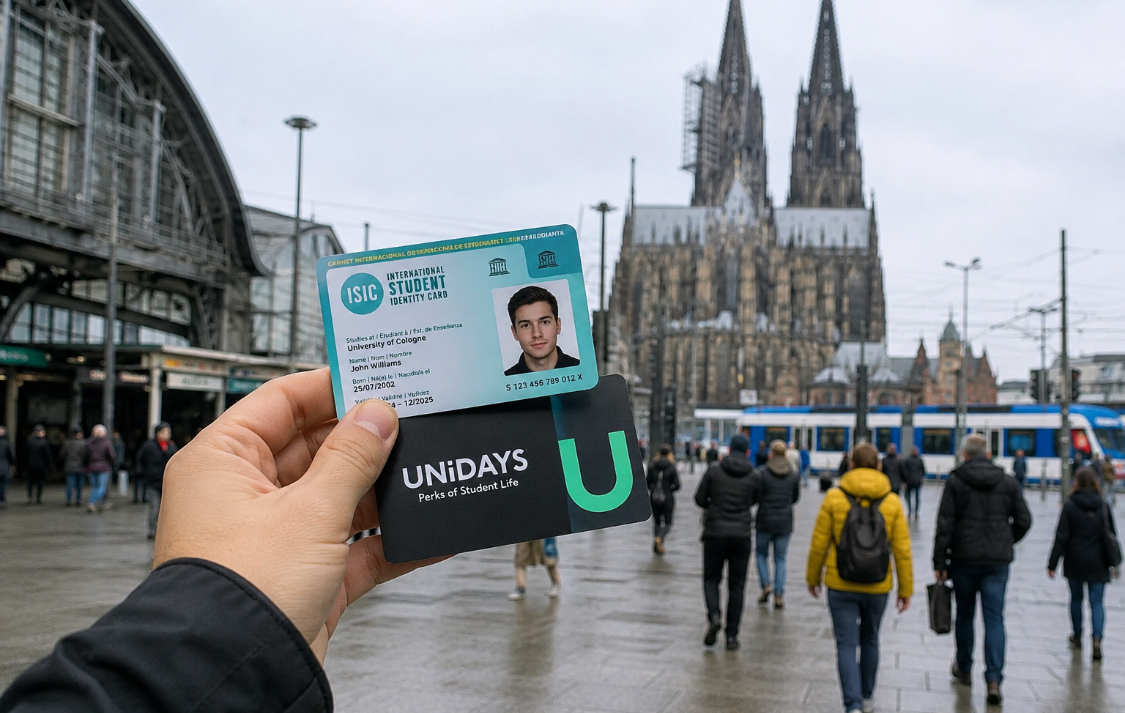
Last updated: May 2026. Student discount offers change often by country, brand, campus, city and verification method. Always confirm the current offer on the official ISIC website, UNiDAYS app or the retailer’s own student discount page before paying.
A student in Europe can lose money quietly.
Not from one major mistake. From small daily payments that look harmless on their own: a train ticket bought without checking student fares, a museum entry paid at full price, a laptop purchased without education pricing, a fashion order placed without a student code, a streaming subscription renewed for the normal price, a bus trip booked without checking whether ISIC has a valid voucher.
By the end of a semester, those missed savings can become real money.
That is why student discounts in Europe deserve more serious attention than they usually get. They are not just little bonuses for shopping. Used properly, they can reduce the cost of transport, software, entertainment, culture, clothing, food delivery, gym access, phone plans and some travel expenses. For an international student living on a tight budget, that difference matters.
The two names students encounter most often are ISIC and UNiDAYS.
ISIC, the International Student Identity Card, works more like a recognised student identity and discount card. It is useful when a student needs student proof beyond a local university card, especially during travel, at museums, attractions, transport partners and some international discount networks. The official ISIC site describes it as the only internationally accepted student identity card and links it to thousands of discounts worldwide.
UNiDAYS works differently. It is a free digital student verification platform used by major brands to confirm student status and provide discount codes or in-app deals. It is especially strong for online shopping, tech, fashion, food, beauty, entertainment and subscription services. UNiDAYS describes itself as a free digital platform for verified students, with brand partnerships that vary by country and region.
The strongest savings usually come from using both.
ISIC often helps when a student is moving physically through Europe: buses, museums, cultural attractions, travel discounts and student proof in places where a home university card may not be recognised. UNiDAYS often performs better when the purchase happens online or inside a brand’s app: clothing, headphones, laptops, software, shoes, phone plans or subscriptions.
Neither one replaces a university ID for official campus matters. A university may still require its own student card for exams, libraries, residence access or local student services. ISIC and UNiDAYS sit beside that system. They are money-saving tools, not replacements for institutional identity.
Students who understand that difference save more because they stop asking which one is “better.” The better question is where each one works best.
What ISIC Actually Is
ISIC stands for International Student Identity Card. It has existed since 1953 and has become one of the most widely recognised student identity systems in the world. Its strength is not that every shop in Europe accepts it. They do not. Its strength is that it gives students a portable, internationally recognised proof of student status that can travel across borders better than many local campus cards.
That matters in Europe because students often move between countries.
A student based in Germany may travel to Prague for a weekend, take a FlixBus to Vienna, visit museums in Italy, book hostels in Spain, or buy attraction tickets in France. A local university card may still work in some places, but it may not be understood everywhere. ISIC reduces that friction because it was designed for international recognition.
The official ISIC website says the card provides student status verification, thousands of discounts worldwide and access to a global student community. Students can apply through the ISIC website by choosing their country, or through local issuing partners where available.
ISIC is usually available to full-time students at school, college or university level. The proof required can include a valid student ID, enrolment letter or other documentation showing current student status. Costs vary by country and issuer. In some places the card may cost only a small amount; in others it can sit closer to the €15–€25 range depending on local arrangements, delivery method and whether a physical card is included.
That country variation is important.
Students should not assume the price, issuing process or available discounts will be identical in every European country. ISIC is international, but the local card seller, national website and partner discounts can differ. The safest route is to begin from the official ISIC card page or the ISIC “get your card” country selector.
Official ISIC links:
How to Get an ISIC Card Without Wasting Time
The process is usually simple, but students still make avoidable mistakes.
Most applications require three things: proof of identity, proof of current student status and payment where the card is not free through a local partner. Some students also need a passport-style photo depending on the country or issuing system.
The fastest path is usually this:
- Go to the official ISIC website.
- Select the country where you want to apply.
- Check the local issuer’s card cost and document rules.
- Prepare current student proof before starting the application.
- Apply online or through the approved local provider.
- Activate the digital card inside the ISIC app where available.
Students who wait until the day before a trip often run into problems. Verification may be quick, but delays happen when documents are unclear, expired or written in a format the issuer cannot easily read.
For international students, the safest proof is usually a recent enrolment letter showing the student’s name, institution, programme and academic year. A student card can work too, but some cards do not show enough detail. A card without an expiry date can slow verification because the issuer may not know whether the student status is still current.
Translations can matter as well. If an enrolment document is not in a widely understood language, a clearer English version from the university’s student office may reduce friction. Many European universities can issue English enrolment confirmations on request.
What the ISIC App Adds
The ISIC app is not just a place to store a digital card. It can also show nearby offers, discount categories and partner deals. That matters because many students never use the card properly after buying it.
The card only saves money when it is checked before payment.
A student buying bus tickets, museum entries or attraction passes should search the ISIC app before paying. A student travelling across several European cities should check the app again after crossing borders because local offers can change from one country to another.
The most practical students treat ISIC like a travel habit. Before booking a ride, entering a museum, buying a ticket or paying for an activity, they check whether an ISIC discount exists. It takes less than a minute and can save enough over a semester to justify the card cost several times over.
There is one weakness students should know: ISIC acceptance is not universal.
Some museums may prefer local student IDs. Some transport partners may run limited-time offers. Some vouchers may exclude peak travel dates or require booking through a specific app. A discount can exist today and disappear later. That is not a reason to ignore ISIC. It is a reason to verify before paying.
What UNiDAYS Does Differently
UNiDAYS is not a physical student identity card in the traditional sense.
It is a digital verification system used by brands to confirm whether someone is a student before giving access to student pricing or discount codes. That difference explains why UNiDAYS works so well for online shopping and why it may not always work as student proof at a museum ticket desk.
A student uses UNiDAYS by creating an account, verifying student status and accessing partner offers through the website or app. The offer may appear as a code, a tracked link, an in-app redemption or a student verification gateway on a brand’s own website.
UNiDAYS is especially visible in the United Kingdom and across many European markets. Its brand partnerships often include fashion, sportswear, beauty, technology, entertainment, food and subscription services. The exact offers depend on the country selected in the account and the brand’s active campaign.
The official UNiDAYS website describes the platform as free and exclusive for students. Its corporate verification page also lists major brand relationships, including names such as Apple, Nike and Samsung. Those partnerships can change, so students should always check the current UNiDAYS app rather than relying on old screenshots.
The main advantage of UNiDAYS is cost. It is free for students. The main limitation is scope. It works where partner brands accept UNiDAYS verification. It does not automatically prove student status everywhere in Europe.
How UNiDAYS Verification Actually Works
Students usually expect UNiDAYS verification to take seconds.
Sometimes it does. Sometimes it absolutely does not.
The fastest verification happens when the student’s university already supports automatic institutional verification. In those cases, the student signs in using a university email address or institutional portal login, and the account becomes verified almost immediately.
That smooth process creates unrealistic expectations because not every institution connects to the system cleanly.
International students run into delays more often than domestic students, especially when:
- the institution uses a less common domain,
- the student recently enrolled,
- the university database has not updated yet,
- or the institution is outside the platform’s strongest regional coverage.
Manual verification is where frustration usually begins.
UNiDAYS may request a student ID card, acceptance letter, timetable, tuition invoice or enrolment confirmation. If the upload is blurry, expired or missing dates, the review can fail. Some students keep submitting the same unclear screenshot repeatedly and then complain that the platform “doesn’t work.”
The problem is often documentation quality.
The safest verification documents usually contain:
- the student’s full name,
- institution name,
- current academic year,
- active enrolment confirmation,
- and visible dates.
A surprising number of student cards fail verification because they do not show expiry dates or active semester information.
Students should also expect delays during peak university periods. September and October verification traffic becomes heavy because new students across Europe are trying to activate discounts at the same time.
I have noticed another issue international students rarely discuss openly: many institutions outside the UK and Western Europe still integrate less smoothly with large student verification platforms. German, Dutch and British universities usually verify faster than smaller institutions in some other regions.
That does not mean verification is impossible. It simply means students should not wait until Black Friday or a major sale weekend to attempt account approval.
Why Students Lose Discounts Even After Getting Verified
Verification alone does not guarantee savings.
The biggest financial mistake students make is forgetting to check student pricing before paying.
That sounds obvious until you watch how people actually buy things.
A student opens a clothing app, sees a sale, checks out quickly and only later remembers that UNiDAYS had an additional student code. Another books train tickets directly from the transport app without checking ISIC transport partners first. Someone buys a MacBook at full retail price during exam season even though the education pricing would have reduced the cost significantly.
The discounts are often there. Students simply rush past them.
The strongest savers build a routine around verification. Before buying anything expensive — electronics, transport, subscriptions, fashion, software, museum tickets — they pause briefly and check:
- Does UNiDAYS have a code?
- Does ISIC have a partner discount?
- Does the brand offer direct education pricing?
- Can the discount stack with a seasonal sale?
That last point matters more than students realise.
Some companies allow student discounts on top of existing promotions. Others block discount stacking completely. Apple education pricing works differently from a fashion coupon code. Spotify student plans work differently from transport vouchers. Students who understand those differences save much more over time because they stop assuming every discount system behaves the same way.
Travel Discounts Across Europe: Where ISIC Starts Paying for Itself
Travel is where many students recover the cost of an ISIC card quickly.
Europe encourages movement. Weekend trips become normal fast. Students travel between countries for concerts, cheap flights, internships, language exchanges, conferences or simply because crossing borders is easier than many first-time international students expect.
Transport companies know this.
That is why student-focused travel partnerships appear repeatedly across bus, rail, accommodation and attraction systems.
FlixBus and FlixTrain are among the examples students discuss most often because the network stretches across large parts of Europe. ISIC has periodically partnered with Flix for student offers, including percentage discounts on selected bookings. The exact conditions change constantly — blackout dates, route limits and voucher windows appear regularly — but active travellers often save meaningful amounts over a semester.
A student moving repeatedly between Berlin, Prague, Vienna, Budapest and Munich can save far more than someone who rarely leaves campus.
The difference becomes clearer with actual numbers.
| Travel Example | Without Student Discounts | Possible Discounted Cost | Potential Savings |
|---|---|---|---|
| Multi-city FlixBus trip across Central Europe | €180 | €160–€165 | €15–€20+ |
| Museum-heavy weekend in Paris or Rome | €70 | €45–€55 | €15–€25+ |
| Semester streaming + software subscriptions | €250+ | €140–€180 | €70–€100+ |
These are not guaranteed numbers. Discounts shift constantly. The point is that students who actively combine student pricing systems usually reduce recurring costs much more than students who rely only on occasional random sales.
Museums and attractions create another overlooked category.
Students arriving in Europe often assume cultural attractions are cheap everywhere. They are not. Entry costs across major cities add up quickly. Paris, Amsterdam, Rome, Vienna and Barcelona can become expensive fast once museums, galleries and attractions stack together across multiple weekends.
ISIC acceptance is uneven, but many attractions still recognise international student proof through the card. Some locations provide reduced entry only on certain days. Others combine student pricing with youth pricing. Students should always ask before paying because many ticket desks do not advertise every available student reduction clearly.
The strongest travellers also combine discounts strategically:
- student transport discounts,
- budget accommodation timing,
- museum reductions,
- and low-cost intercity routes.
Transport savings become even more valuable in expensive cities. Students trying to reduce living costs in major urban centres often discover that travel spending quietly drains their monthly budget. The pressure becomes obvious in places like London, where transport and daily expenses rise quickly across a semester. Students comparing broader budgeting strategies can also review this analysis on the cost of living in London for students.
Why UNiDAYS Dominates Online Shopping for Students
UNiDAYS became powerful because student spending moved heavily online.
Students no longer depend only on physical shops around campus. They buy trainers from apps, stream lectures through subscriptions, order electronics online, pay for cloud storage, purchase editing software, subscribe to music platforms and shop during digital sales events.
That environment favours verification platforms like UNiDAYS.
The biggest savings categories usually include:
- technology,
- fashion,
- subscriptions,
- beauty,
- sportswear,
- and software.
Apple’s education pricing remains one of the most widely used student purchase systems in Europe. Depending on the device and country, students can reduce the cost of MacBooks, iPads and accessories significantly compared with standard pricing. During some promotional periods, extra gift-card incentives appear as well.
Adobe Creative Cloud is another major example.
Design, architecture, media and engineering students often pay heavily for creative software if they miss student pricing windows. The student plan discounts can reduce annual software costs substantially compared with commercial rates.
Streaming services quietly create recurring savings too.
Spotify Premium Student plans and similar subscription structures can reduce monthly costs meaningfully over a full academic year. Students often underestimate recurring subscriptions because each individual payment feels small. Combined together, they become one of the easiest places to lose money without noticing.
Fashion discounts drive a huge amount of UNiDAYS traffic as well.
Brands such as Nike, adidas, ASOS and other rotating retail partners frequently run student-specific codes alongside public promotions. Sometimes the student code stacks on top of seasonal discounts. Sometimes it does not. Students who check carefully before checkout usually save more than students who assume a visible sale is already the lowest available price.
One weakness students should understand clearly: not every “student discount” is genuinely impressive.
Some offers look large until the original retail price is examined properly. Others exclude popular products entirely. Some student discounts are weaker than public Black Friday sales.
The smartest students compare before buying instead of assuming the student label automatically means the best price.
Where Student Discounts Become Financially Serious
Many people think student discounts matter only for small luxuries.
That is not really true anymore.
The largest long-term savings usually appear in categories students already need for academic life:
- laptops,
- software,
- transport,
- subscriptions,
- phone contracts,
- and recurring online services.
A student replacing a laptop during university could save more from one properly timed education purchase than from dozens of small café discounts combined.
Students studying creative or technical subjects feel this most heavily.
Architecture students paying for software. Film students buying storage. Engineering students replacing devices. Media students subscribing to editing platforms. Those costs escalate quickly without student pricing.
International students also face another layer of pressure: currency conversion and banking fees.
A discount becomes less useful if the payment system itself drains money through foreign transaction charges or poor exchange rates. That is one reason budgeting systems work better when student discounts combine with smarter banking choices. Students studying in the UK, for example, often save more effectively once they pair student pricing with better account structures and local payment systems, similar to the strategies discussed in this breakdown on opening a student bank account in the UK.
Why Physical Student Proof Still Matters in Europe
Digital verification dominates online shopping now, but Europe still contains many situations where physical or internationally recognised student proof matters.
Museum counters. Independent cinemas. Local attractions. Regional transport systems. University towns with smaller businesses.
Not every location uses QR-based verification systems.
That is why ISIC still survives despite the rise of digital student apps.
Some students assume showing a university portal login on a phone will always work. Sometimes it does. Sometimes the staff member simply wants a recognised student card immediately without translation or explanation.
International students experience this more often because local staff may not recognise overseas university cards instantly.
A French museum employee may not know how to interpret a small university ID from another continent. An internationally recognised card removes some of that uncertainty.
The physical-versus-digital issue becomes more obvious once students begin travelling outside their study country regularly.
Students who remain mostly on campus may barely notice it. Students moving across Europe constantly usually notice it quickly.
ISIC vs. UNiDAYS: The Difference Students Usually Understand Too Late
Students often compare ISIC and UNiDAYS as if one must replace the other.
That comparison misses the point completely.
The two systems solve different problems.
ISIC functions more like internationally recognised student proof combined with travel, cultural and partner discounts. UNiDAYS functions more like a digital gateway between verified students and commercial brands.
One works better at a museum desk in Prague. The other works better during an online Nike checkout.
That distinction matters because students waste money trying to force one system into situations where the other performs better.
| Feature | ISIC | UNiDAYS |
|---|---|---|
| Main Purpose | International student identity + discounts | Digital student verification for brands |
| Cost | Usually paid | Free |
| Best For | Travel, museums, attractions, physical proof | Online shopping, fashion, tech, subscriptions |
| Physical Card | Yes in many countries | No |
| International Recognition | Strong | Limited outside partner systems |
| Verification Type | Student identity verification | Platform-based digital verification |
| Weakness | Not accepted everywhere | Not useful for many physical student checks |
The strongest setup for an international student in Europe is usually:
- ISIC for movement and physical verification,
- UNiDAYS for online and app-based purchasing,
- and local university benefits layered on top.
Students who combine systems usually save noticeably more than students relying only on one platform.
The Countries Where Student Discounts Feel Strongest
Student discount culture is not equally aggressive across Europe.
Some countries integrate student pricing deeply into daily life. Others rely more heavily on local youth pricing systems, regional transport cards or university-specific partnerships.
The United Kingdom remains one of the strongest environments for commercial student discounts.
Fashion brands, technology companies, food delivery services, subscription platforms and electronics retailers actively target UK students because the student discount ecosystem there became highly competitive over time. UNiDAYS, Student Beans and TOTUM all gained strong traction partly because British student spending online became enormous.
Germany works differently.
The savings culture often leans more toward transport systems, public infrastructure, museum access, regional student tickets and institutional discounts rather than aggressive retail campaigns alone.
Students in Germany frequently save large amounts through semester transport tickets, rail systems and student-priced cultural access rather than only through shopping apps.
France and Italy create another pattern.
Youth pricing overlaps heavily with student pricing in many places. Age-based reductions sometimes matter as much as student verification itself. A student under 26 in parts of Europe may receive discounts even without using ISIC or UNiDAYS directly.
That overlap confuses many international students initially.
The smartest travellers usually check three things before paying:
- student discounts,
- youth discounts,
- and local resident pricing.
One category can sometimes outperform the others.
The result is that “student discounts in Europe” is not really one single system. It is a patchwork of:
- international student tools,
- local government concessions,
- commercial promotions,
- and regional transport structures.
Students who understand that complexity usually save more because they stop assuming every country behaves identically.
The Student Apps Most International Students End Up Using Together
Very few experienced international students rely on only one discount platform anymore.
Most eventually build a small ecosystem of savings apps because different platforms dominate different categories.
UNiDAYS may provide the better fashion code. Student Beans may provide the stronger electronics offer. ISIC may unlock a transport discount that neither of the others supports.
That overlap is exactly why students should stop treating these platforms like competitors in a fight.
They overlap sometimes, but they also fill different gaps.
| Platform | Strongest Area | Typical Use Case |
|---|---|---|
| ISIC | Travel + physical proof | Transport, museums, attractions |
| UNiDAYS | Online shopping | Fashion, subscriptions, tech |
| Student Beans | Retail + lifestyle deals | Fashion, food, electronics |
| TOTUM | UK-focused student offers | Retail and local UK student discounts |
Student Beans deserves more attention than it usually gets in international student conversations.
Many students discover it only after arriving in Europe, even though some of its offers compete directly with UNiDAYS and occasionally go deeper in specific categories.
TOTUM is more UK-focused but still relevant for students spending long periods in Britain. It evolved partly from the older NUS student discount system and continues to maintain retail partnerships across several sectors.
The strongest savers usually enable notifications carefully rather than blindly.
Too many notifications turn these apps into noise. Selective alerts around categories that actually matter — technology, transport, clothing or subscriptions — work much better.
The Students Who Save the Most Usually Behave Differently
Heavy savers rarely look obsessed with discounts publicly.
What they usually do is build habits quietly.
Before buying anything expensive, they pause and check whether student pricing exists. Before travelling, they compare youth pricing, ISIC offers and transport passes. Before paying for software, they verify whether the university already includes institutional access.
That last point saves huge amounts of money.
Many universities already provide:
- Microsoft Office access,
- cloud storage,
- Adobe access in labs,
- software licenses,
- journal subscriptions,
- or discounted student packages.
Students who ignore institutional benefits often pay twice for services they already partly own through tuition fees.
Accommodation choices influence savings too.
A student living farther from campus may spend more on transport even if the rent looks cheaper initially. Another student may choose expensive city-centre housing and then cut costs elsewhere aggressively through discounts and transport passes.
There is no universal formula.
But the strongest budget outcomes usually happen when student discounts become part of a wider financial system rather than isolated random coupon hunting.
Housing pressure becomes especially visible in expensive student cities such as Munich, Amsterdam and London. Students balancing transport costs against accommodation pricing often discover that location affects total monthly spending more than expected. The trade-offs become clearer in city-specific housing markets such as the one discussed in this analysis on student accommodation in Munich.
Why International Students Sometimes Struggle More With Verification
European students often underestimate how much easier verification feels when your institution sits inside the same regional system as the discount platform.
International students face more friction because their documents, student cards and institutional formats may look unfamiliar to the verifier.
Name formatting differences cause problems. Missing expiry dates cause problems. Delayed enrolment updates cause problems.
Some students even lose discounts temporarily because they changed institutions and forgot to update their verification profile afterward.
The safest approach is boring but effective:
- keep updated enrolment proof saved as a PDF,
- store a clear student ID image,
- use a university email consistently,
- and renew verification before expiry rather than after.
Students who travel heavily should also keep backup proof available offline.
A digital app failing at a train station or museum entrance becomes annoying very quickly when internet access disappears unexpectedly.
Physical backup proof still matters more often than students expect.
Where Student Discounts Become Misleading
Not every student discount is a genuine bargain.
That reality deserves more honesty than most student marketing provides.
Some “exclusive” student offers simply return the price to normal market value after artificial markups. Others block popular products entirely. Some discounts exist mainly to collect student data and push long-term brand loyalty rather than provide serious short-term savings.
Fashion brands are especially aggressive here.
A student may see:
“20% student discount available now.”
Then discover the discount excludes the newest collection, stacks poorly with shipping fees or disappears during major public sales periods.
The strongest savers compare:
- public sales,
- student pricing,
- coupon aggregators,
- and direct retailer pricing.
Students should also understand that discount psychology can increase spending instead of reducing it.
Buying unnecessary items simply because a student code exists is not saving money. Several retail platforms understand this extremely well. Student-focused marketing works partly because it creates urgency around identity and belonging.
The financially strongest students usually apply discounts to purchases they already genuinely needed.
The Discounts Students Use Repeatedly Every Month
The biggest long-term savings usually do not come from one dramatic purchase.
They come from repeated monthly reductions.
Students who lower recurring costs every single month often outperform students chasing occasional giant discounts.
The categories that matter most over a full academic year are usually:
- music subscriptions,
- streaming services,
- cloud storage,
- transport,
- software access,
- food delivery,
- and mobile phone plans.
These are the payments students stop noticing psychologically because they become automatic.
A €5–€10 monthly reduction across several services can quietly become hundreds of euros across a degree programme.
That matters more than students initially think because Europe’s cost structure already pressures international students heavily through rent, energy, deposits and transport.
Healthcare and insurance costs also affect budgeting decisions, especially for students comparing systems between countries. While European student discounts do not replace proper medical coverage, students evaluating broader international budgeting structures sometimes compare them alongside systems discussed in analyses such as this overview of student health insurance options in the USA.
The Students Who Accidentally Waste the Most Money in Europe
The largest financial mistakes international students make in Europe are usually not dramatic.
They are repetitive.
Small overspending patterns repeated across months quietly destroy budgets faster than one expensive weekend trip.
I have watched students aggressively search for 10% discount codes while ignoring the fact that they pay full price daily for transport, subscriptions, food delivery or banking fees.
The psychology behind student discounts sometimes creates the illusion of financial discipline without actual budgeting discipline underneath.
A student can use UNiDAYS constantly and still overspend heavily overall.
The stronger financial pattern usually looks different:
- reduced recurring costs,
- planned transport decisions,
- smart accommodation positioning,
- careful subscription management,
- and selective use of discounts where they create real reductions.
Transport creates one of the biggest hidden leakages.
Students in cities such as London often underestimate how quickly daily underground, bus and regional train spending accumulates. Small student reductions suddenly matter far more once travel becomes part of everyday life rather than tourism. The pressure becomes clearer when students examine real monthly spending patterns like those discussed in this breakdown of the cost of living in London for students.
Food delivery is another major trap.
Several discount platforms aggressively target students with reduced delivery fees and app-based promotions. The discounts look attractive individually. The spending pattern underneath often remains expensive.
The strongest savers usually separate:
- planned purchases,
- necessary recurring costs,
- and impulse discount spending.
That distinction matters more than students realise initially.
How Students Quietly Combine Discounts With Banking Strategies
The students who stretch their money furthest across Europe usually combine student discounts with smarter banking behaviour.
That combination changes everything.
A 10% student discount becomes weaker if the bank quietly charges poor exchange rates, foreign transaction fees or unnecessary conversion costs underneath.
This becomes especially relevant for international students arriving with non-European cards.
Many students initially continue using cards from home countries for everyday spending because it feels familiar. Months later, they realise hidden conversion charges have already consumed large amounts of money.
That is one reason international student banking conversations matter more than they appear at first glance.
A student discount saves money only if the payment structure underneath remains efficient too.
Several students now combine:
- local student bank accounts,
- discount platforms,
- budgeting apps,
- and transport subscriptions
into one wider financial system.
The students who ignore banking structure often lose money silently through:
- ATM withdrawal charges,
- poor currency conversion,
- international transfer fees,
- and blocked payment systems.
Students planning long-term study in the UK usually discover this quickly once rent payments, Oyster top-ups and subscription billing begin operating locally. The pressure becomes clearer in situations discussed in this analysis on opening a student bank account in the UK.
What Most Students Never Realise About Museum and Cultural Discounts
Cultural discounts across Europe are far more fragmented than students expect.
One museum may accept ISIC instantly. Another may prefer a university-issued student card. A third may only recognise EU student status under a certain age.
This inconsistency frustrates international students constantly because social media discussions often oversimplify the system.
Europe does not operate one unified student discount structure for cultural access.
Different countries, cities and institutions apply completely different pricing philosophies.
France heavily integrates youth access into several cultural systems. Italy mixes age-based and student-based reductions frequently. Germany often combines institutional discounts with public cultural funding systems.
The result is that experienced student travellers rarely assume anything anymore.
Before paying, they ask directly:
- student price?
- youth price?
- international student accepted?
- ISIC accepted?
That habit alone saves large amounts of money across a year.
Museum-heavy cities especially reward students who carry physical proof properly.
Rome, Paris, Vienna, Prague, Berlin and Amsterdam all contain cultural systems where student reductions can change total trip costs dramatically across several attractions.
Students travelling aggressively through Europe usually recover the cost of an ISIC card surprisingly fast through transport and cultural access alone.
The Difference Between “Student Discounts” and Real Student Affordability
Student discounts help.
They do not magically make Europe cheap.
This distinction matters because social media sometimes creates unrealistic expectations around student life abroad.
A 15% clothing discount does not offset impossible rent. Reduced museum entry does not solve transport inflation. Discounted Spotify subscriptions do not remove tuition pressure.
The countries where students survive financially strongest are usually not simply the countries with the biggest discounts.
They are often the countries where:
- transport systems work efficiently,
- student housing remains manageable,
- banking structures are accessible,
- and part-time work integrates realistically with study schedules.
That broader context matters.
Student discounts function best as pressure reduction mechanisms inside an already organised budget.
They become much weaker when students rely on them emotionally as survival tools while the larger financial structure remains unstable.
The strongest international students usually treat discounts as one layer inside a wider financial strategy rather than the strategy itself.
Why Some Students Stop Using Discount Platforms After a Few Months
Discount fatigue is real.
Students often begin enthusiastically, downloading every student app available, enabling endless notifications and checking promotions constantly.
Three months later, many stop paying attention completely.
The reason is simple:
too much noise.
Most student discount platforms bombard users with offers unrelated to their actual spending habits.
Fashion promotions dominate heavily because retail partnerships generate large engagement numbers. Students who rarely buy clothes still receive constant fashion notifications while more useful categories — software, transport or educational tools — become buried underneath.
The students who continue benefiting long-term usually simplify their setup aggressively.
They focus only on categories that genuinely affect their budget.
For one student that may be transport and software. For another it may be food delivery and electronics. Another may care mainly about travel and museums.
Personalisation matters more than volume.
Students chasing every possible offer often end up spending more overall because discount browsing itself encourages unnecessary purchases.
How Verification Problems Usually Start
Most verification failures begin through small administrative mistakes rather than platform malfunction.
Students upload blurry documents. Expired enrolment letters. Cropped IDs. Screenshots with hidden dates.
Then frustration starts when the platform rejects verification repeatedly.
International students encounter another layer of friction because institutional formats vary heavily across countries.
Some universities provide excellent digital proof systems. Others still issue outdated PDFs or paper confirmations that confuse automated verification tools.
The students who avoid most problems usually prepare verification documents before they urgently need discounts.
Documents Students Should Keep Ready
- Current enrolment letter
- Student ID card photo
- University email access
- Passport or government ID
- Proof showing current academic year validity
Students travelling across borders should also remember that mobile data failures happen constantly.
Offline screenshots or downloaded proof can save enormous stress during transport checks or entrance verification.
The Discounts That Usually Deliver the Highest Long-Term Value
Students often overestimate luxury discounts and underestimate infrastructure discounts.
The largest long-term savings usually come from categories connected to recurring life systems:
- rail travel,
- city transport,
- software access,
- study tools,
- food systems,
- and recurring subscriptions.
A single electronics discount may feel exciting emotionally because the numbers look large immediately.
But repeated monthly reductions usually outperform one-time purchases financially over a degree programme.
Students who move around Europe frequently especially benefit from transport integrations.
FlixBus discounts alone can become surprisingly powerful for students travelling between countries regularly during semester breaks.
A student moving through:
- Germany,
- Austria,
- Czech Republic,
- Italy,
- France
multiple times yearly can reduce transport spending noticeably through strategic booking combined with student pricing.
Students who ignore transport systems entirely often overspend massively on last-minute travel.
The Psychological Side of Student Discounts Nobody Talks About
Student discounts are not only financial tools.
They are behavioural systems.
Retailers understand something students rarely think about openly:
once spending feels discounted, resistance drops.
A student who would hesitate at a €120 purchase may suddenly accept €96 because the reduction creates emotional justification.
That emotional effect matters.
Some platforms quietly encourage higher overall consumption while appearing financially supportive on the surface.
The financially disciplined students usually ask one extra question before buying:
Would I still buy this without the discount?
If the answer is no, the “saving” may not actually be saving money at all.
This becomes especially dangerous around:
- fashion sales,
- technology upgrades,
- subscription stacking,
- and food delivery promotions.
The strongest financial outcomes usually come from selective discount use, not maximum discount exposure.
Why Some Student Discounts in Europe Feel Better Than the Actual Savings
Students sometimes overestimate the financial value of discounts because the emotional effect feels larger than the real savings.
A €12 reduction on a purchase can feel psychologically significant during student life even when the long-term financial impact is relatively small.
Brands understand this very well.
That is one reason student marketing across Europe often focuses heavily on urgency:
- limited student offers,
- exclusive access,
- countdown timers,
- and app-only promotions.
The emotional experience of “saving money” sometimes becomes stronger than the actual amount saved.
This affects students most heavily in categories linked to identity and lifestyle:
- fashion,
- technology,
- food delivery,
- and subscription culture.
The financially disciplined students usually separate emotional satisfaction from actual budgeting impact.
They ask a harder question:
Did this discount reduce necessary spending, or did it simply encourage extra spending?
That distinction often determines whether student discounts genuinely improve financial stability or simply reshape consumption patterns.
Students Should Understand That Europe Is Becoming More Digitally Verified
Student verification systems across Europe are becoming more digital every year.
That shift creates convenience, but it also increases dependence on:
- institutional databases,
- email systems,
- automated identity checks,
- and app ecosystems.
Students from institutions with weaker digital infrastructure sometimes feel excluded temporarily because automated verification systems favour universities already integrated into major international databases.
This affects international students disproportionately.
Several platforms now prioritise instant automated verification because manual verification creates operational costs and delays.
The result is faster approval for some students and frustrating waiting periods for others.
That imbalance explains why some students receive approval within minutes while others wait days despite holding perfectly valid enrolment status.
The safest mindset is preparation rather than urgency.
Students who wait until the exact moment they need a discount often create avoidable stress for themselves.
Student Discounts Do Not Eliminate Emergency Costs
One reality many students only understand after arriving in Europe is that discounts mostly reduce predictable spending.
Unexpected costs still hit hard.
A broken laptop before exams. Emergency train tickets. Medical prescriptions. Deposit disputes. Last-minute accommodation changes. Lost documents.
None of those problems become easy because a student saved 10% on clothing purchases.
This is why financially stable international students usually build two systems at the same time:
- a savings strategy,
- and a discount strategy.
The savings strategy protects against disruption.
The discount strategy reduces recurring pressure.
Students who rely only on discounts often feel financially comfortable until a larger unexpected expense appears.
Healthcare surprises expose this very quickly.
International students comparing insurance systems between Europe and countries like the United States usually notice how different pricing structures feel. Even then, emergency medical or insurance-related costs can still create pressure if students arrive without financial reserves. Students researching broader international student healthcare structures can compare systems discussed in this analysis of student health insurance options in the USA.
The Students Who Usually Save the Most Across Europe
The strongest savers rarely look obsessed with saving money publicly.
They usually look organised.
Their financial decisions connect together logically.
They tend to:
- book transport early,
- track recurring subscriptions,
- understand local banking systems,
- monitor housing carefully,
- and use student discounts consistently without becoming impulsive buyers.
Accommodation positioning especially affects everything else financially.
A student living in the wrong area can easily spend hundreds more yearly on transport alone.
This becomes extremely visible in expensive university cities.
Munich is one example where students often discover that poor accommodation planning increases pressure across transport, food and social spending simultaneously. Housing systems like Studentenwerk and WG-Gesucht influence total student budgets much more than discount apps alone, as discussed in this analysis on student accommodation in Munich.
The financially strongest students usually think in systems rather than isolated purchases.
ISIC Still Holds More Weight for International Mobility
UNiDAYS dominates digital student shopping conversations online.
ISIC still carries stronger international identity weight physically.
That difference matters more during cross-border movement than many students initially expect.
Transport workers, museum staff, attraction operators and tourism systems across Europe often recognise ISIC immediately because the card has existed internationally for decades.
The recognition factor matters.
A digital verification screen from a shopping platform does not always communicate legitimacy clearly in face-to-face situations.
ISIC works differently because it functions closer to a formal international student identity system rather than a retail-only platform.
Students travelling frequently across multiple European countries usually appreciate this distinction quickly.
Especially when language barriers appear.
A recognised physical or digital international student identity card reduces explanation pressure during:
- museum access,
- tourist attractions,
- transport verification,
- student pricing checks,
- or local student promotions.
UNiDAYS remains stronger for:
- online retail,
- electronics,
- fashion,
- software subscriptions,
- and app-driven deals.
The two systems overlap sometimes, but they are not interchangeable.
Why Student Discount Culture Became So Competitive
Large brands aggressively target students because student spending behaviour shapes future consumer habits.
That is the real economic logic underneath many student partnerships.
A student using one software ecosystem throughout university may continue paying for it professionally years later.
A student comfortable with one clothing brand may remain loyal long after graduation.
Student discounts are partly customer acquisition systems.
Technology companies understand this especially well.
Adobe, Apple, Samsung, Microsoft, Spotify and similar brands aggressively compete for student attention because university years often shape long-term subscription behaviour permanently.
This explains why some student discounts appear unusually generous compared with standard retail promotions.
The companies are investing in long-term user retention, not only short-term sales.
Students should understand this dynamic clearly because it helps explain why verification systems continue becoming stricter and more integrated.
The Biggest Mistake Students Make With Travel Discounts
Students often focus entirely on discount percentages while ignoring timing.
Timing usually matters more.
A 10% student discount on an expensive last-minute ticket often saves less money than early booking without any student discount at all.
This appears constantly across:
- FlixBus,
- budget airlines,
- Eurostar,
- and regional rail systems.
The strongest travellers usually combine:
- student pricing,
- early booking windows,
- flexible travel times,
- and low-demand days.
That combination creates much larger savings than discounts alone.
Students travelling during holidays without planning ahead often discover that “student discounts” barely matter once dynamic pricing increases heavily.
Another issue appears around discount assumptions.
Students sometimes assume one European country’s student pricing culture applies everywhere else.
It does not.
Germany, France, Italy, Spain, the Netherlands and the UK all structure student pricing differently across transport and cultural systems.
The students who save the most during travel usually research locally rather than relying on assumptions carried from another country.
How Digital Student Identity Is Expanding Beyond Discounts
Student verification systems are slowly becoming wider digital identity systems.
Several platforms now integrate:
- payment systems,
- event access,
- software licensing,
- transport integration,
- and educational subscriptions
inside student verification ecosystems.
This trend is becoming more visible across Europe because universities increasingly operate through app-based infrastructure.
The traditional physical student card still exists, but digital identity verification now influences much larger parts of student life.
Students who understand this transition early usually move more comfortably through:
- transport systems,
- online learning platforms,
- subscription management,
- and retail ecosystems.
The downside is increased dependence on phone access and digital infrastructure.
Battery failure during travel suddenly becomes more stressful when student proof, tickets and payment systems all sit inside one device.
Experienced student travellers usually keep backup screenshots or physical proof somewhere accessible.
The Students Who Usually Regret Ignoring Student Discounts
Not every student needs every discount platform.
But students who ignore them entirely often regret it later once they calculate yearly spending properly.
The cumulative effect surprises people.
Small reductions repeated across:
- transport,
- software,
- subscriptions,
- electronics,
- food,
- and entertainment
can realistically save several hundred euros yearly for active students.
Students travelling heavily across Europe sometimes save far more.
The strongest approach usually avoids two extremes:
Poor Approaches Students Commonly Take
- Ignoring student discounts completely
- Obsessing over every available promotion
- Impulse buying because something looks discounted
- Depending emotionally on “sale culture” for budgeting
The financially stable students usually behave somewhere in the middle.
They use discounts strategically where the savings remain meaningful and repeatable.
Europe Quietly Rewards Students Who Learn Financial Systems Early
Students arriving in Europe often focus heavily on academic adaptation first.
The financial adaptation usually matters just as much.
Students who understand:
- transport systems,
- banking structures,
- discount ecosystems,
- housing markets,
- and digital student infrastructure
usually experience much less pressure overall.
The difference becomes visible after the first semester.
One student constantly feels financially unstable despite similar income and similar living conditions.
Another moves through the same city much more comfortably because small systems underneath daily life are functioning properly.
Student discounts alone do not create that stability.
But they often become part of the wider structure that makes European student life more manageable financially.
Why ISIC and UNiDAYS Work Best Together Rather Than Separately
Students often ask which platform is “better.”
The question itself usually misses the point.
ISIC and UNiDAYS solve different problems.
ISIC works better as:
- an internationally recognised student identity system,
- a travel and cultural discount tool,
- and physical proof of student status across borders.
UNiDAYS works better as:
- a retail and online shopping ecosystem,
- a subscription and technology discount platform,
- and a digital student deal environment.
The strongest student setups usually combine both.
Especially for international students moving frequently across countries while also relying heavily on digital subscriptions and online purchases.
One system handles identity and mobility better.
The other handles digital consumer life better.
That overlap is exactly why many experienced students eventually stop treating them as competitors entirely.
What Students Should Do Before Arriving in Europe
Several financial problems students face in Europe begin before departure.
Not after arrival.
Students who wait until orientation week to think about discounts, banking or transport systems usually enter unnecessary financial pressure immediately.
The stronger approach begins earlier.
Before arriving, students should already understand:
- whether their institution supports automatic UNiDAYS verification,
- how to apply for ISIC in their country,
- what transport systems dominate their destination city,
- and which recurring student costs appear most heavily there.
Students arriving in London, for example, usually encounter transport costs immediately. Students arriving in Germany often feel housing pressure first. Students moving between Schengen countries regularly may prioritise transport and cultural discounts much more heavily than students staying mostly in one city.
The students who adapt financially fastest usually research their destination realistically rather than romantically.
That mindset changes spending behaviour quickly.
How Europe’s Student Discount Culture Differs From Country to Country
Students sometimes speak about “Europe” as though it operates financially like one country.
It does not.
The student discount culture changes dramatically across borders.
Germany often integrates student reductions deeply into transport and public systems. France strongly supports youth and cultural access through museums and public institutions. The UK leans heavily toward retail and subscription ecosystems. Italy and Spain mix local, regional and age-based discounts inconsistently depending on the city.
Eastern European cities sometimes provide surprisingly strong cultural value for students despite lower international visibility in online student discussions.
This unevenness creates one important reality:
students who rely only on global discount apps often miss local opportunities completely.
Local transport cards, city youth passes, regional museum memberships and university partnerships sometimes outperform international student apps financially.
The strongest students combine:
- international discount systems,
- local student infrastructure,
- city-specific transport plans,
- and institution-level partnerships.
Why International Students in Europe Often Miss Local Student Discounts Completely
One pattern appears repeatedly among newly arrived international students in Europe:
they rely heavily on global student apps while overlooking local student systems sitting directly around them.
That mistake quietly costs money.
Many universities across Europe already negotiate their own local partnerships independently from platforms like ISIC or UNiDAYS.
Students sometimes discover months later that their university email alone already unlocks:
- reduced cinema tickets,
- local gym memberships,
- student cafés,
- regional transport partnerships,
- museum access,
- software licensing,
- and discounted cultural events.
Berlin is a strong example.
Several student discounts there operate more through local student culture and institutional arrangements than through international discount apps alone.
The same pattern appears in parts of France, Italy, Spain and the Netherlands.
Students focused only on international discount platforms sometimes miss the cheaper local systems entirely because those offers circulate mainly through:
- student unions,
- campus newsletters,
- local apps,
- or university partnership pages.
The financially strongest students usually combine both worlds:
- international student platforms for travel and major brands,
- and local student ecosystems for everyday living.
That combination usually creates much larger long-term savings than relying on one platform alone.
The Most Overlooked Student Discounts in Europe
Students usually focus heavily on visible categories:
- fashion,
- technology,
- Spotify,
- food delivery,
- and transport.
Several quieter categories often create stronger long-term value.
Software access is one of them.
Many students pay full price for tools they could access cheaply or free through institutional partnerships, student licensing systems or educational verification.
Academic software, cloud storage, productivity tools, language-learning platforms and creative applications frequently contain hidden student ecosystems students never fully explore.
Insurance reductions are another overlooked area.
Travel insurance, gadget protection and educational insurance products sometimes integrate student-specific pricing structures through ISIC partnerships or university agreements.
Printing and coworking systems also matter more than many students expect.
Postgraduate students especially can spend large amounts yearly on:
- printing,
- research materials,
- software access,
- and productivity subscriptions.
The students who investigate educational licensing systems properly usually reduce these costs heavily.
Why Verification Timing Matters More Than Students Think
Verification failures become most stressful when students need discounts urgently.
A student trying to verify identity during a transport booking deadline or laptop purchase emergency usually experiences far more frustration than a student who completed verification calmly weeks earlier.
Peak periods also affect approval times.
September and October especially create pressure because huge numbers of students across Europe attempt verification simultaneously.
Platforms become slower.
Manual checks increase.
Institutions respond slowly.
The students who avoid most of this pressure usually complete verification before major semester rush periods begin.
Another issue appears around institutional email access.
Students changing universities, progressing between degrees or arriving from exchange programmes sometimes temporarily lose access to one academic email before the next institution fully activates the new one.
That gap can interrupt verification systems unexpectedly.
Students planning carefully usually maintain backup proof:
- current enrolment letters,
- screenshots of active student portals,
- and updated student documentation.
How Some Students Quietly Save Hundreds on Technology Alone
Technology pricing creates one of the largest hidden opportunities inside student discount systems.
Especially for students entering:
- engineering,
- architecture,
- design,
- computer science,
- or media-related programmes.
The cost difference between standard and educational pricing can become enormous over a degree.
Apple education pricing alone sometimes removes hundreds of euros from laptop purchases.
Adobe Creative Cloud student pricing frequently cuts subscription costs dramatically compared with commercial plans.
Microsoft educational ecosystems often provide software access students would otherwise pay heavily for independently.
Students who ignore educational pricing systems often overspend massively during their first year because they rush purchases under academic pressure without checking verification options first.
The strongest students usually delay major purchases briefly until verification systems activate fully.
That patience alone can reduce spending significantly.
The Students Who Usually Handle Europe Best Financially
After watching international student spending patterns repeatedly, one thing becomes obvious:
the students who survive Europe most comfortably financially are usually not the richest students initially.
They are often the students who understand systems fastest.
They learn:
- how transport works,
- where discounts actually matter,
- which subscriptions are unnecessary,
- how housing changes total spending,
- and how local financial culture operates.
That learning curve matters enormously during the first academic year.
Students who never adapt financially often remain under pressure constantly regardless of income level because small inefficiencies repeat every day.
Student discounts do not solve every financial problem in Europe.
But students who ignore them entirely usually spend more than necessary year after year.
What Usually Happens After Graduation
Several students assume discount systems disappear instantly after graduation.
The reality is more uneven.
Some platforms remove verification access quickly once student status expires. Others operate through annual verification cycles, meaning access may continue temporarily until the next re-check period.
ISIC also connects to wider youth travel systems in some situations.
Students under certain age limits sometimes transition toward youth-focused travel cards or related discount ecosystems even after academic enrolment ends.
That said, most major educational discount systems increasingly tighten verification standards because abuse has become widespread.
Brands understand that student pricing attracts non-students constantly attempting access through expired accounts or borrowed credentials.
This explains why:
- manual re-verification,
- institutional database checks,
- and annual proof requests
have become more aggressive across platforms.
Why Europe’s Student Discount Ecosystem Will Probably Keep Expanding
Student discount systems have become deeply connected to digital consumer culture.
Brands now compete aggressively for student attention because university years shape long-term buying habits heavily.
At the same time, the cost of international education continues rising across multiple European cities.
That pressure increases student dependence on financial reduction systems naturally.
Platforms such as ISIC and UNiDAYS are no longer niche student tools.
They now sit inside wider international education infrastructure.
Transport systems recognise them. Technology companies integrate them. Universities indirectly support them. Retail ecosystems build campaigns around them.
The students who understand these systems early usually navigate European student life with much less financial friction.
The Students Who Benefit Most From ISIC and UNiDAYS
The biggest beneficiaries are usually not casual users.
They are students whose lifestyles naturally intersect repeatedly with the categories these systems support.
Students who:
- travel frequently,
- move between countries,
- depend heavily on software,
- buy technology,
- use subscription services,
- or engage actively with cultural spaces
usually recover the value fastest.
A student rarely travelling and barely using paid subscriptions may not save dramatically.
A student crossing borders regularly while studying in Europe can save surprisingly large amounts over several years.
The systems reward activity.
That is why exchange students, Erasmus students and highly mobile postgraduate students often become the strongest long-term users.
What Students Should Remember Before Depending on Any Discount
Student discounts are temporary privileges tied to student status.
Platforms change.
Offers disappear.
Verification rules tighten.
Regional restrictions shift constantly.
The students who avoid frustration usually approach discounts with realistic expectations.
They verify details before purchases.
They keep proof updated.
They understand that one country’s offer may not apply elsewhere.
And they remember something many students forget:
The strongest financial advantage rarely comes from one giant discount. It usually comes from dozens of smaller smart decisions repeated consistently across an academic year.
Official ISIC Resources
Official ISIC Card Information
Other Student Discount Platforms
Student Beans Official Website
Official UNiDAYS Resources
Discount availability, eligibility rules, verification methods and regional offers can change regularly. Students should always confirm current details directly through official platforms before making purchases or travel decisions.
Frequently Asked Questions About ISIC and UNiDAYS Student Discounts in Europe (FAQ)
Can international students use ISIC and UNiDAYS in Europe?
Most international students studying at recognised institutions in Europe can use both ISIC and UNiDAYS if they successfully verify their student status. Eligibility rules still vary slightly depending on the country, institution and specific discount partner.
Is ISIC better than UNiDAYS for student discounts in Europe?
They work differently. ISIC functions more as an internationally recognised student identity card with travel, museum and in-person discounts across many countries, while UNiDAYS focuses heavily on online shopping, technology, fashion and app-based student offers. Many students end up using both together.
Do ISIC and UNiDAYS discounts work in every European country?
No. Discount availability changes by country, city and commercial partner. Some offers work across Europe, while others only apply in specific regions or stores. Students should always verify current terms directly inside the ISIC or UNiDAYS platforms before making purchases.
How long does student verification take on UNiDAYS?
Students using institutional email verification are often approved quickly, sometimes within minutes. Manual verification using enrollment letters or student IDs can take several days depending on the institution and review volume.
Can students still use ISIC after graduation?
The standard ISIC card normally requires active student status. Some former students transition to alternatives such as youth travel cards or country-specific youth discount programmes after graduation, depending on age and location.

Founder of The Global Scholar Guide, focused on international scholarships, student visas, and practical study abroad guidance.