
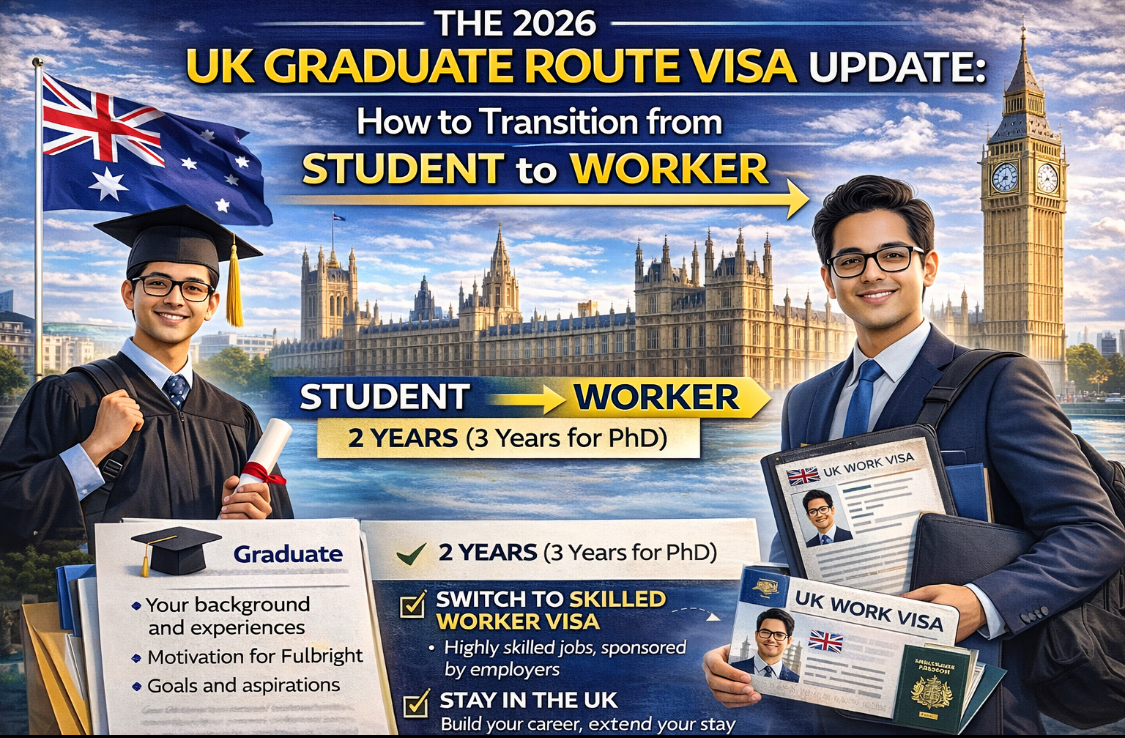
For many international students, the Graduate Route visa has quietly become one of the most important bridges in the UK immigration system. It sits between study and long-term work, offering a window to move from academic life into the labour market without the immediate pressure of sponsorship.
That window, however, is not static. Policy adjustments over the past year have made it clear that the route is evolving, and the timeline attached to it is becoming more strategic than many initially assumed. What used to be treated as a comfortable two-year buffer is now being reconsidered in light of the upcoming reduction set to take effect from January 2027.
For international graduates planning to remain in the UK beyond their studies, this route has become a central part of that transition, particularly as other immigration pathways continue to tighten.
As outlined in the official Graduate visa guidance, the route continues to allow international graduates to work in the UK without sponsorship after completing an eligible degree. That flexibility remains unchanged. What is changing is how graduates are expected to use that time.
Across the UK job market, this shift is already visible. Employers are increasingly selective about sponsorship, salary thresholds have risen under the Skilled Worker framework, and graduates are now navigating a narrower path between entry-level employment and long-term eligibility.
As of April 2026: The Graduate Route remains valid under current rules, but its duration will reduce for new applicants from January 2027. Always confirm updates directly through official UK government sources before making decisions.
What distinguishes the Graduate Route from most UK immigration pathways is its structure. It does not guarantee long-term stay, and it does not lead directly to settlement. Instead, it functions as a transition phase — a period where decisions carry more weight than they appear to at first glance.
The question is no longer whether the route exists, but how effectively it is used. For some graduates, it becomes a stepping stone into a Skilled Worker visa. For others, it passes without a clear transition, often due to timing, salary gaps, or lack of sponsorship opportunities.
Understanding that difference early changes how you approach the entire process. It influences the roles you target, the salaries you accept, and the timeline you work within. It also shapes how you position yourself in a job market that is increasingly tied to immigration thresholds.
Why the 2026 Update Matters More Than It Looks
The upcoming change in duration is not just a technical adjustment. It shifts the practical timeline available to graduates, especially those completing bachelor’s or master’s degrees. A reduction from two years to eighteen months may appear modest on paper, but in practice, it compresses job searching, progression, and sponsorship planning into a tighter window.
In sectors where career growth takes time — particularly outside high-paying industries — this shorter period introduces additional pressure. Graduates who previously relied on gradual progression may now need to approach the route with more deliberate planning from the outset.
At the same time, the route continues to offer something rare in the UK system: immediate access to the labour market without sponsorship. That flexibility still provides a significant advantage, particularly for those entering competitive industries where employers are hesitant to sponsor at the early stage.
The difference now is that flexibility alone is not enough. What matters is how that time is structured, and how early the transition toward sponsorship begins.
What the Graduate Route Visa Actually Offers in 2026
The Graduate Route sits in an unusual position within the UK immigration system. It is not tied to an employer, it does not impose a salary threshold, and it does not require sponsorship at the point of entry. For a system that is otherwise highly structured around employer control, that level of flexibility is rare.
At its core, the route allows international students who have completed an eligible UK qualification to remain in the country and work freely for a limited period. The emphasis is on transition rather than permanence. It provides time — but not certainty.
According to the current criteria outlined in the official policy, eligibility depends primarily on successful completion of a recognised UK degree while holding a valid Student visa. The institution must be a licensed sponsor, and the Home Office must have received confirmation of completion before an application can proceed.
Unlike most work routes, the Graduate visa does not restrict the type of employment you can take. Graduates are permitted to work at any skill level, move between employers, or even take on multiple roles simultaneously. The only notable exclusions relate to professional sport and certain training roles in regulated fields such as medicine and dentistry.
A Route Built Around Flexibility — But With Limits
That flexibility often creates a false sense of security. Because there is no immediate requirement for sponsorship or salary thresholds, many graduates treat the route as a period of open exploration. In reality, it functions more effectively when approached as a structured transition phase.
There is no extension available once the visa expires. There is also no automatic progression into long-term residence. Everything depends on what is achieved within the validity period — particularly in securing a role that can meet the criteria for a Skilled Worker visa.
This is where the route differs from similar post-study options in other countries. It gives access, but not direction. That responsibility remains with the applicant.
Key point: The Graduate Route is not designed as a long-term visa. It is designed as a transition period where employment choices directly affect your ability to remain in the UK beyond its duration.
What You Can Do on the Graduate Route
The scope of work permitted under this route is intentionally broad. Graduates are not required to meet a minimum salary, and there is no restriction to graduate-level roles. This means it is legally possible to take positions across a wide range of sectors and levels.
- Full-time or part-time employment across most industries
- Multiple jobs at the same time
- Self-employment or freelance work
- Switching employers without notifying the Home Office
From a legal standpoint, this makes the Graduate Route one of the least restrictive visas available. From a strategic standpoint, however, not all of these options are equally useful if the goal is long-term residence.
A role that offers flexibility today may not support sponsorship tomorrow. This is where many graduates begin to encounter friction — particularly when salary thresholds and employer licensing come into play.
Why Employers View Graduate Visa Holders Differently
Employers in the UK are increasingly aware of how the Graduate Route works. For many, it represents a low-risk entry point. Hiring someone on a Graduate visa requires no sponsorship commitment at the outset, which makes it easier to bring candidates into the organisation.
That initial advantage, however, does not always translate into long-term sponsorship. Employers may be open to hiring, but more cautious when it comes to meeting salary thresholds or administrative requirements later on.
This creates a dynamic where the first job is often easier to secure than the second step — transitioning into a sponsored role. Understanding this distinction early changes how graduates approach their first position in the UK.
Rather than focusing only on entry, the more important question becomes whether a role has the potential to evolve into something that meets Skilled Worker requirements. That consideration tends to matter more than job title or short-term salary.
How Long the Graduate Route Lasts — And What Changes After 2026
The duration of the Graduate Route has always been one of its defining features. It determines not just how long you can stay, but how much time you realistically have to secure long-term work in the UK.
Under the current structure, the length of the visa depends on the level of qualification completed. As confirmed in the official Graduate visa policy, most graduates receive two years, while those completing doctoral-level qualifications receive three.
That framework, however, is already scheduled to change. From January 2027, the standard duration for bachelor’s and master’s graduates will be reduced.
Current and Upcoming Duration Structure
| Qualification | If Applied by 31 Dec 2026 | From 1 Jan 2027 |
|---|---|---|
| Bachelor’s / Master’s | 2 Years | 18 Months |
| PhD / Doctoral | 3 Years | 3 Years (unchanged) |
The distinction is straightforward, but its implications are not. A reduction from two years to eighteen months removes six months from an already limited transition period. That difference becomes significant when measured against job search cycles, probation periods, and salary progression timelines.
Timing matters: If your application is submitted on or before 31 December 2026, the two-year duration still applies. Applications made from 1 January 2027 onward fall under the reduced 18-month period for non-PhD graduates.
Why the Six-Month Reduction Is More Significant Than It Appears
On paper, six months may not seem substantial. In practice, it often represents the difference between reaching a sponsorship-ready salary and falling short of it.
Most graduate roles in the UK follow a progression structure. Initial salaries are typically below Skilled Worker thresholds, with increases occurring after performance reviews or role changes. That progression often takes time — time that the Graduate Route used to provide more comfortably.
With a shorter duration, that margin becomes tighter. Graduates entering sectors with slower salary growth may find themselves needing to make earlier career moves, negotiate more aggressively, or shift toward roles that align more directly with sponsorship criteria.
For those in high-demand fields such as technology, engineering, or finance, the impact may be less pronounced. For others, particularly in fields where entry-level salaries are lower, the change introduces a level of urgency that did not previously exist.
A Fixed Timeline With No Extension
One of the most important aspects of the Graduate Route is that it cannot be extended. Once it expires, the only options are to switch into another visa category or leave the UK.
There is no bridging period and no automatic continuation. This makes the end date of the visa a hard deadline rather than a flexible milestone.
Because of this, many graduates who succeed in transitioning do not wait until the final months. They begin positioning themselves for sponsorship early — often within the first year — even if the actual switch happens later.
Understanding that timeline from the beginning changes how decisions are made throughout the visa period. It shifts the focus from simply finding employment to finding employment that can realistically lead somewhere.
Salary Expectations on the Graduate Route — And Why They Matter Later
One of the reasons the Graduate Route became widely used is its lack of a salary requirement. Unlike most UK work visas, it allows graduates to accept roles at any pay level. That flexibility lowers the barrier to entry into the labour market, especially for those starting out.
In practice, most graduates do not begin at salaries that meet long-term immigration thresholds. Across many sectors, entry-level roles tend to fall within a relatively narrow band. For a large portion of the market, that range sits between £25,000 and £35,000, with variation depending on location, industry, and prior experience.
Some fields move beyond that range more quickly. Roles in technology, finance, and certain engineering disciplines often start higher, sometimes reaching £30,000 to £45,000 or more. Even within those sectors, however, progression rather than starting salary is what determines long-term viability.
Why the Starting Salary Is Only Part of the Picture
Looking at salary only at the point of entry can be misleading. What matters more is whether a role creates a path toward meeting Skilled Worker requirements later. That path usually depends on progression — either through promotion, internal movement, or switching employers.
A lower starting salary is not necessarily a disadvantage if the role allows for structured growth. On the other hand, a slightly higher salary without long-term progression may not be enough to sustain a transition.
This is where the Graduate Route starts to connect directly with Skilled Worker rules. At some point during the visa period, the role must align with sponsorship criteria — and that alignment is heavily influenced by salary thresholds.
The Skilled Worker Salary Threshold in 2026
Under the current framework, the general salary threshold for the Skilled Worker visa is set at £41,700 per year, or the “going rate” for the specific occupation — whichever is higher. This threshold is confirmed in the official Skilled Worker salary guidance.
For many graduates, this creates a gap between entry-level pay and long-term eligibility. It is not unusual for new graduates to begin below that threshold and work toward it over time.
Reality check: Most Graduate visa holders do not meet the Skilled Worker salary threshold immediately. The transition typically depends on salary progression rather than starting pay.
When Lower Salaries Still Work: The “New Entrant” Option
There is, however, some flexibility built into the system. Graduates switching from the Graduate Route may qualify as “new entrants,” which allows for a reduced salary threshold under certain conditions.
As outlined in the official policy on salary discounts, this can bring the required salary down to around £33,400 or 70% of the occupation’s going rate, depending on the role.
This adjustment plays a significant role in making the transition achievable for many graduates. It provides a narrower, but still realistic, entry point into sponsored employment.
Even with this reduction, the gap between typical graduate salaries and required thresholds remains noticeable. That is why timing, negotiation, and role selection become central to the process.
A Practical View of Salary Progression
In many cases, the first job taken under the Graduate Route is not the one that leads directly to sponsorship. Instead, it serves as a starting point — a way to gain UK experience, build references, and position for a stronger role later.
Graduates who transition successfully often follow a pattern. They enter the workforce at a moderate salary, gain experience within the first year, and then either move internally or switch employers to reach a role that meets sponsorship requirements.
That movement is not guaranteed, but it is common enough to shape how the route is used in practice.
What This Means for Decision-Making Early On
When choosing a role, the question is not only “Can I get this job?” but also “Where does this job lead?” Roles that appear similar at entry level can differ significantly in long-term outcomes.
- Does the employer hold a sponsorship licence?
- Is there a clear progression path within the role?
- Do similar roles in the company reach sponsorship-level salaries?
- Is the industry aligned with Skilled Worker eligibility?
These questions are often more important than the starting salary itself. A well-positioned role can close the gap over time, while a stagnant one may not.
The Graduate Route provides access, but salary thresholds define the exit path. Understanding that relationship early is what allows graduates to use the route effectively rather than reactively.
What the First Six Months Often Look Like in Practice
There is a difference between how the Graduate Route is described and how it unfolds in practice. The first six months tend to shape everything that follows, even though they are often treated as a settling-in period.
In reality, this phase is where direction either starts to form or begins to drift. Graduates typically enter the workforce through roles that are accessible rather than strategic. These roles provide immediate income and experience, but they do not always align with long-term visa requirements.
A common pattern emerges during this period. The first job is often secured within a few months, but the question of progression remains open. Employers are usually willing to hire at this stage because no sponsorship is required. The relationship changes later, when salary thresholds and visa commitments become relevant.
By the third or fourth month, a clearer picture begins to form. Some roles show signs of progression — structured reviews, salary adjustments, or internal mobility. Others remain fixed, offering stability but limited advancement. The difference between those paths becomes more visible over time.
What tends to work: Graduates who start assessing their position early — rather than waiting until the final year — are more likely to adjust direction in time.
This is also the stage where expectations begin to shift. Initial flexibility gives way to more focused decisions. Questions about sponsorship, salary growth, and long-term viability start to influence job choices more directly.
Those who navigate this phase effectively do not necessarily start in the highest-paying roles. What they do differently is pay attention to where those roles lead. They treat early employment as part of a sequence, not as an end point.
The Graduate Route does not require immediate certainty, but it does reward early awareness. The first six months often determine whether the rest of the timeline remains flexible or becomes constrained.
Moving from the Graduate Route to a Skilled Worker Visa
The Graduate Route only becomes meaningful if it leads somewhere. For most international graduates, that next step is the Skilled Worker visa. The transition is possible from within the UK, but it is not automatic and does not depend on time alone. It depends on meeting a specific set of conditions at the point of application.
As set out in the official switching guidance, graduates can move directly from the Graduate Route into a Skilled Worker visa without leaving the UK, provided their current visa is still valid.
What Must Be in Place Before You Can Switch
The transition is built around employment. Without the right job offer, the process does not begin. That job must meet a number of conditions, both on the employer’s side and the applicant’s side.
- A confirmed job offer from a UK employer licensed to sponsor workers
- A role that meets the required skill level under current immigration rules
- A Certificate of Sponsorship (CoS) issued by the employer
- A salary that meets either the general threshold or the applicable discounted rate
- Proof of English language ability (usually already satisfied through UK study)
- A valid passport and supporting documentation
Each of these elements must be in place at the time of application. Missing one requirement is enough to prevent the switch.
Important: You cannot apply for a Skilled Worker visa without a sponsoring employer. The Graduate Route allows you to work freely, but the Skilled Worker route is employer-dependent from the start.
How the Switching Process Works in Practice
Although the requirements are defined, the process itself is relatively straightforward once a qualifying job offer is secured. It follows a sequence that is largely administrative, but timing matters.
- Secure a qualifying job offer: The role must meet skill and salary requirements, and the employer must hold a sponsorship licence.
- Receive a Certificate of Sponsorship: This is issued by the employer and contains details of the role, salary, and start date.
- Prepare and submit your application: This includes completing the online form, uploading documents, and paying the required fees.
- Complete biometrics if required: Depending on your circumstances, this may involve attending an appointment or using a digital verification process.
Processing times for in-country applications are typically around eight weeks, although faster options may be available for an additional fee.
During this period, applicants can usually continue working under the conditions of their current visa until a decision is made.
How the Two Routes Compare
| Feature | Graduate Route | Skilled Worker Visa |
|---|---|---|
| Sponsorship | Not required | Required |
| Work Flexibility | Any job | Specific sponsored role |
| Salary Requirement | None | Minimum threshold applies |
| Duration | Fixed (2 yrs / 18 months / 3 yrs) | Up to 5 years (renewable) |
| Path to Settlement | No | Yes (subject to conditions) |
The contrast is clear. The Graduate Route offers freedom without long-term security, while the Skilled Worker visa offers stability with stricter conditions.
Where Most Challenges Appear
The transition is not blocked by the process itself. It is shaped by the labour market.
Three challenges tend to appear consistently:
- Employers who are willing to hire, but not sponsor
- Roles that meet skill requirements but fall below salary thresholds
- Competition for positions that combine both sponsorship and qualifying pay
These challenges are not new, but they have become more visible as salary thresholds have increased and the Graduate Route timeline has tightened.
Graduates who navigate this successfully often approach the process early. They identify employers with sponsorship licences, target roles with progression potential, and position themselves for transition well before their visa approaches expiry.
The difference is rarely in eligibility. It is in preparation and timing.
How to Use the Graduate Route Period Without Losing Time
What separates successful transitions from stalled ones is rarely eligibility. It is timing. The Graduate Route gives access to the UK labour market, but it does not structure how that time should be used. That structure has to be created deliberately.
When looked at closely, the period between graduation and visa expiry tends to follow a pattern. Those who move early tend to have more options. Those who delay often find themselves working against both time and salary thresholds.
Before Graduation: Positioning Starts Earlier Than Expected
Preparation does not begin after the visa is granted. It begins months before graduation. By this stage, the focus should already be shifting toward employability within the UK market.
- Identify employers that hold a sponsorship licence
- Align your CV with UK hiring expectations
- Build connections through university networks, internships, or industry events
- Understand which roles in your field typically meet Skilled Worker requirements
This stage is often underestimated. Graduates who wait until after completing their studies to begin this process usually start from a weaker position.
First Phase on the Graduate Route: Entry Into the Labour Market
The early months on the Graduate visa are typically focused on securing employment. For many, this involves entering roles that may not yet meet long-term visa thresholds but provide initial UK experience.
At this point, the priority is not perfection. It is entry. However, the type of role still matters. Positions that offer exposure, progression, or alignment with sponsorship pathways tend to create more opportunities later.
This is also where many graduates begin to understand the difference between employment and progression. A job can provide income without providing direction.
Mid-Period: Building Toward Sponsorship
Once employment is secured, the focus shifts. The question is no longer how to get a job, but how to move toward a role that meets Skilled Worker requirements.
This phase often involves one of two paths:
- Progression within the same organisation, leading to increased responsibility and salary
- Transition to a different employer offering sponsorship and qualifying pay
Neither path is guaranteed, but both require active positioning. Waiting for progression without seeking it is rarely effective in a system where salary thresholds are fixed externally.
Practical approach: By the midpoint of your Graduate visa, you should have a clear view of whether your current role can lead to sponsorship. If not, it is usually better to adjust direction early rather than wait.
Final Phase: Securing the Transition
As the visa approaches its later stage, the timeline becomes more defined. This is where a qualifying job offer, sponsorship, and application preparation must come together.
At this point, the process is less about exploration and more about execution:
- Confirm that the employer is ready to sponsor
- Ensure salary requirements are met under the relevant threshold
- Receive a valid Certificate of Sponsorship
- Submit your Skilled Worker application before your current visa expires
Delays at this stage can be difficult to recover from. Once the Graduate Route expires, the opportunity to switch from within the UK is lost.
A Simplified Timeline Overview
| Phase | Focus | Outcome |
|---|---|---|
| Pre-Graduation | Research, networking, CV preparation | Positioning for UK job market |
| Early Graduate Period | Secure initial employment | Entry into workforce |
| Mid Graduate Period | Progression or job transition | Alignment with sponsorship path |
| Final Phase | Secure CoS and apply | Switch to Skilled Worker visa |
What this timeline reflects is not a rigid process, but a pattern. The Graduate Route works best when it is treated as a structured period rather than an open-ended one. Each stage builds on the previous one, and delays in the early stages tend to carry forward.
The shorter duration coming into effect from 2027 makes this structure even more relevant. With less time available, the margin for delay becomes smaller.
What Makes the Transition Difficult — And Why It Still Works for Some
The Graduate Route is often presented as an opportunity, but it is better understood as a window with conditions. The rules allow for flexibility, but the outcome depends on factors that sit outside the visa itself — particularly the job market, employer behaviour, and salary structures.
Several challenges tend to appear consistently, regardless of field or background. They are not obstacles in isolation, but they shape how realistic the transition becomes within the available timeframe.
A Shorter Timeline Changes the Margin for Error
The reduction in duration for non-doctoral graduates from January 2027 introduces a tighter window for progression. What was previously a two-year period becomes eighteen months, and that difference affects more than just time — it affects sequencing.
Graduates now have less room to experiment with roles that do not lead toward sponsorship. Early decisions carry more weight, and delays in the first phase of employment are harder to recover from later.
Salary Thresholds Are Fixed — Progression Is Not
The Skilled Worker salary requirement remains one of the most decisive factors in the transition process. While flexibility exists through new entrant discounts, the broader threshold still sits above most entry-level salaries.
This creates a structural gap. Employers may be willing to hire graduates at market rates, but sponsorship requires salaries that align with immigration policy rather than entry-level norms.
Bridging that gap depends on progression — and progression is not guaranteed. It varies by sector, employer, and individual performance. This is why timing and positioning matter as much as initial employment.
Sponsorship Is a Business Decision
From the employer’s perspective, sponsorship is not simply a procedural step. It involves cost, compliance, and long-term commitment. Not all organisations are willing to take on that responsibility, even if they are satisfied with an employee’s performance.
This creates a situation where employability and sponsorship readiness do not always align. A graduate may be employable in the general sense, but not in a role that meets immigration requirements.
Understanding this distinction early helps avoid a common assumption — that performing well in a role will automatically lead to sponsorship. In practice, the decision often depends on factors beyond individual contribution.
Key reality: The Graduate Route gives you time to work, but it does not guarantee a pathway to stay. The transition depends on aligning your role, salary, and employer with Skilled Worker requirements.
Why the Route Still Works — When Used Deliberately
Despite these constraints, the Graduate Route continues to function as an effective pathway for many graduates. Its value lies in the access it provides. It removes the immediate barrier of sponsorship and allows candidates to enter the UK workforce, build experience, and position themselves for roles that would otherwise be difficult to access from outside the country.
Graduates who use the route successfully tend to approach it with a clear understanding of its limits. They do not treat it as a period of indefinite flexibility, but as a defined phase with a specific outcome in mind.
They enter roles that offer more than short-term employment, monitor their progression closely, and adjust direction when necessary. Most importantly, they begin preparing for sponsorship well before the end of their visa, rather than waiting for the final months.
Closing Perspective
The Graduate Route remains one of the most accessible entry points into the UK labour market for international students. What has changed is not the existence of the route, but the conditions surrounding it.
Shorter durations, higher salary thresholds, and employer considerations have made the transition more structured than it appears at first glance. Success is no longer tied to simply having the visa, but to how that time is used.
For those who approach it with clarity, the route still provides a viable bridge from study to long-term work. For those who treat it as open-ended, the window tends to close faster than expected.
The difference is rarely in the rules themselves. It lies in how early those rules are understood, and how deliberately they shape each decision along the way.
This analysis reflects UK immigration policy as of April 2026. Immigration rules can change, and salary thresholds or requirements may be updated. Always confirm your situation using official UK government guidance before making decisions.
Frequently Asked Questions
Can I switch from the Graduate Route to a Skilled Worker visa without leaving the UK?
Yes. You can apply to switch from within the UK as long as your Graduate visa is still valid and you meet all Skilled Worker requirements, including having a licensed sponsor and a qualifying salary.
Do I need a minimum salary while on the Graduate Route visa?
No. The Graduate Route does not require a minimum salary. However, salary becomes important if you plan to switch to a Skilled Worker visa later.
What happens if I don’t secure a sponsored job before my Graduate visa expires?
If you do not switch to another visa before your Graduate Route expires, you will be required to leave the UK, as the visa cannot be extended.
Can my employer decide not to sponsor me even if I am already working with them?
Yes. Sponsorship is entirely the employer’s decision. Even if you are employed, the company must be willing and able to meet sponsorship requirements.