
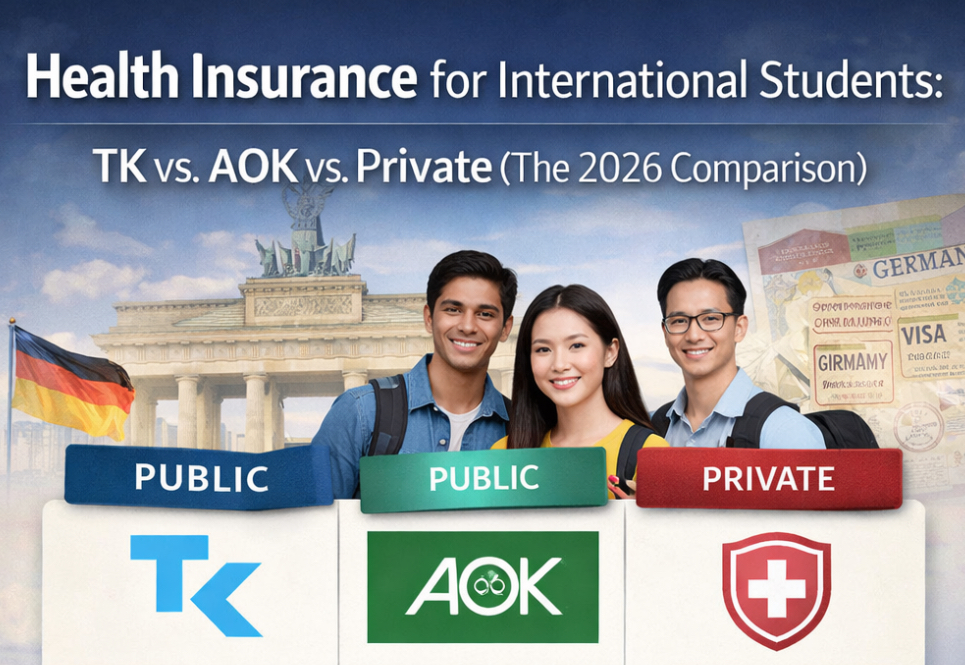
If you are preparing for your German student visa or university enrollment in 2026, you’ve likely realized one thing very quickly: Germany does not negotiate when it comes to health insurance. It is a strict prerequisite for your residence permit, and without proof of coverage, your matriculation at the university will be halted before it even starts.
For most international students, the decision boils down to a three-way tug-of-war between the heavyweights of public insurance—Techniker Krankenkasse (TK) and AOK—and the highly flexible world of Private Health Insurance (PKV). While the public system is the “default” for many, 2026 has brought updated contribution rates and new digital service standards that make the choice a bit more nuanced than it used to be.
A Transparent Note on 2026 Coverage:
In Germany, all public insurers provide roughly 95% of the same core benefits by law. Whether you choose TK or AOK, your surgery, GP visits, and hospital stays are covered. The real “battle” is fought in the remaining 5%: the English-language support, the quality of the mobile app, professional dental cleanings, and travel vaccinations. Private insurance, on the other hand, is a different beast entirely, offering lower costs for some but higher administrative hurdles for others.
This guide provides a direct, head-to-head comparison of costs, eligibility, and service quality to help you decide which provider earns a spot in your 2026 budget.
The Eligibility Rules for 2026
In Germany, your eligibility for health insurance isn’t just about your student status; it’s a calculation based on your age, your course type, and how many semesters you’ve already studied. For 2026, the German government has maintained the strict division between the Statutory (Public) and Private systems.
The Under 30 Rule (Public Insurance Territory)
If you are under the age of 30 and enrolled in a degree-seeking program (Bachelor’s or Master’s) at a state-recognized university, you are compulsorily insured in the public system. This means providers like Techniker Krankenkasse (TK) or your regional AOK must accept you at the discounted student rate.
Who is Eligible for the Public Student Tariff?
- Degree-seeking students at public or state-approved universities.
- Students under the age of 30.
- Students who have not yet exceeded their 14th subject semester.
The Over 30 “Cliff” (Private Insurance Territory)
Once you hit your 30th birthday, the “student discount” in the public system vanishes. Your monthly premium at TK or AOK will jump from roughly €130 to over €250+ per month because you move into the “voluntary” insurance category.
According to 2026 trends cited by Studying-in-Germany.org, this is the point where many international students switch to Private Health Insurance (PKV). Private providers like ottonova or DR-WALTER often offer specialized student tariffs for those over 30 that can be significantly more affordable than the public voluntary rate.
Language & Preparatory Students
If you are in Germany for a language course or a Studienkolleg (preparatory college), you are usually not eligible for public insurance yet. In these cases, you must take out a private “Incoming” or “Travel” insurance policy—like those from Mawista or Care Concept—until you officially begin your degree studies.
Visa Strategy Tip:
Applying for the wrong insurance can lead to a visa rejection. If you are under 30 and starting a degree, use a public provider certificate. If you are in a language school, ensure your private policy is “Embassy-approved” and covers the full €30,000 minimum required for Schengen/National visas.
The Monthly Bill: 2026 Price Breakdown
For the 2026 academic year, the cost of public health insurance is calculated based on the BAföG reference rate. As of early 2026, the average monthly premium for a student under 30 in the public system (GKV) ranges between €140 and €160. Private insurance, conversely, can range from as little as €30 (for basic travel-style plans) to over €150 (for comprehensive student tariffs).
| Provider Option | Monthly Cost (Under 30) | Monthly Cost (Over 30) | Key Pricing Factor |
|---|---|---|---|
| TK (Techniker) | ~€141 – €146 | €250+ (Voluntary) | Low additional contribution (2.69%) |
| AOK (Regional) | ~€139 – €160 | €255+ (Voluntary) | Varies by city/branch (e.g., AOK PLUS vs. Nordost) |
| Private (ottonova/Study Secure) | ~€125 | ~€144 | Individual health check & age at entry |
| Private (Mawista/Dr-Walter) | €30 – €80 | €50 – €110 | Limited “Travel-style” coverage; high deductibles |
According to the 2026 Statutory Health Insurance calculator, students aged 23 and older without children pay a higher rate for long-term care insurance (Pflegeversicherung). This is a mandatory component of both TK and AOK plans that accounts for about €35 of your total monthly bill.
Hidden Costs: The “Co-payment” Factor
Don’t be fooled by the monthly premium alone. In the public system (TK/AOK), you have direct billing. You show your card, and the doctor bills the insurance directly. You only pay small co-pays (€5–€10) for prescriptions.
In many cheaper private plans, you must pay the doctor upfront and wait weeks for reimbursement. Furthermore, basic private plans (like Mawista Student) may have an “excess” or deductible of up to €250 per year, meaning you pay the first €250 of your medical bills out of pocket.
Beyond the Basics: Service, Apps, and English Support
In 2026, both TK and AOK provide the “GKV-Spitzenverband” standard of care: hospital stays, GP visits, and basic dental. However, for an international student who may not yet be fluent in German, the “wrapper” around those services—the apps and the call centers—is what actually matters.
Techniker Krankenkasse (TK): The Digital Leader
TK has long been the favorite for international students, and for good reason. According to the March 2026 Focus Money report, TK was again rated as Germany’s “Best Health Insurance Fund” for students.
- English-First Support: TK offers 24/7 English-speaking phone consultants and a fully translated application process.
- The TK-App: You can download your insurance certificate (required for your visa and university) in seconds. As of 2026, the app also includes TK-Doc, allowing you to have video consultations with doctors in English to avoid waiting rooms.
- Bonus Programs: The TK-Fit program literally pays you to stay active. By syncing your fitness tracker, you can earn up to €160 in cash bonuses annually for hitting step targets and attending dental check-ups.
AOK: The Regional Powerhouse
AOK is not a single company but a group of 11 regional branches (like AOK PLUS or AOK Nordost). This regional structure is their greatest strength—and their greatest weakness.
- Physical Presence: AOK has over 1,200 physical branches. Many are located directly on or near university campuses, which is perfect if you prefer speaking to a human being rather than using an app.
- Specialized Student Service: Branches like AOK Student Service provide tailored advice for those working part-time jobs alongside their studies.
- Local Bonuses: Depending on your region, AOK might offer better subsidies for specific things like professional teeth cleaning (up to €50 in some regions) or skin cancer screenings starting at age 18.
Private Insurance: The “Elite” Perks
If you opt for a high-tier private plan (like ottonova), the benefits shift from “standard” to “premium.”
The Private “Specialist” Hack:
In Germany, public patients often wait 4–8 weeks for a non-urgent specialist appointment (e.g., a dermatologist or neurologist). Private patients are typically seen within 3–7 days. If you have chronic issues that require frequent specialist visits, the speed of private insurance might outweigh the simplicity of public insurance.
The “Catch” for 2026:
While private insurance sounds superior, it often excludes pre-existing conditions. If you have a documented history of mental health treatment or a chronic illness, a private insurer may either reject you or charge a “risk surcharge,” making it much more expensive than TK or AOK.
The Final Verdict: Which One Should You Choose?
By now, it’s clear that there is no universal “best” provider—only the best provider for your specific situation. According to updated 2026 data from All About Berlin, public insurance remains the “safest” long-term bet, but private options are increasingly attractive for those over 30.
| Provider | Best For… | The “Dealbreaker” (Cons) |
|---|---|---|
| TK (Techniker) | English speakers, tech-savvy students, and those who want a “set and forget” digital experience. | Limited physical offices; strictly focused on digital-first service. |
| AOK (Regional) | Students who prefer in-person support, campus proximity, and region-specific wellness bonuses. | Regional benefits don’t always travel with you if you move cities; English service varies. |
| Private (PKV) | Students over 30, language students, or those healthy individuals seeking fast specialist access. | Excludes most pre-existing conditions; difficult to switch back to public system later. |
Making the Choice: A Quick Checklist
To make this final, ask yourself these three questions before hitting the “Apply” button:
- Are you under 30? If yes, Public (TK or AOK) is almost always the smarter choice due to the low student tariff and lack of medical exams.
- Is English a priority? If your German is shaky, TK wins. Their app and phone lines are natively built for English speakers.
- Are you a language or PhD student? If you aren’t in a “degree” program, you might have to go Private. In that case, look for embassy-approved providers like ottonova or Feather.
The “Exemption” Trap:
If you are under 30 and choose Private insurance, you must apply for an exemption from public insurance. Warning: This exemption is permanent for the duration of your studies. You cannot “try” private for a year and then switch back to TK if you get sick. Think carefully before opting out of the public safety net.
Step-by-Step: Getting Your Insurance Certificate
Once you have chosen between TK, AOK, or Private, the clock starts ticking. You need a specific digital document—the Versicherungsbescheinigung—to upload for your visa and university enrollment. In 2026, this process is 100% digital.
The 2026 Quick-Action Checklist:
- Apply Online: Use the provider’s English portal (e.g., TK Student Portal). You only need your passport and university admission letter.
- The “M10” Notification: For 2026 enrollments, your insurer must send a digital “M10” notification directly to your university’s registration office. Ensure you provide your university’s Sender ID during the application.
- Travel Insurance (The Bridge): If your public insurance starts on the first day of the semester (e.g., October 1st) but you arrive in Germany on September 15th, you need a 15-day “Incoming” insurance. Many providers like Expatrio or Fintiba bundle this for free when you sign up for TK.
- Physical Card: Your plastic health card (EHIC) will be mailed to your German address within 7–14 days of your arrival. You must upload a photo for this via the provider’s app.
Summary of the 2026 Landscape
To wrap up: TK is the undisputed champion for English-speaking ease and digital efficiency. AOK remains a powerful choice if you value local, in-person campus support. Private Insurance is your strategic fallback if you are over 30 or strictly on a budget for a short-term language course.
Final Conclusion
Choosing your health insurance is the first “adult” decision you’ll make in Germany. While it feels like a tax, it is actually your ticket to one of the best healthcare systems in the world. In 2026, the focus has shifted toward digital accessibility—so choose the provider whose app and support language make you feel the most confident. Secure your coverage early, get your visa, and we’ll see you in Germany!
Sources & Disclaimer: This comparison is based on 2026 data from Techniker Krankenkasse (TK), AOK Bundesverband, and independent insurance brokers like Feather and ottonova. Monthly premiums and “Zusatzbeitrag” rates can fluctuate slightly by region. This article is for informational purposes and does not constitute professional insurance advice. Always verify final rates on the official provider websites before signing a contract.
Frequently Asked Questions: Student Health Insurance 2026