
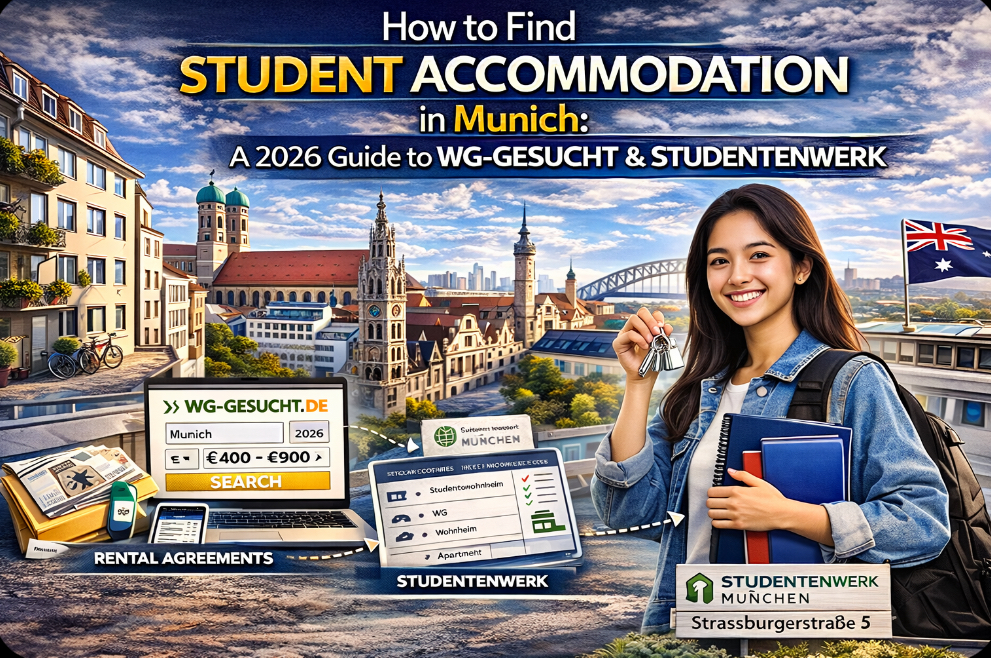
Munich does not ease students into its housing market. It tests them early. By 2026, the city has become one of the most competitive places in Europe to secure a student room, with demand consistently outpacing supply across both public and private options. Yet every semester, thousands of international and local students still manage to find a place — not by luck, but by understanding how the system actually works.
At the center of that system are two channels that matter more than anything else. The first is the official route through the Studierendenwerk München Oberbayern, which offers subsidized student halls with relatively lower rents but long waiting times. The second is the private market, dominated by WG-Gesucht, where shared flats (WGs) move quickly, competition is intense, and success depends heavily on how you present yourself.
These two paths define the Munich student housing experience. One offers affordability and structure but requires patience. The other offers speed and flexibility but demands effort, persistence, and a strong first impression. Most students who succeed in Munich do not rely on just one — they combine both strategically.
The numbers alone explain why preparation matters. A typical room in a shared flat now ranges between €400 and €900 per month depending on location, condition, and demand. Official student residences remain more affordable, often averaging around €300 to €450, but availability is limited and waiting periods can stretch across multiple semesters. This imbalance is not temporary; it reflects Munich’s broader economic reality as a high-demand academic and tech hub.
There is also a shift happening beneath the surface that many guides ignore. In earlier years, finding accommodation was mostly about availability. In 2026, it is increasingly about selection. Flatmates are not just offering rooms — they are choosing people. Messages are filtered, profiles are compared, and informal interviews (“WG castings”) determine outcomes. The process now resembles a social and professional evaluation as much as a housing search.
That is why a simple list of websites is no longer enough. What matters is understanding timing, positioning, communication, and risk — especially in a market where scams have grown alongside demand. A strong application message can multiply your chances. A poorly handled payment can cost you months of rent.
This guide focuses entirely on what works in Munich today. It breaks down the real options available in 2026, the actual cost ranges students are paying, and the exact steps required to secure a place through both Studentenwerk and WG-Gesucht. It also includes a practical messaging framework you can adapt immediately, along with a clear system for identifying and avoiding housing scams.
Everything here is built around one goal: helping you move from uncertainty to a confirmed address. No assumptions, no generic advice — just the structure that students who succeed in Munich tend to follow.
A student I spoke with last winter arrived in Munich with everything prepared — admission secured, finances arranged, and a clear plan. What he did not have was an address. For the first two weeks, he stayed in a small temporary room while sending messages daily on WG-Gesucht. Most went unanswered. A few led to short calls. One led to a viewing where five other candidates were present at the same time.
What changed his situation was not luck, but adjustment. He rewrote his messages, made them more personal, referenced each listing carefully, and expanded his search area beyond the city center. Within a week, responses started coming in. By the end of the month, he had secured a room in a shared flat slightly outside central Munich — not his first choice, but a stable starting point.
That pattern is common. The process often begins with uncertainty, then shifts once the approach becomes structured and intentional.
Understanding Your Options and Real 2026 Costs in Munich
Before applying anywhere, it helps to understand what “student accommodation” actually means in Munich. The term covers three distinct categories, each with very different realities in terms of cost, availability, and experience. Most students will interact with at least two of these during their stay.
1. Studentenwerk Student Halls (Official Housing)
The most structured and affordable option comes from the official system managed by the Studierendenwerk München Oberbayern. These are purpose-built student residences with thousands of rooms across Munich and nearby areas such as Freising and Rosenheim. Rooms are often furnished, and many include shared kitchens and bathrooms, though some studio-style units exist.
The key advantage is cost stability. Based on published data from the official rent and waiting list overview, most rooms fall roughly within €280 to €450 per month, with an average around €400.60. Utilities are usually included, making it easier to plan your budget.
The limitation is availability. Demand is consistently high, and waiting times can extend from 1 to 7 semesters depending on the residence. This means it is rarely an immediate solution unless you apply early and remain in the system long enough.
2. WG Rooms (Shared Flats via WG-Gesucht)
The most common route for students in Munich is the shared flat, known locally as a “WG” (Wohngemeinschaft). In this setup, you rent a private bedroom while sharing a kitchen, bathroom, and living space with others. Listings are heavily concentrated on platforms like WG-Gesucht, which functions as the central marketplace for this type of housing.
In 2026, WG prices have settled into a wide but predictable range. Most rooms fall between €400 and €900 per month (warm rent, meaning utilities included). Location plays a major role:
- Central districts like Maxvorstadt and Schwabing: typically €550–€850
- Outer areas or less competitive zones: €400–€600
- High-end or newly renovated WGs: €800–€900+
Unlike Studentenwerk housing, availability here is higher — but so is competition. Many listings receive dozens of applications within hours, and tenants often select new roommates based on personality, lifestyle fit, and communication style.
3. Private Studios and Apartments
This option exists but is rarely the primary choice for students due to cost. A single-room apartment in Munich typically ranges from €700 to €1,500+ per month depending on location and size. In most cases, students only consider this route if they have a higher budget or cannot secure shared accommodation in time.
Deposits are also higher, and landlords often require strong financial proof, which can be difficult for international students without a German income history.
What “Warm Rent” Actually Includes
Many listings in Munich are quoted as “warm” (Warmmiete), meaning utilities such as heating, water, and sometimes internet are already included. However, always verify what is covered. In some WG listings, electricity or broadcasting fees (Rundfunkbeitrag) may still be separate.
You should also plan for:
- Deposit (Kaution): usually 2–3 months’ rent
- Broadcasting fee: ~€18/month per household
- Basic setup costs: bedding, kitchen items, small furniture if needed
Side-by-Side Comparison
| Option | Typical Cost | Availability | Main Advantage | Main Limitation |
|---|---|---|---|---|
| Studentenwerk | €280–€450 | Low (waitlist) | Affordable, stable | Long waiting time |
| WG (Shared Flat) | €400–€900 | Moderate | Faster access, social | Highly competitive |
| Private Apartment | €700–€1500+ | Low | Privacy, independence | Very expensive |
What becomes clear is that there is no perfect option — only trade-offs. Students who navigate Munich successfully tend to start with Studentenwerk applications early while actively searching for WGs as a practical short-term or long-term solution. Treating these paths as complementary rather than separate significantly improves your chances.
Note: Prices reflect early 2026 averages based on official data and market observations. Always verify current listings, as rents in Munich can shift depending on demand and seasonal intake periods.
Studentenwerk München Oberbayern: The Official Route Most Students Start With
If you are looking for stability in Munich’s housing market, the official system run by the Studierendenwerk München Oberbayern is the first place to anchor your search. It does not move quickly, and it does not guarantee results — but it remains the most reliable long-term option for affordable student accommodation in the city.
The organization manages more than 9,000 rooms across Munich and surrounding areas. These include single rooms with shared facilities, apartment-style units, and a limited number of self-contained studios. Most are furnished, and the structure is designed specifically for student life — predictable rent, clear contracts, and minimal hidden costs.
Who Can Apply and What They Expect
Eligibility is straightforward on paper: you must be enrolled at a recognized university in Munich or be able to provide proof that your admission is in progress. In practice, demand means that timing matters more than eligibility alone.
First-year students are often given priority in certain application windows, but this does not eliminate waiting periods. The system is designed as a queue, not a fast-track allocation. Your position improves over time, especially if your application remains active and updated.
Step-by-Step Application Process (2026)
The application itself is simple, but small mistakes or delays can quietly push you back in the queue. The process below reflects how it is handled in 2026:
- Review available residences: Start by exploring the official list of halls and pricing details to understand options and expected waiting times. Each residence has different demand levels and timelines.
- Submit your online application: Apply through the official portal at
the application page
. You will provide personal details, preferred locations, and study information. - Upload proof of enrollment: This is critical. If you apply before receiving admission, you must later upload your matriculation certificate by the required deadlines (typically around November 1 for winter semester or May 1 for summer semester) to remain active in the system.
- Wait and monitor your status: There is no shortcut here. Waiting periods can range from one semester to several, depending on your preferences and timing.
- Accept an offer when received: If you are selected, you will receive an offer via email. You must respond quickly, sign the contract, and pay the deposit to secure the room.
Understanding Waiting Times in Reality
Official data shows that waiting periods can extend from 1 to 7 semesters depending on the residence and demand. Some centrally located halls fill faster, while those further from the city center may move slightly quicker.
This is why many students treat Studentenwerk not as an immediate solution, but as a long-term plan. You apply early, keep your application active, and continue searching elsewhere while waiting for a potential offer.
Required Documents Checklist
Preparing your documents in advance reduces delays when an offer arrives. Most applications and contracts will require:
- Valid passport or national ID
- University admission or matriculation certificate
- Proof of enrollment updates each semester
- Bank details for payments
- Occasionally proof of financial stability (depending on case)
What Many Students Overlook
One of the most common mistakes is treating the application as a one-time task. In reality, you need to maintain it. If you fail to upload updated enrollment documents on time, your application can become inactive without obvious warning.
Another overlooked point is flexibility. Limiting your preferences to only a few central residences can extend your waiting time significantly. Expanding your options — even slightly outside the most popular districts — increases your chances.
How Studentenwerk Fits Into a Broader Strategy
The most effective approach in 2026 is not choosing between Studentenwerk and private housing, but combining them. You apply to the official system immediately, then actively search for a WG while waiting. If a Studentenwerk offer eventually arrives, it becomes a stable upgrade or fallback option.
This layered approach reduces pressure. Instead of relying on a single outcome, you build multiple paths toward securing accommodation — which is exactly how most successful students navigate Munich’s housing market.
WG-Gesucht: Where Most Students Actually Secure a Room
If Studentenwerk represents patience, WG-Gesucht represents action. It is the most active housing marketplace for students in Munich, and for many, it becomes the primary route to securing a room before arrival. The platform itself is simple to use. What is not simple is standing out among dozens of applicants competing for the same space.
You can explore current listings directly here:
WG-Gesucht Munich listings
. At any given time, thousands of rooms are posted — but the best ones often receive responses within minutes.
Why WG-Gesucht Works — and Why It Feels Competitive
Unlike traditional rentals, WG rooms are not allocated purely based on financial ability. Existing flatmates are usually the decision-makers, and they are looking for someone they can live with comfortably. This introduces a different kind of competition — one based on personality, communication, and perceived fit.
In practice, this means your message matters as much as your budget. A generic “Is the room still available?” is rarely answered. A thoughtful, personalized introduction often is.
Step-by-Step: How to Use WG-Gesucht Effectively
- Create a complete profile: Add a clear photo and a short description of who you are — your studies, lifestyle, and habits. Profiles without photos are often ignored.
- Set your filters carefully: Choose Munich, define your budget (typically €400–€900), and adjust move-in dates. You can also filter by WG type (quiet, mixed, international).
- Check listings multiple times daily: The timing matters. New listings gain traction quickly, and early applicants are more likely to be considered.
- Activate email alerts: This reduces delay and helps you respond within minutes when suitable listings appear.
- Apply consistently: Most successful students send 10–20+ messages during the early phase of their search.
- Prepare for WG-Castings: If shortlisted, you will be invited for a viewing or informal interview — sometimes online, sometimes in person.
The Message That Gets Replies (Template You Can Use)
This is where many applications succeed or fail. Below is a structured template that reflects what works in Munich today. It is not about sounding perfect — it is about sounding genuine, specific, and easy to trust.
Subject: Application for WG Room in [Location]
Hi [Name(s)],
My name is [Your Name], I’m [age], and I will be studying [program] at [LMU/TUM/etc.] starting [semester/date]. I’m currently looking for a room from [move-in date].
I came across your listing and really liked [mention something specific from the ad — e.g., the calm atmosphere, shared dinners, or location].
A bit about me: I’m [brief personality — e.g., organized, social but respectful of quiet time]. I enjoy [2–3 genuine interests — e.g., cooking, sports, reading]. I’m a non-smoker/smoker (if applicable), and I’m comfortable with shared responsibilities around the apartment.
I have experience living in shared spaces (or I’m looking forward to it), and I value a clean and respectful environment.
I would be happy to join a viewing or chat with you at your convenience. I’ve also attached a short profile with more details.
Thank you, and I look forward to hearing from you.
Best regards,
[Your Name]
This structure works because it answers the questions flatmates care about immediately: who you are, whether you read their listing, and whether you are easy to live with. Small details — like referencing something specific from the ad — significantly increase response rates.
What to Attach (Optional but Powerful)
- Short profile PDF (photo, studies, basic details)
- Proof of enrollment or admission
- Identification document (only when appropriate)
- Optional: reference from previous landlord or roommate
Attaching a simple, well-organized profile can quietly separate you from other applicants without making the process feel formal or forced.
Understanding WG-Castings (The Final Step)
A WG-casting is essentially a selection conversation. It can be a group meeting with current flatmates, a one-on-one chat, or even a casual video call. The tone is usually informal, but the decision is deliberate.
You are not expected to perform. What matters is clarity and compatibility. Flatmates are trying to answer simple questions:
- Will this person respect shared spaces?
- Is communication going to be easy?
- Does this person fit our lifestyle?
It helps to prepare a few questions of your own — about cleaning schedules, shared expenses, or house routines. This shows that you are thinking beyond just securing the room.
What Actually Improves Your Chances
Across hundreds of applications, a pattern emerges. Students who succeed tend to:
- Apply early and consistently
- Personalize every message
- Keep communication clear and concise
- Remain flexible with location and expectations
There is no guaranteed formula, but there is a clear difference between passive searching and active positioning. In Munich, that difference often determines how quickly you move from applications to an actual offer.
How to Avoid Scams When Searching for Housing in Munich
As demand for student housing in Munich continues to rise, so does the number of fraudulent listings targeting new arrivals. This is not a rare issue — it is a recurring pattern, especially during peak intake periods when students are under pressure to secure accommodation quickly.
The structure of the market creates an opening for scams. High demand, limited supply, and urgency make it easier for fraudulent offers to appear convincing. Platforms like WG-Gesucht actively monitor listings, but no system is completely immune. Knowing what to look for is your strongest protection.
Common Red Flags You Should Never Ignore
- The landlord is “abroad” and unavailable: A frequent tactic involves someone claiming they are outside Germany and cannot show the apartment in person.
- Unrealistically low rent: Listings offering large, well-located rooms below €400 in central Munich should be treated with caution.
- Pressure to pay quickly: Requests to transfer a deposit or rent before viewing the property or signing a contract are a major warning sign.
- Unusual payment methods: Payments requested through Western Union, cryptocurrency, or PayPal “friends and family” are difficult to trace and recover.
- Vague or incomplete contracts: Missing details, unclear terms, or reluctance to provide a formal agreement should raise concern.
- Copied images and generic descriptions: Some fraudulent listings reuse photos from unrelated properties, often paired with minimal or inconsistent details.
Safe Practices That Reduce Your Risk
Avoiding scams is not about eliminating risk entirely — it is about reducing exposure through consistent checks and habits.
- Never pay before verification: Do not transfer money until you have seen the room in person or through a reliable live video viewing and reviewed a proper contract.
- Use platform messaging first: Keep initial communication within WG-Gesucht or official channels before moving to email or phone.
- Request a video call if abroad: If you cannot attend in person, ask for a live walkthrough with current tenants or the landlord.
- Check identities and documents: Ask for proof of ownership or legitimate rental rights when necessary.
- Review the contract carefully: Ensure rent, deposit, and terms are clearly defined before signing.
- Report suspicious listings: Platforms provide reporting tools — using them helps protect other students.
A Pattern Many Students Encounter
A typical scenario follows a predictable structure. A student finds a well-priced room, receives a quick and friendly response, and is told that due to high demand, a deposit is required immediately to “secure” the space. The landlord may provide scanned documents or even a contract to build trust. Once payment is made, communication stops.
The consistency of this pattern is what makes it identifiable. Genuine landlords do not require immediate payment without verification, and they do not avoid direct interaction.
If You Suspect or Experience a Scam
- Stop communication immediately if something feels inconsistent
- Do not send additional money or personal documents
- Report the listing on the platform where you found it
- Contact your bank quickly if a payment has already been made
- Inform your university’s student services for guidance
While recovery of funds is not always possible, acting quickly improves your chances and prevents further loss.
A Practical Rule That Protects Most Students
There is one guideline that consistently reduces risk: do not send money for a room you have not verified. Whether through an in-person visit or a credible live interaction, verification should always come before payment.
In a competitive market like Munich, urgency is common — but urgency should not override caution. A legitimate opportunity will withstand basic verification. A fraudulent one will not.
Your 2026 Timeline, Documents, and a Practical Strategy That Works
Finding accommodation in Munich is less about a single action and more about timing. Students who succeed rarely do one thing right — they align multiple steps early and consistently. The difference between arriving with a confirmed address and arriving without one often comes down to when you start and how structured your approach is.
A Realistic 6–12 Month Timeline
The most effective approach is to treat your housing search as a phased process rather than a last-minute task. The timeline below reflects what works in Munich’s 2026 market:
| Phase | Timeline | What to Do | Expected Outcome |
|---|---|---|---|
| Preparation | 6–12 months before arrival | Research options, apply to Studentenwerk, prepare documents | Position in waiting list secured |
| Active Search | 3–6 months before arrival | Start WG-Gesucht applications, send daily messages | Shortlists and WG-casting invitations |
| Finalization | 1–2 months before arrival | Secure a room or prepare temporary accommodation | Confirmed or interim housing |
| Adjustment | After arrival | Attend in-person viewings, upgrade housing if needed | More stable long-term option |
Essential Documents You Should Prepare Early
Having your documents ready before you begin applying reduces delays and makes your applications more credible. In Munich’s competitive market, speed combined with preparation gives you a clear advantage.
- Passport or national ID
- University admission or enrollment certificate
- Proof of financial support (blocked account or sponsor if required)
- Schufa credit report (if available — often requested for private rentals)
- Guarantor details (especially for higher-cost WGs or private landlords)
- Short personal profile (PDF) for WG applications
The Munich Student Housing Success Framework
What separates successful searches from unsuccessful ones is not luck — it is structure. The framework below reflects a pattern that consistently works for students navigating Munich:
- Start early: Apply to Studentenwerk as soon as possible, even before arrival.
- Search actively, not passively: Treat WG-Gesucht as a daily task, not an occasional check.
- Communicate with intention: Use personalized messages that reflect the listing and your personality.
- Stay flexible: Expanding your location or budget slightly increases your chances significantly.
- Plan for temporary housing: Many students arrive with short-term accommodation and secure long-term housing locally.
Where Location and Budget Intersect
Munich’s geography plays a direct role in pricing and availability. Central districts such as Maxvorstadt, Schwabing, and Ludwigsvorstadt are highly desirable due to proximity to universities, but they come with higher rents and stronger competition.
Looking slightly outside the center — areas connected by efficient public transport — often improves both affordability and response rates. Munich’s transit system makes this a practical compromise rather than a disadvantage.
A Practical Reality Many Students Face
Even with preparation, some students arrive without permanent housing. This is not a failure — it is part of the reality of a competitive market. Temporary accommodation for the first few weeks allows you to attend in-person viewings, which significantly increases your chances of securing a room.
What matters is not avoiding this situation entirely, but being prepared for it. Having a structured plan reduces stress and keeps the search focused rather than reactive.
By aligning your timeline, documents, and strategy early, you move from uncertainty into a controlled process — and that shift is often what leads to a confirmed place in Munich.
Challenges, Realistic Expectations, and What Actually Works in Munich
There is no way to approach Munich’s housing market in 2026 without acknowledging the pressure built into it. Demand consistently exceeds supply, and even well-prepared students often face rejection before securing a place. This is not a reflection of your profile or effort — it is the structure of the market itself.
Studentenwerk accommodation remains limited, with waiting periods that can extend across semesters. WG-Gesucht offers more immediate opportunities, but success depends on persistence, timing, and how effectively you present yourself to potential flatmates. Many students send multiple applications before receiving a response, and even strong candidates may not be selected on the first attempt.
Another reality is that prices are not static. The €400–€900 range for WG rooms reflects early 2026 averages, but listings fluctuate depending on demand, location, and the time of year. What appears available today may shift quickly during peak intake periods. This is why flexibility — in both budget and location — plays a significant role in success.
It is also common for students to begin their stay in temporary accommodation before transitioning into a long-term solution. Short-term arrangements are not a setback; they are often part of a broader strategy that allows you to attend viewings in person and secure a more suitable space once you are in the city.
What Makes the Difference Over Time
Across different experiences, a consistent pattern emerges. Students who eventually secure stable housing tend to approach the process with a combination of structure and persistence. They apply early to Studentenwerk, engage actively with WG-Gesucht, refine their communication based on responses, and remain open to adjusting their expectations.
The process is rarely linear. It involves multiple attempts, small adjustments, and moments of uncertainty. What changes the outcome is not a single action, but the ability to stay consistent while adapting to the realities of the market.
A Clear Starting Point
If you are beginning this process now, the next steps are straightforward:
- Submit your Studentenwerk application as early as possible
- Set up your WG-Gesucht profile and alerts
- Prepare your documents and personal profile
- Begin sending structured, personalized messages
- Stay consistent, even if responses are limited at first
These steps do not guarantee immediate results, but they position you correctly within a competitive system. In Munich, positioning matters as much as opportunity.
Final Perspective
Munich remains one of the most challenging cities in Germany for student accommodation, but it is also one of the most navigable once you understand how it works. The system is not random. It rewards preparation, clarity, and persistence.
Approach it with structure, verify every step carefully, and treat the process as part of your transition into student life. With the right strategy, the outcome becomes less uncertain — and eventually, a confirmed address replaces the search.
References and Further Reading
Studierendenwerk München Oberbayern – Accommodation Overview
Studierendenwerk Application Portal
Official Rent and Waiting Time Overview (PDF)
WG-Gesucht Munich Listings
WG-Gesucht Platform
Cost of Living in Munich – Expatrio
Note: All data reflects early 2026 observations and official sources. Housing availability, pricing, and application processes may change — always verify details directly on official platforms before making decisions.