
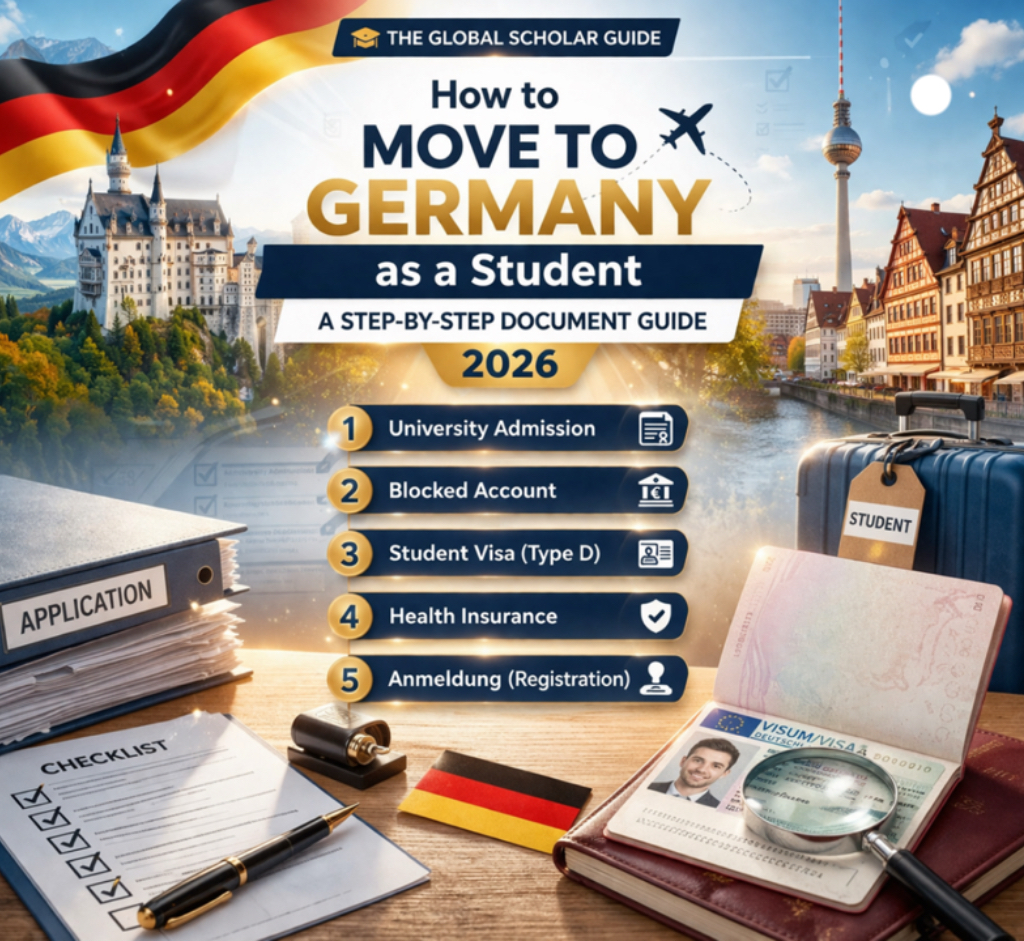
2026 Compliance Alert: The German Federal Foreign Office has confirmed that for the 2026 academic cycle, the required “Proof of Financial Resources” (Blocked Account) remains €11,904 per year. Additionally, new labor laws now allow non-EU students to work up to 140 full days per year, a significant increase from previous years.
This guide serves as your definitive 2026 roadmap. We have stripped away the “AI fluff” and generic advice to provide a technical, step-by-step document checklist based on current mandates from the Federal Government’s “Make it in Germany” portal and recent embassy updates. Whether you are aiming for a tuition-free public university in Berlin or a specialized Master’s in Munich, this is how you navigate the 2026 student visa process.
Disclaimer: While this guide is based on 2026 data, visa regulations are subject to change. Always verify specific local requirements with the German Embassy or VFS Global center in your specific home country before your appointment.
Phase 1: The University Admission Stage
Before you can even look at a visa application, you must possess a formal invitation to study. In 2026, many universities have shifted to fully digital application portals, but the underlying document requirements remain rigorous.
Key Documents Required:
- Zulassungsbescheid (Letter of Admission): This is your primary document. It must be either an unconditional offer or a conditional offer (requiring a preparatory language course).
- Proof of Language Proficiency:
- For English-taught programs: Usually IELTS (6.5+) or TOEFL iBT (90+).
- For German-taught programs: TestDaF (Level 4) or DSH-2.
- The APS Certificate (Mandatory for select countries): If you are applying from India, China, or Vietnam, you cannot proceed without an APS (Akademische Prüfstelle) certificate. This document verifies the authenticity of your academic records and is a mandatory prerequisite for both university enrollment and the visa interview.
Pro-Tip: Check if your university uses uni-assist. This central service processes applications for over 170 German universities. If they do, your documents must be “pre-checked” by them before the university ever sees your application.
Phase 2: Proving Financial Means (Sperrkonto)
To secure a 2026 student visa, you must demonstrate that you have the financial capacity to live in Germany for at least one year. The German government enforces this through the Sperrkonto (Blocked Account). Without a “Confirmation of Blocked Funds,” your visa application will be summarily rejected.
2026 Financial Thresholds
- Total Required Amount: €11,904 for 12 months.
- Monthly Withdrawal Limit: €992 per month.
- Additional Buffer: Most embassies recommend adding an extra €100–€200 to cover bank transfer fees and the account opening fee (usually around €49–€89).
Approved Providers: While several fintech companies operate in this space, the most reliable for 2026 remain Expatrio, Fintiba, and Coracle. These providers offer fully digital setups that generate your “Sperrbestätigung” (Blocking Confirmation) within 24–48 hours of receiving your funds.
Alternatives to the Blocked Account:
- Verpflichtungserklärung (Formal Obligation): A document signed by a person living in Germany (usually a relative or sponsor) at their local Aliens’ Authority, guaranteeing they will cover your costs.
- Scholarship Proof: Confirmation of a scholarship from a recognized provider (e.g., DAAD, Erasmus+, or a state-funded foundation). If the scholarship is less than €992/month, you must “top up” the difference in a blocked account.
Phase 3: Navigating the Health Insurance Dual-Layer
In Germany, health insurance is not optional; it is a legal requirement for university enrollment and visa approval. For 2026, the process involves two distinct stages:
1. Incoming/Travel Insurance (For the Visa)
For your initial entry, you need “Travel Health Insurance” that is Schengen-compliant. It must cover at least €30,000 in medical costs and repatriation. This is usually valid for the first 90 days of your stay.
2. Statutory Public Insurance (For the University)
Once you arrive and enroll, students under 30 should opt for Statutory Health Insurance (GKV) providers like TK (Techniker Krankenkasse), AOK, or Barmer.
Note: In 2026, the student rate for public health insurance is approximately €125–€135 per month, including long-term care insurance.
Critical Step: You will need an “Insurance Confirmation” (Versicherungsbescheinigung) from a public provider to complete your university registration. Many blocked account providers now offer “Value Packages” that bundle the blocked account with health insurance to streamline this step.
Phase 4: The Student Visa Application (National Visa Type D)
Once your admission and blocked account are secured, you must apply for a National Visa (Category D). This is a long-term visa (90+ days) specifically for academic purposes. Do not apply for a Schengen Visa (Category C), as it cannot be converted into a student residence permit once you are in Germany.
The 2026 Core Document Checklist
You will typically need to provide the original plus two sets of high-quality photocopies for each of the following:
- ✅ Valid Passport: Must be valid for at least 12 months beyond your intended stay and have at least 2 blank pages.
- ✅ VIDEX Application Form: Completed and signed. Use the official VIDEX portal to ensure the barcode is scannable.
- ✅ Biometric Photos: Two recent photos (not older than 6 months) following strict ICAO standards.
- ✅ University Admission Letter: The Zulassungsbescheid or a “Proof of Application” if you are applying for a Student Applicant Visa.
- ✅ Academic Transcripts & Certificates: Original degree certificates and transcripts (with an APS certificate for India/China/Vietnam).
- ✅ Proof of Funds: The “Sperrbestätigung” from your blocked account provider showing the full €11,904.
- ✅ Health Insurance: Proof of incoming travel insurance (Schengen-compliant).
- ✅ Declaration of Authenticity: A signed document stating all provided info is true.
- ✅ Motivation Letter: A precise statement (1–2 pages) explaining why you chose this specific course and how it fits your career goals in your home country.
The Visa Interview
Most 2026 applications require a physical appointment at a German Embassy or a VFS Global center. During the interview, stay consistent with your Motivation Letter. Consular officers are trained to look for “Academic Integrity”—they want to ensure you are moving to Germany to study, not solely for migration purposes.
Weakness Warning: Processing times in 2026 can range from 4 to 12 weeks. If your semester starts in October, you should aim to have your visa interview no later than early July. Missing your enrollment deadline due to visa delays is a common reason for admission deferrals.
Phase 5: Arrival and Address Registration (Anmeldung)
Your student visa (Type D) is typically valid for 90 to 180 days. Within your first 14 days of arriving in Germany, you must complete the Anmeldung. This is the process of registering your living address with the local citizens’ office (Bürgeramt or Einwohnermeldeamt).
Documents Required for Anmeldung:
- ✅ Valid Passport & Visa.
- ✅ Wohnungsgeberbestätigung: A specific form signed by your landlord confirming you have moved in. A rental contract alone is often not sufficient.
- ✅ Registration Form: Available at the local office or online via the city’s service portal (e.g., service.berlin.de).
Note: Without your Meldebescheinigung (Registration Certificate), you cannot open a full German bank account, get a tax ID, or apply for your long-term residence permit.
Phase 6: The Residence Permit (Aufenthaltstitel)
Before your entry visa expires, you must convert it into a Temporary Residence Permit for Study Purposes (Section 16b AufenthG) at the local Foreigners’ Authority (Ausländerbehörde). In 2026, many cities like Hamburg and Munich have shifted this to an “Online-Antrag,” where you upload documents before your physical appointment.
Document Checklist for the Permit:
- 📄 Proof of Enrollment: The Immatrikulationsbescheinigung from your university for the current semester.
- 📄 Proof of Financial Resources: An updated statement from your blocked account or scholarship provider.
- 📄 Health Insurance Confirmation: A letter from your Statutory (Public) insurance provider (e.g., TK, AOK).
- 📄 Biometric Photo: A new photo taken in Germany to ensure it meets the latest 2026 standards.
- 📄 Certificate of Registration: Your Meldebescheinigung from Phase 5.
- 📄 Application Fee: Usually €100–€110 (Check for student exemptions in certain federal states).
2026 Work Rights Update
As a student resident, your permit will now explicitly state your right to work. Under the 2026 regulations, you are allowed to work 140 full days (or 280 half days) per year. This is a significant increase from the 120-day rule of previous years, designed to help international students offset the rising cost of living in Germany.
Critical Weakness: Appointment wait times at the Ausländerbehörde can be several months. Always apply for your extension or initial permit at least 8–10 weeks before your entry visa expires to avoid falling into “illegal stay” status.
The 2026 Student Visa Timeline
Success in moving to Germany is determined by your “lead time.” Here is the recommended schedule for an October (Winter Semester) start:
| Timeline | Action Item |
|---|---|
| Jan – March | Finalize language tests (IELTS/TestDaF) and begin university applications. |
| April – May | Receive admission. Open your Blocked Account and transfer the €11,904. |
| June – July | Book and attend your Visa Interview at the embassy or VFS Global. |
| August – Sept | Receive visa. Secure temporary accommodation (crucial for Anmeldung). |
| Arrival (Week 1) | Register address (Anmeldung) and finalize health insurance. |
Common Pitfalls & 2026 “Weakness” Report
Based on 2025/2026 rejection trends, avoid these critical errors:
- Generic Motivation Letters: In 2026, embassies are cracking down on “AI-generated” letters. Your statement must be specific to that university and that city. If you use a template, customize at least 70% of the content.
- Insufficient Funds for “Top-Up”: If your university is in a high-cost city like Munich, some embassies may ask for more than the standard €11,904. Always check your specific consulate’s “Additional Requirements” PDF.
- Insurance Gaps: Ensure your travel insurance explicitly covers repatriation and has zero deductible. Policies that require you to pay upfront and claim later are often rejected.
- The APS Delay: For students from India, China, or Vietnam, failing to apply for APS 6 months in advance is the #1 cause of missed semesters. Do not wait for university admission to start your APS.
Official 2026 Resource Directory
Verify all current document templates and fees through these portals:
- Visa Application (VIDEX): Official National Visa Portal
- University Search (DAAD): International Programs Database
- Government Gateway: Make It In Germany (Official Advice)
- Blocked Account Providers: Expatrio | Fintiba | Coracle