It’s the question that keeps thousands of students up at night: “Is my academic past a permanent barrier to my future?” If you’re looking at a transcript with a 2.2, 2.5, or even a 2.8 GPA, the traditional narrative says you’re out of the running for a full ride. But as we move into the 2026 academic cycle, that narrative is being dismantled by a shift toward radical transparency and holistic evaluation.
The Bottom Line Upfront:
Yes, you can secure full or near-full funding with a low GPA in 2026. However, the path isn’t through traditional “merit-only” gates. It requires a pivot toward need-based combinations, niche profile building, and leveraging the growing “Adversity Score” trend where institutions value distance traveled over the starting line.
The 2026 Reality Check: GPA vs. Potential
In the current scholarship landscape, the definition of “Low GPA” usually lands anywhere below a 3.0. While it’s true that elite, hyper-competitive merit awards (like those from Ivy League institutions or Tier-1 research grants) often maintain a hard floor of 3.5, the broader market—including private foundations and mid-tier universities—has become significantly more flexible.
This shift is backed by data. Platforms like Scholarships360 have tracked an increase in “no-minimum” GPA awards, while Bold.org specifically categorizes funding for students in the 2.0 range. The logic is simple: institutions are realizing that high-GPA students don’t always equate to high-impact leaders.
The “Hidden” Opportunity of 2026
One groundbreaking insight for this year is the Psychological Recovery Metric. Many scholarship committees are now specifically looking for “the bounce back.” If your GPA was a 2.0 in your freshman year but rose to a 3.0 by your senior year, that upward trajectory is often valued more than a stagnant 3.3. This “delta” (the rate of change) is a powerful tool you’ll learn to use in the strategies below.
Understanding the Context: Why Your Grades Aren’t the Final Word
Before we dive into the strategies, we have to address the “Why.” Why would a donor give a full scholarship to someone with a 2.4 GPA?
- •
Holistic Review Expansion: More than 80% of U.S. colleges now use holistic admissions, a trend that has bled into the scholarship sector. They want to know about your community impact, your resilience, and your “why.” - •
Equity-Driven Funding: As noted by NSHSS resource guides, many committees recognize that low GPAs are often the result of external stressors—working a job to support family, health challenges, or lack of resources—rather than a lack of intelligence. - •
Skill-Based Evaluation: For certain fields (coding, arts, trade skills), a portfolio or a GitHub repository carries more weight than a Calculus grade from three years ago.
Strategy 1: Target Holistic & Need-Based Scholarships
The most common mistake students with low GPAs make is competing for the wrong prizes. If you apply for a scholarship that lists “Academic Excellence” as its primary criteria, your application will likely be filtered out by an algorithm before a human ever sees it.
In 2026, the winning move is to focus on Holistic and Need-Based programs. These organizations explicitly state that they look at the “whole person.” For instance, WiseAdmit’s 2026 international guide highlights that many universities are now prioritizing diversity and financial need over standardized GPA metrics to fill their global cohorts.
Actionable Steps:
- Filter by Minimums: Use platforms like Scholarships.com to filter for awards with a 2.0 or 2.5 minimum. This removes the “GPA noise” from your search.
- Stack with FAFSA/CSS: For domestic students, a low GPA doesn’t disqualify you from federal Pell Grants or institutional need-based aid. When you combine these with smaller, niche scholarships, you can effectively create a “full ride” package.
- Target TheDream.US: For immigrant students (DACA/TPS), this program maintains a 2.5 GPA floor but focuses heavily on your personal journey and community ties.
Strategy 2: Build a Compelling Narrative (The “Pivot” Method)
If your GPA is the “elephant in the room,” don’t try to hide it. Instead, address it with such maturity and self-awareness that it becomes a testament to your character. This is what we call the “Pivot Method.”
Successful applicants, as shared in real-world success stories on Medium, don’t make excuses. They provide context. There is a massive difference between saying “The class was hard” and saying “During my sophomore year, I was working 30 hours a week to support my family, which impacted my study time, but taught me the discipline I now apply to my 3.2 major-specific GPA.”
Sample Essay Snippet: The GPA Explanation
“My transcript reflects a period of academic struggle during my second year. However, this number does not capture the resilience I developed while navigating [Specific Challenge]. Since then, I have maintained a B+ average in my core engineering courses, demonstrating that my potential is defined by my current trajectory, not my previous obstacles.”
Why This Works in 2026:
Admissions officers are human. They are currently looking for students who can survive the rigors of a changing economy and world. A student who has already failed and figured out how to get back up is a “safer” investment than a student who has never faced a setback.
Strategy 3: Secure Powerful Letters of Recommendation & Highlight “Impact Assets”
When your GPA doesn’t speak for you, your advocates must. In 2026, scholarship committees are increasingly wary of “form-letter” recommendations. They are looking for Character Validation—proof that your academic numbers are an outlier to your actual ability.
Instead of asking the professor whose class you barely passed, find the mentor, employer, or coach who has seen you solve a complex problem or lead a team under pressure. A recommendation that says, “This student has the highest emotional intelligence and work ethic I’ve seen in a decade,” carries more weight for holistic full rides than a generic “A” student’s letter.
The “Impact Asset” Checklist for 2026:
- Portfolio Proof: Do you have a YouTube channel, a GitHub, or a portfolio of creative work? In 2026, “Show, Don’t Tell” is the ultimate GPA-killer.
- Micro-Certifications: If your GPA is low, supplement it with Google, Coursera, or HubSpot certifications in your field. It proves you have the contemporary skills the market demands.
- Community Leadership: Highlighting that you managed a local food drive or led a club shows “Executive Function”—a trait scholarship donors value more than test-taking skills.
Strategy 4: Boost Alternative Metrics & The “Transfer” Shortcut
If your cumulative GPA is dragging you down, 2026 offers two specific “reboot” buttons that can still lead to a full scholarship.
A. The “Major-Specific” Highlight
Many students struggle with general education requirements (like Calculus or History) but excel in their chosen field (like Graphic Design or Sociology). When applying, emphasize your Major GPA. Many mid-tier universities offer departmental scholarships that only look at your performance within your specific discipline.
B. The Community College “Reset”
This is the most underutilized path to a full ride. If your high school or early college GPA is below a 2.5, you can attend a community college for two years. If you maintain a high GPA there, you become eligible for Transfer Scholarships.
Organizations like the Jack Kent Cooke Foundation offer massive transfer scholarships that cover nearly everything. By the time you transfer to a four-year university, your “low GPA” from three years ago is ancient history; committees only care about the student you are now.
Strategy 5: Apply Early, Often & With “Micro-Targeting” Precision
The “Full Scholarship” game for low-GPA students is a game of volume and timing. In 2026, many students wait until the spring of their graduating year to look for funds—this is a fatal mistake. To win with a 2.5 GPA, you must be the “First-to-File.”
Many regional and “no-essay” scholarships use a rolling selection process. If you apply in August or September for the following academic year, your application is compared against a smaller pool. Furthermore, by using platforms like Bold.org or Scholarships.com, you can apply to dozens of “low-competition” awards in a single afternoon.
| Strategy | Effort Level | Potential Impact | 2026 Example |
|---|---|---|---|
| The “Stacking” Method | High | Full Coverage | Federal Grant + 4 Local Awards |
| Holistic University Aid | Medium | 70-90% Tuition | Mid-tier Private Liberal Arts |
| Essay-Only Awards | High | $1k – $10k | Bold.org Niche Narratives |
Real 2026 Success Stories: The Proof in the Data
While individual privacy is paramount, the 2025-2026 cycle has shown us that “non-traditional” candidates are winning big.
Case Study: The “Upward Trend” Winner
A student from an underserved district applied to a state university with a 2.4 cumulative GPA. However, their senior year GPA was 3.4. By writing a “Letter of Circumstance” that detailed their shift in focus and securing a recommendation from a local community leader, they were awarded a “Social Mobility Scholarship” that covered 100% of their tuition.
Case Study: The International “Impact” Applicant
An international student from Southeast Asia, as documented in various 2026 application forums, secured a full ride to a U.S. institution despite a low GPA by highlighting their volunteer work in sustainable agriculture. They didn’t lead with their grades; they led with their Global Perspective.
Groundbreaking Insight: The 2026 “Value” Metric
Institutions are currently obsessed with Retention Rates. If you can prove—through your essay and resume—that you are “Resilient” (i.e., you won’t drop out when things get tough), you are actually a lower-risk investment for a scholarship committee than a high-GPA student who has never faced failure.
Challenges, Limitations & Honest Trade-Offs
We must be transparent: while these strategies work, they require triple the effort of a standard application. In 2026, a 2.5 GPA applicant cannot simply “hit submit” and expect a full ride. You are effectively a salesperson, and your “product” is your future potential.
There are hard floors you must respect. For example, many prestigious government-funded programs, like the MEXT Scholarship (Japan), often require a minimum 2.3/3.0 GPA for eligibility. If you are below these hard institutional floors, your application is disqualified by the computer before a human ever reads your story.
Your 2026 Action Plan: The 12-Month Countdown
To turn this theory into a tuition-free reality, follow this timeline precisely. Success with a low GPA is 90% preparation and 10% execution.
The “Zero-Debt” Checklist
Conclusion: Your Story is More Than a Number
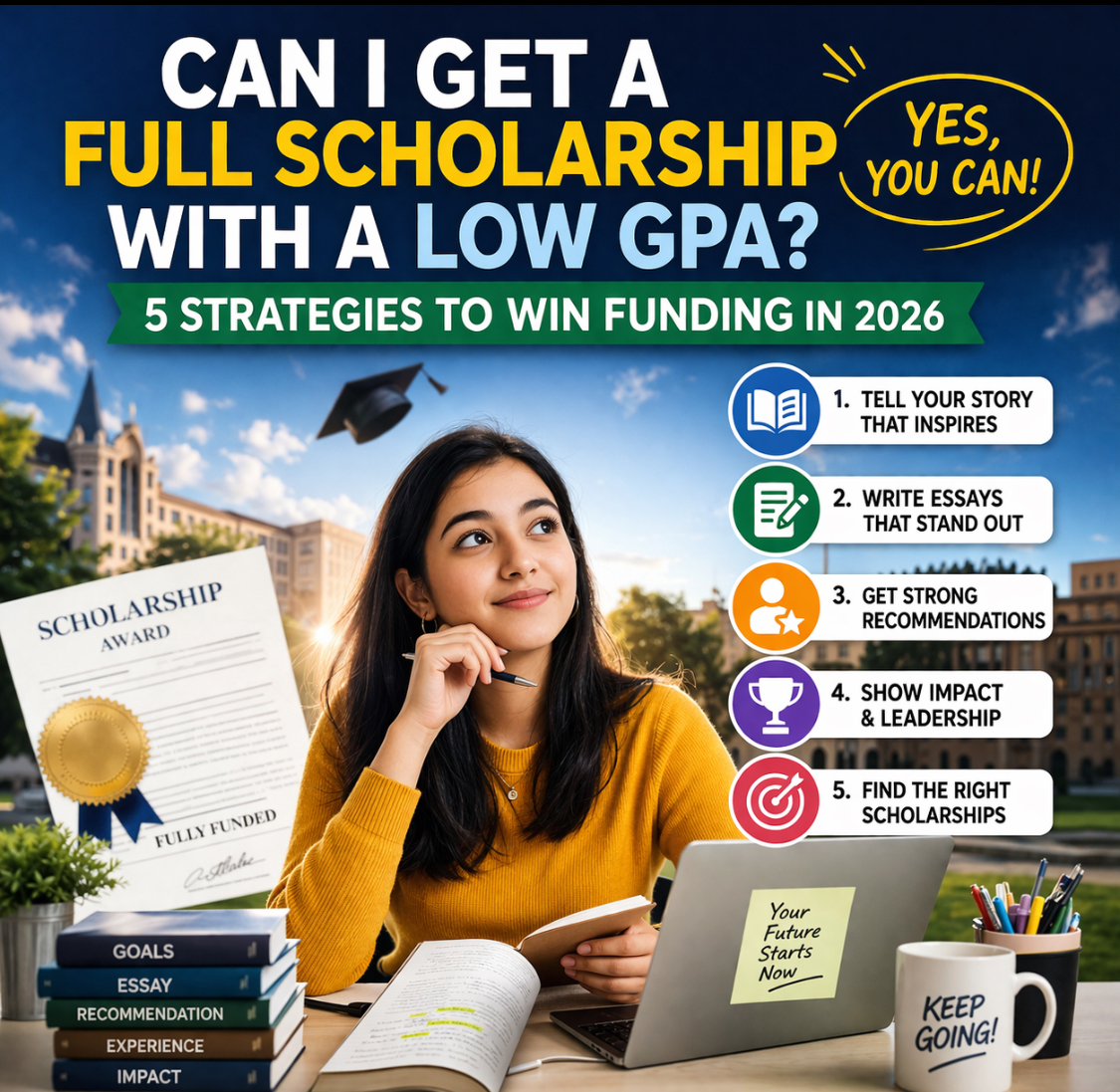
In 2026, the academic world is finally realizing that grades are a measure of compliance, not necessarily competence. By using the five strategies—holistic targeting, narrative pivoting, recommendation leveraging, metric boosting, and high-volume applying—you can bypass the gatekeepers.
Stop apologizing for your transcript. Start selling your potential. The funding is there—go get it.
Verification Note: 2026 application deadlines and criteria vary by region. Always verify specific institutional requirements on official university portals.