
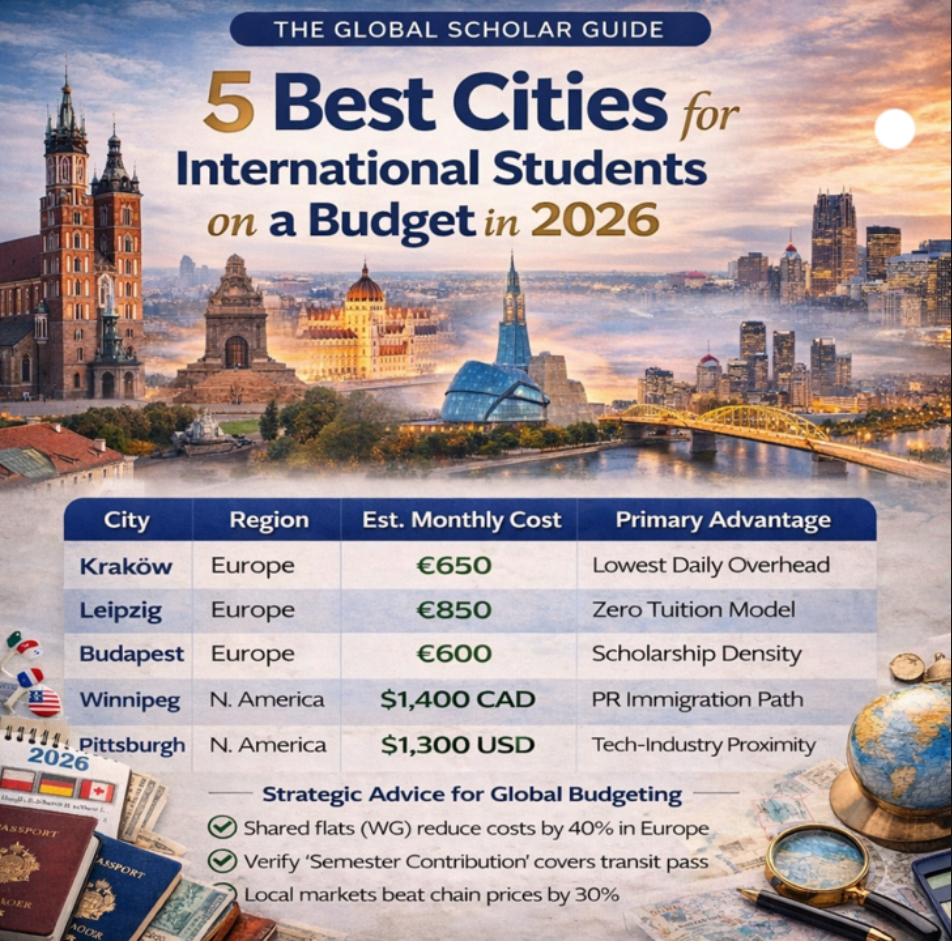
Data Accuracy Note: Financial estimates are based on the 2025/2026 academic cycle. While these cities represent the best value in their respective regions, international students should budget an additional 10% buffer for potential inflation and currency fluctuations.
In this guide, we analyze the five most affordable cities across Europe and North America based on a composite “Affordability Score.” This score weighs three critical factors: tuition fees (prioritizing low-cost public institutions), monthly living expenses (rent, groceries, and transport), and the student-to-cost ratio (the quality of life offered relative to every dollar spent). Our data is synthesized from recent Numbeo cost-of-living indices and the QS Best Student Cities 2026 affordability metrics.
A Note on Regional Balance: You will notice that European cities dominate the list. This is a functional reality; many European nations offer near-zero tuition at public universities. In contrast, North American “affordability” is relative, focusing on cities that provide a lower cost of living compared to their national averages. Below are the top-tier selections for budget-conscious scholars in 2026.
#1. Warsaw, Poland
Poland has emerged as a powerhouse for international education in 2026, and its capital, Warsaw, remains the undisputed champion of value in Europe. It offers a sophisticated, modern lifestyle at a fraction of the cost found in neighboring Germany or France.
Tuition Fees (International Students)
Public universities like the University of Warsaw typically charge between €2,000 and €4,500 per year for English-taught programs. While not free, these rates are significantly lower than private institutions in Western Europe.
Monthly Cost of Living (2026 Estimate)
| Shared Accommodation / Dorm | PLN 1,600 – 2,200 (~€370 – €510) |
| Groceries & Dining | PLN 1,000 – 1,400 (~€230 – €320) |
| Monthly Transport (Student Pass) | PLN 55 (~€13) |
| Total Monthly Estimate | PLN 2,800 – 4,000 (~€650 – €925) |
Top Universities: University of Warsaw (Ranked highly for Social Sciences), Warsaw University of Technology (Engineering).
The Pros & Cons: Warsaw is incredibly safe and well-connected. However, the Polish language can be a barrier for daily life outside the university, and winters are notably long and dark. To maximize savings, look for housing on the “Praga” side of the river, which remains more affordable than the city center.
#2. Budapest, Hungary
Budapest consistently ranks in the top tier of the QS Best Student Cities for affordability. For 2026, it remains a “triple threat”: low tuition, exceptionally cheap public transport for students, and a central European location that makes travel to neighboring countries highly affordable.
Tuition Fees (International Students)
Most English-taught degrees at public institutions like Eötvös Loránd University (ELTE) range from €1,200 to €3,000 per semester. While more expensive than Germany’s “free” model, the drastically lower cost of living often makes the total “first-year price tag” in Budapest lower than in Western Europe.
Monthly Cost of Living (2026 Estimate)
| Private Room in Shared Flat | €300 – €450 |
| Groceries & Local Markets | €200 – €250 |
| Monthly Transport (Student Pass) | ~€10 (approx. 3,900 HUF) |
| Total Monthly Estimate | €550 – €750 |
Top Universities: Corvinus University (Business/Econ), Budapest University of Technology and Economics (BME).
The Pros & Cons: The student nightlife is world-famous and affordable. However, Hungary’s current inflation rates mean that imported goods (electronics/clothes) are expensive. Stick to local markets like the Great Market Hall to keep your food budget under control.
#3. Berlin, Germany
Berlin is the only “Major Global Capital” on this list. While it is more expensive than Warsaw or Budapest, its zero-tuition policy for international students at public universities makes it a fiscal winner for 2026. You are essentially trading slightly higher rent for world-class, free education.
Tuition Fees (The “Free” Factor)
At public universities (e.g., HU Berlin, FU Berlin), there is no tuition. Instead, students pay a “Semester Contribution” of approximately €350 – €370 per semester (2026 rates). This fee crucially includes the Deutschlandsemesterticket, providing unlimited public transport across all of Germany.
Monthly Cost of Living (2026 Estimate)
| Shared Flat (WG) Room | €550 – €750 |
| Mandatory Health Insurance | ~€130 |
| Groceries & Mensa Meals | €250 – €300 |
| Total Monthly Estimate | €950 – €1,200 |
Top Universities: Humboldt University of Berlin, Technical University of Berlin (TU Berlin).
The Pros & Cons: Berlin offers unparalleled career networking and a 100/100 “Student View” score. The massive “weakness” here is the housing crisis. Finding a room is difficult; students often spend months in temporary sublets. Start your search on portals like WG-Gesucht at least 4 months before your visa interview.
#4. Prague, Czech Republic
Prague is often cited as one of the most beautiful cities in the world, but for international students in 2026, its true beauty lies in its financial accessibility. Positioned as a bridge between Western and Eastern Europe, it offers a high standard of living with costs that remain significantly lower than in neighboring Austria or Switzerland.
Tuition Fees (English-Taught Programs)
At prestigious institutions like Charles University or UCT Prague, tuition for English-taught Bachelor’s and Master’s degrees typically ranges from €3,000 to €5,000 per year.
Insider Tip: If you are willing to learn Czech, education at public universities is 100% free, regardless of your nationality.
Monthly Cost of Living (2026 Estimate)
| Student Dormitory (University-run) | €150 – €260 |
| Private Room in Shared Apartment | €450 – €600 |
| Groceries & Monthly Transport | €250 – €300 |
| Total Monthly Estimate | €600 – €900 |
Top Universities: Charles University (Oldest in Central Europe), Czech Technical University (CTU).
The Pros & Cons: Prague is a global transport hub, making weekend travel easy. However, the bureaucracy for a Czech student visa can be notoriously slow. To mitigate this, ensure your proof of accommodation is notarized exactly as required by the Ministry of Interior.
#5. Montreal, Canada
Montreal is the North American outlier. While the US and Canada are generally higher-cost regions, Montreal consistently ranks as Canada’s best student city in the QS 2026 Rankings due to its relative affordability. It provides a “European feel” in North America, with rent prices that are often 30-40% lower than in Toronto or Vancouver.
Tuition Fees (International Students)
International tuition in Canada is higher than in Europe, typically ranging from $20,000 to $35,000 CAD per year. However, McGill University recently implemented a “Guaranteed Tuition Model” for some programs, locking in your rate for the duration of your degree to protect against annual increases.
Monthly Cost of Living (2026 Estimate)
| Shared Apartment Rental | $800 – $1,100 CAD |
| Food & Groceries | $400 – $550 CAD |
| Monthly Transport (STM Student Pass) | $63 CAD |
| Total Monthly Estimate | $1,400 – $1,900 CAD (~€950 – €1,280) |
Top Universities: McGill University (World Top 30), Concordia University, Université de Montréal.
The Pros & Cons: Montreal is bilingual and culturally vibrant. The major hurdle is the cold—winters are extreme. However, the city’s “Underground City” (RÉSO) allows students to navigate the downtown core without ever stepping into the snow.
2026 Cost Comparison Table (Averages)
To help you decide which city aligns with your financial capacity, we have standardized the monthly costs into Euro (€) for a direct comparison. These figures assume a “frugal student” lifestyle: shared housing, cooking at home, and utilizing student transit discounts.
| City, Country | Avg. Monthly Living Cost | Annual Tuition (Intl.) | Key Advantage |
|---|---|---|---|
| Warsaw, Poland | €650 – €925 | €2,000 – €4,500 | Best overall balance of cost & quality. |
| Budapest, Hungary | €550 – €750 | €2,400 – €6,000 | Lowest monthly lifestyle costs. |
| Berlin, Germany | €950 – €1,200 | €0 (Public Unis) | Tuition-free with elite networking. |
| Prague, Czechia | €600 – €900 | €3,000 – €5,000 | Safety and central EU connectivity. |
| Montreal, Canada | €950 – €1,280 | €13,500 – €24,000 | Top-tier NA degree for lower rent. |
General Advice: How to Lower Costs Further
In 2026, the cost of studying abroad is highly dependent on your choice of accommodation and your ability to secure local student work. Consider these three pillars of budget management:
- The “Blocked Account” (Germany/Europe): As of late 2025, the required amount for a German Blocked Account increased to approximately €11,904. While this is your own money to spend, it must be available upfront. Plan your savings 6-12 months before you apply.
- Legal Working Hours: Most EU countries and Canada allow international students to work 20 hours per week during the semester. In cities like Berlin or Montreal, a part-time job in hospitality or campus tech support can cover up to 70% of your living expenses.
- Student Discount Cards: Beyond your university ID, apply for an ISIC (International Student Identity Card). In cities like Prague and Budapest, this card provides significant discounts on intercity rail, museum entries, and even local restaurants.
Strategic Weakness Check: Managing Expectations
To provide 100% accuracy, we must address the limitations of these “cheapest” rankings. International students should be aware of the following trade-offs in 2026:
- Housing Scarcity: While Berlin and Montreal are “affordable” in terms of tuition or base rent, the availability of housing is at a historic low. Finding a room may take 8–12 weeks of active searching.
- The North American Gap: Montreal is affordable relative to the US and Canada, but it remains significantly more expensive than Warsaw or Budapest. If your total budget is under €10,000 per year, focus exclusively on the European options.
- Language Barriers: In Prague, Warsaw, and Budapest, while your degree is in English, daily administration (visas, utilities, healthcare) often requires the local language. Budget for a basic language course or a local “buddy” to assist with paperwork.
Verified 2026 Application Portals
Do not rely on third-party agencies. Use these official government and university portals to verify current 2026 fees and visa requirements:
- Germany: Study in Germany (DAAD)
- Poland: Study in Poland Official
- Hungary: Study in Hungary Portal
- Czech Republic: Study in Czechia Official
- Canada: EduCanada (Official Government Site)