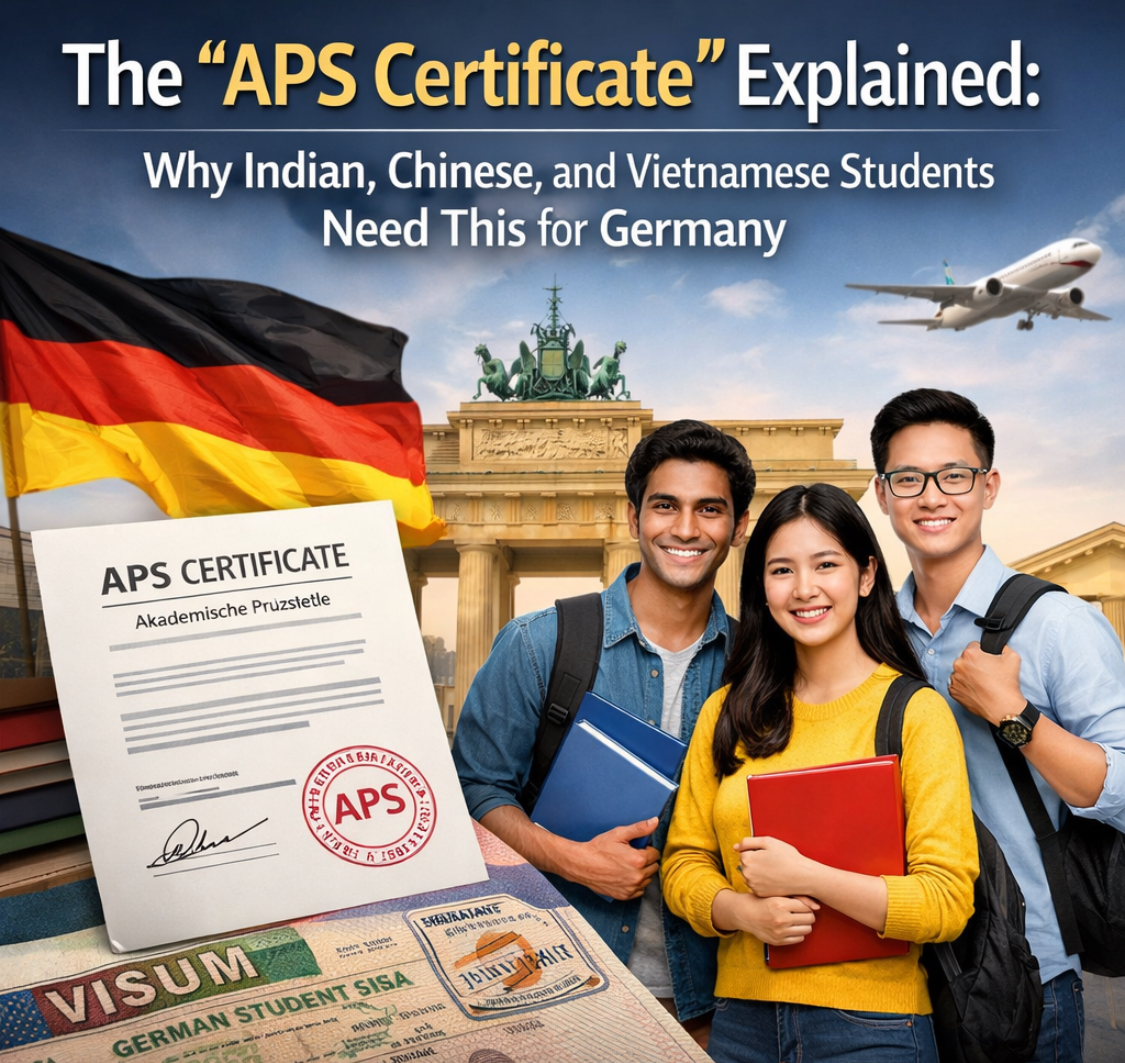
For students from India, China, and Vietnam dreaming of a German degree in 2026, the road to Berlin or Munich no longer starts with a university application. It starts with a document that has become the ultimate gatekeeper: the APS Certificate. While Germany remains one of the world’s most welcoming destinations for international talent, the surge in applications has led to stricter verification protocols to ensure that every transcript and degree presented is 100% authentic.
APS stands for Akademische Prüfstelle (Academic Evaluation Centre). It is a joint operation between the German Embassy and the German Academic Exchange Service (DAAD). Essentially, it is a screening process that validates your academic history before you even step foot in a visa office. If you are a student from one of the designated “APS countries,” this certificate is not just an “extra” document—it is the foundation of your entire journey.
Important Reality Check for 2026:
The APS process is currently a major bottleneck in the study abroad timeline. Without this certificate, German universities will not issue a final admission letter, and VFS Global will not even accept your visa file. Processing times in early 2026 are ranging from 4 weeks to over 4 months depending on the volume of backlogs. This guide breaks down the requirements based on current 2026 mandates, but you must treat the official country-specific portals as your final source for real-time updates.
In this guide, we strip away the confusion and look at why this requirement exists, who specifically needs to apply, and how to navigate the nuances of the 2026 evaluation criteria for each country.
What Exactly is the APS Certificate?
At its core, the Akademische Prüfstelle (APS) is a verification filter. It is not an entrance exam or a language test. Instead, it is a thorough audit of your academic past. The German authorities use this process to confirm that your transcripts, degrees, and marksheets are genuine and that your home country’s educational standards align with German higher education through the anabin database.
In 2026, the certificate is primarily issued as a DigZert (Digital Certificate), though physical copies may still be required in specific territorial cases. Once issued, the certificate is valid indefinitely—meaning if you secure it for a Bachelor’s application, you typically won’t need a new one for that same level of study later.
Why Indian, Chinese, and Vietnamese Students?
It is no coincidence that these three nations face this extra hurdle. According to detailed reporting by Studying-in-Germany.org, the APS was originally a response to the massive volume of applications originating from China in the early 2000s. The goal was to combat document fraud and streamline the workload for German university admissions offices (uni-assist) that were being overwhelmed.
Vietnam followed shortly after, and India was integrated into the mandatory APS fold in late 2022. For Indian students, the inclusion was a direct result of India becoming the largest group of international students in Germany. By centralizing the verification in New Delhi, the German Embassy ensures that every student entering the visa interview has already been “pre-cleared” academically.
The 2026 Strategic Logic:
- Standardization: It ensures a student from a small private college in rural India is evaluated on the same playing field as one from a major metropolitan university in Beijing.
- Fraud Mitigation: It eliminates the “fake degree” industry by requiring direct verification from the awarding bodies or universities.
- Visa Efficiency: By the time you reach the VFS appointment, your academic eligibility is de facto confirmed, allowing the consular officer to focus purely on your financial stability and intent.
Essentially, while it feels like a bureaucratic roadblock, it actually protects the integrity of the German education system and ensures that only genuine students are competing for limited seats in popular Master’s programs.
Who is Required to Apply in 2026?
The APS mandate is broad, but it is strictly tied to where you obtained your prior education, not just your nationality. If you are an Indian, Chinese, or Vietnamese citizen who completed your schooling or degree in your home country, you are almost certainly in the “mandatory” category.
Mandatory for:
- Undergraduate Applicants: Those seeking entry into a Bachelor’s program or Studienkolleg (preparatory course).
- Postgraduate Applicants: Those applying for a Master’s degree using a Bachelor’s degree from an APS country.
- Transfer Students: Even if you have completed only a few semesters at a local university, you need APS to transfer those credits to Germany.
The 2026 Exemption List
There is a common misconception that everyone from these regions needs an APS. However, the German authorities have carved out specific “safe zones” where the certificate is either waived or handled differently. According to the official APS India FAQ, the following groups are typically exempt:
| Category | Exemption Status | Condition |
|---|---|---|
| PhD & Postdocs | Exempt | Most research-based roles do not require APS; verify with your specific professor/DLI. |
| Foreign Degree Holders | Exempt | If an Indian student has a Bachelor’s from the UK or USA, they do not need APS India. |
| EU-Based Students | Exempt | Citizens of India living/studying in the EU with local credentials. |
| Scholarship Holders | Partial/Case-by-Case | Some EU or DAAD-funded programs have integrated verification; check your award letter. |
The 2026 Bottleneck Warning:
Do not assume you are exempt without a written confirmation from either your target university or the APS office. Many students miss the Winter intake because they waited for an exemption that never came. In 2026, with the sheer volume of applicants, “erring on the side of caution” means applying for your APS the moment you decide to study in Germany.
Country-Specific APS Guidelines for 2026
While the purpose of the APS is the same globally, the execution—fees, document lists, and interview requirements—varies significantly between New Delhi, Beijing, and Hanoi. Below is the updated breakdown for the 2026 academic cycle.
1. APS India (New Delhi)
As of early 2026, APS India has shifted almost entirely to a digital verification model. However, a major policy change took effect in March 2026 regarding undergraduate eligibility.
- The 70% Rule: For the Winter 2026/27 semester, the anabin database has been updated. Undergraduate applicants typically now need a minimum overall score of 70% in their Class XII certificate to qualify for the standard APS pathway to a Studienkolleg.
- Cost: INR 18,000 (Non-refundable).
- Processing Time: 3 to 6 weeks on average.
- Key Documents: Aadhaar Card (linked to mobile), Passport, Class 10 & 12 Marksheets, and all University Transcripts (for Master’s applicants).
2. APS China (Beijing & Shanghai)
The APS China procedure remains the most rigorous, often involving a mandatory 20-minute academic interview conducted in English or German to verify the applicant’s subject knowledge.
- Cost: 2,500 RMB (approx. €320).
- Interview Locations: Beijing or Shanghai (traveling juries may apply for other regions).
- Gaokao Requirement: Undergraduate applicants must submit their National University Entrance Exam scores.
- Processing Time: 4 to 8 weeks, especially during peak seasons (March–June).
3. APS Vietnam (Hanoi)
For Vietnamese students, the German Embassy in Hanoi manages a dual-stream process: the “Audit” for graduates and a “TestAS” based procedure for undergraduates.
- Cost: $250 USD for Master’s/Postgraduate procedures; $150 USD for others.
- Mandatory Interview: Most Master’s applicants must undergo an interview session, typically held twice a year (May and November). Planning is critical to avoid waiting six months for the next slot.
- Processing Time: Highly dependent on the interview cycle.
Regardless of your country, the golden rule of 2026 is Document Integrity. Any discrepancy between your digital upload and the physical copies couriered to the office can result in an immediate rejection without a refund.
The 2026 Timeline: When Should You Apply?
One of the biggest mistakes students make is treating the APS as a “last-minute” visa document. In reality, it is a prerequisite for your university admission. According to the 2026 roadmap provided by Expatrio, you should ideally have your APS certificate in hand 4 to 6 months before your university’s application deadline.
Strategic 2026 Countdown:
- September – October (Previous Year): Start gathering transcripts and getting translations notarized.
- November – January: Submit your APS application and pay the fee. This avoids the “February Rush.”
- March – April: Receive your digital certificate (DigZert).
- May – July: Apply to German universities with your validated credentials.
Critical Update: The “70% Rule” for India
A major shift occurred on March 15, 2026. The APS India office confirmed that for the Winter 2026/27 intake and beyond, Indian undergraduate applicants must have a minimum overall score of 70% in their Class XII board exams. Previously, a successful first year of a Bachelor’s degree in India could sometimes “offset” a lower school score—this is no longer the case. You must now meet both the 70% threshold and the academic year requirement to be eligible for a Studienkolleg or direct admission.
Common Pitfalls & Success Tips
To ensure your application doesn’t join the “Pending” pile for months, keep these three tips in mind:
- Document Naming: When uploading your digital files to the APS portal, do not rename the PDFs. Keep the original names from your scanner to avoid triggering automated verification errors.
- Transcript Completeness: Ensure your university provides “semester-wise” marksheets. A “Consolidated Marks Card” is often not enough for APS; they need to see the breakdown of every single subject you took.
- The Vietnam Cycle: If you are in Vietnam, remember that interviews only happen twice a year. Missing the March application deadline for the May session means you cannot apply again until the end of the year.
Final Conclusion
The APS Certificate is more than just a piece of paper; it is your verified ticket to a world-class education. While the 2026 landscape has become more demanding—especially with the new 70% rule in India and the strict interview windows in Vietnam—it also provides a much clearer pathway. By starting your verification process six months in advance, you remove the biggest variable of uncertainty from your German study journey. Focus on the details today, so you can focus on your studies tomorrow.
Sources & Note: This guide reflects official 2026 data from APS India, the German Embassy in Hanoi, and APS China. For specific legal advice, always consult a regulated migration expert or the official government portals directly.