
Last updated: 2026 (updated periodically). Figures and examples in this article reflect the 2025–2026 student insurance landscape. Premiums, networks, waiver rules, and benefits can change every academic year, so students should verify details directly with their university and insurer before enrolling.
Health insurance is one of the first financial realities many students face after gaining admission to a university in the United States. Tuition, housing, visa documents, and arrival plans often get more attention, but medical coverage can quietly become one of the most important parts of the student budget. A single urgent care visit, specialist appointment, lab test, or emergency room bill can become expensive very quickly without the right coverage.
For international students, the issue is even more serious. Many universities require proof of adequate health insurance before enrollment, and some schools automatically bill students for a university-sponsored plan unless a waiver is approved. Domestic students may have more flexibility through a parent’s plan, employer coverage, Medicaid, or marketplace options, but even then, campus location and network access can make a plan that looks good on paper less useful in practice.
The most common confusion comes from three terms that appear everywhere in student insurance documents: PPO, HMO, and University Student Health Plan. They are not always separate categories. A university plan may itself use a PPO network. Another school may arrange coverage around an HMO-style model. That overlap is why students often misunderstand what they are buying.
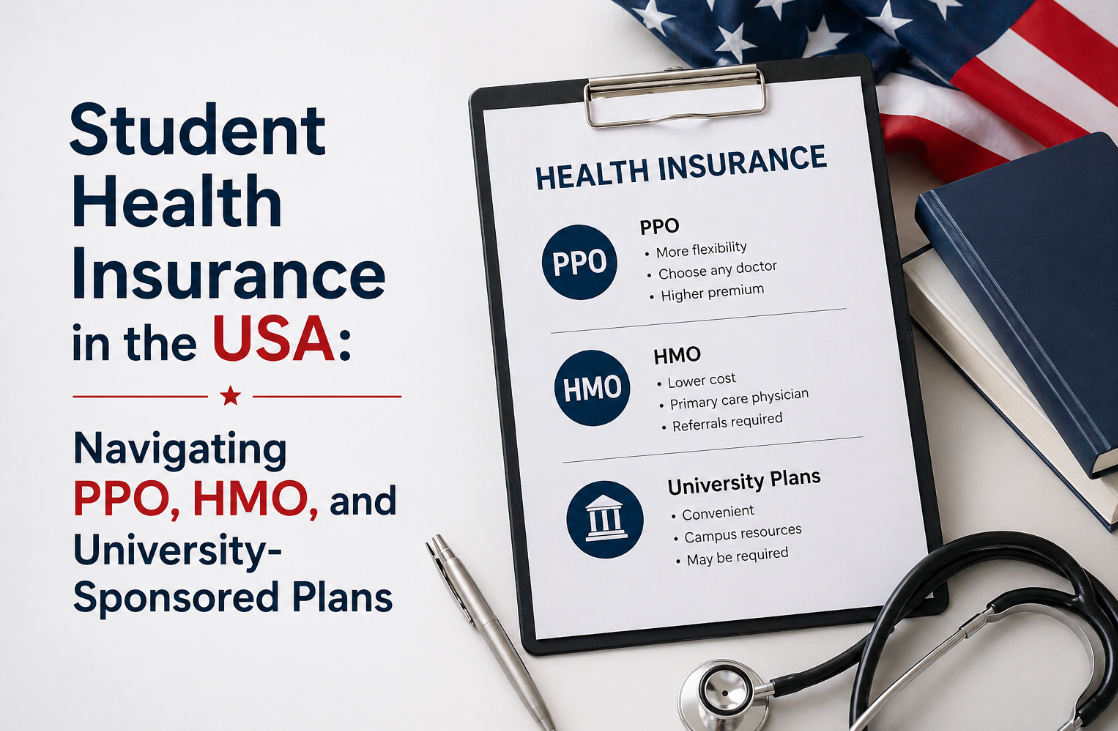
A PPO, or Preferred Provider Organization, usually gives students more freedom to see doctors and specialists without referrals, including some access outside the plan network at a higher cost. An HMO, or Health Maintenance Organization, is usually more controlled: students often need to stay inside the network, choose or use a primary care physician, and get referrals for specialist care. A university student health plan is a school-sponsored arrangement, often administered by companies such as Aetna Student Health or UnitedHealthcare Student Resources, and designed around campus health services, academic calendars, and student waiver rules.
The difference matters in real life. A student in California on an HMO may need a referral before seeing a dermatologist or orthopedic specialist. A student on a PPO may be able to book directly, but the monthly or annual premium may be higher. A student enrolled in a university plan may enjoy easy access to the campus clinic, mental health services, and local billing support, but the plan may cost more than a private student policy or have network limits away from campus.
This article explains how PPO, HMO, and university student health plans work in the USA, where they overlap, what they typically cost, and how students can compare them with fewer assumptions. The emphasis is on practical decision-making: networks, referrals, deductibles, copays, out-of-pocket exposure, waiver rules, and the special concerns international students should check before choosing a plan.
For official definitions of plan types, Healthcare.gov explains that HMOs usually limit coverage to contracted doctors except in emergencies, while PPOs generally provide more provider flexibility at different cost levels. UnitedHealthcare also describes HMO, PPO, EPO, and POS plans as network structures with different rules for doctors, hospitals, referrals, and out-of-network care. Those definitions are useful, but student insurance adds another layer because university rules can be stricter than general consumer insurance pages suggest.
Important note: Student health insurance costs in the United States vary more widely than many guides suggest. Lower-cost private or international student plans can range from roughly $30 to $120 per month (about $360–$1,500 annually), often with higher deductibles and more limited coverage structures.
University-sponsored plans and comprehensive PPO-based policies typically fall between $2,000 and $5,000+ per year, with some institutions exceeding $6,000 depending on location, benefits, and regulatory requirements.
For example, Penn State’s 2025–2026 undergraduate student health plan is reported at $3,618 annually, while higher figures (around $4,400+) apply to separate graduate or subsidized plan categories. These differences highlight why students must always confirm the exact plan category that applies to them.
In practical terms, many student plans include deductibles ranging from $0 to $500 for campus care and $500 to $2,500 for off-campus services, with copays typically between $10 and $50 per visit and coinsurance often around 10%–30% after the deductible.
Always review the full plan document—not just the premium—before making a decision.
Understanding Key Health Plan Types in the USA
Some students may also encounter plan structures such as EPO (Exclusive Provider Organization) or HDHP (High Deductible Health Plans). EPO plans typically combine aspects of HMO and PPO models, offering a defined network without referral requirements but little to no out-of-network coverage. HDHP plans, on the other hand, are built around lower premiums and higher deductibles, sometimes paired with Health Savings Accounts (HSA). While these options are increasingly present in certain university or private offerings, they are best understood as variations within the broader network and cost structures already discussed rather than entirely separate categories.
Before comparing PPO, HMO, and university plans, it helps to understand the language used in nearly every American health insurance document. The terms are not decoration. They decide how much a student pays, which doctors can be used, whether a referral is needed, and what happens when care is received outside the approved network.
A network is the group of doctors, clinics, hospitals, laboratories, pharmacies, and specialists that have agreed to work with an insurance plan. When a provider is in-network, the student usually pays less because the insurer has negotiated rates with that provider. When a provider is out-of-network, the student may pay more, or the plan may not cover the service at all except in emergencies.
A premium is the amount paid to keep the insurance active. For students, this may appear as a semester charge on the university bill, an annual payment, or a monthly payment. A low premium does not automatically mean a cheap plan. The real cost depends on how the plan behaves when the student actually uses medical care.
A deductible is the amount the student may need to pay before the insurance starts paying for certain covered services. Some university plans have relatively low deductibles for care outside the campus health center, while cheaper private plans may use higher deductibles to reduce the premium.
A copay is a fixed amount paid for a service, such as $10, $25, or $50 for a doctor visit. Coinsurance is different. Instead of a fixed amount, the student pays a percentage of the cost, such as 20% after the deductible. The out-of-pocket maximum is the most the student should have to pay for covered in-network services during the plan year, excluding premiums and services the plan does not cover.
A primary care physician, often shortened to PCP, is the main doctor responsible for basic care and referrals. In many HMO arrangements, the PCP acts as the first point of contact before a student can see a specialist. In many PPO arrangements, that gatekeeping role is much weaker or may not exist.
A referral is approval or direction from a primary doctor to see a specialist. This matters for students with ongoing conditions, sports injuries, allergies, skin problems, mental health needs, or any situation where specialist care may be needed. A plan that requires referrals is not automatically bad, but students need to know the rule before assuming they can book any specialist directly.
These mechanics explain why two students can both say they have “health insurance” but experience completely different results. One may walk into a nearby specialist clinic and pay a manageable copay. Another may discover that the clinic is outside the network, the visit needs prior approval, or the insurer will not pay because the referral process was skipped.
What an HMO Means for Students
An HMO, or Health Maintenance Organization, is built around coordination. The idea is simple on paper: care flows through a defined network, and most decisions start with a primary care physician. In practice, that structure shapes almost every step a student takes when seeking treatment.
In many student-facing HMO arrangements, especially those tied to campus systems or regional providers, the student first engages with a primary care doctor or a university health center. If the issue requires specialized attention—orthopedics, dermatology, cardiology, or mental health beyond basic counseling—the student is typically referred to a specialist within the same network. That referral is not just administrative; it is often required for the insurer to recognize the visit as covered.
The main advantage shows up in cost predictability. Because the network is controlled, insurers can negotiate tighter rates, and that often translates into lower premiums compared to more flexible plans. For students who stay close to campus, rely on university clinics, and do not anticipate complex specialist needs, that structure can work without friction. Routine care, vaccinations, minor illnesses, and follow-ups tend to be straightforward within the system.
But the same structure can feel restrictive in less predictable situations. A student who wants to see a specialist directly may need to wait for a referral. A student traveling during academic breaks may find that care outside the network is either not covered or covered only in emergencies. Even within the same city, the available providers may be narrower than expected.
Healthcare.gov describes HMO plans as generally limiting coverage to doctors who work for or contract with the plan, except in emergencies. That description matches what many students experience, especially when university-linked HMO structures are involved. The restriction is not theoretical; it affects where care can be received and how quickly it can be arranged.
There is also a behavioral element. Students who are used to systems where they can walk into any clinic may need to adjust. Booking through campus health services, waiting for internal referrals, and navigating appointment timelines can feel slower at first. Over time, some students find it efficient because everything is centralized. Others see it as a limitation, especially when dealing with time-sensitive issues or unfamiliar conditions.
For cost-conscious students who expect to remain within one geographic area and use campus facilities regularly, the HMO structure can be manageable and sometimes practical. The key is not to assume flexibility where it does not exist. The rules around referrals, network boundaries, and out-of-area care should be understood before enrollment, not after the first medical issue arises.
What a PPO Means for Students
A PPO, or Preferred Provider Organization, takes a different approach. Instead of tightly controlling access through a primary doctor and referral system, it offers a broader network and allows students to make more direct choices about where they receive care.
In many PPO arrangements, a student can schedule an appointment with a specialist without first visiting a primary care physician. That difference alone changes how quickly care can be accessed. For example, a student with a recurring sports injury or a persistent skin condition can often go directly to an orthopedic specialist or dermatologist, provided the provider is within the plan’s network.
The network itself is usually larger. That does not mean every doctor is included, but it often covers more hospitals, clinics, and specialists across wider geographic areas. For students who travel between states, return home during breaks, or study in cities where provider choice matters, this flexibility can reduce friction.
There is also a safety layer in how PPOs handle out-of-network care. While staying in-network is still cheaper, many PPO plans will cover a portion of the cost if a student sees a provider outside the network. The student pays more in that case, but the service is not automatically excluded. This can matter when a specific specialist is not available within the network or when urgent care is needed in a different location.
UnitedHealthcare explains that PPO plans generally allow more flexibility in choosing providers and do not usually require referrals for specialists. That flexibility is what many students value, especially those managing ongoing conditions or uncertain schedules. It is also why PPOs are often discussed as a preferred option for international students who may move, travel, or require access beyond a single campus system.
The trade-off appears in cost structure. Premiums for PPO plans are often higher than those for more restricted models. Deductibles and coinsurance may also be structured differently, meaning the student may pay more before the plan begins to cover certain services. The apparent freedom is not free; it is priced into the plan.
There is also a misconception that a PPO removes all limits. That is not accurate. Networks still exist, and staying within them is still financially important. The difference is that the plan offers more pathways when a student needs to step outside that network, rather than blocking coverage entirely.
For students who value direct access to specialists, expect to move between locations, or prefer not to navigate referral systems, a PPO structure often aligns more closely with how they want to use healthcare. The decision, however, should still consider total cost exposure, not just the monthly or annual premium.
At this point, the contrast between HMO and PPO is clearer in practice than in definition. One emphasizes coordination and cost control within a tighter network. The other emphasizes flexibility and broader access, with a different cost structure attached. The next layer—university student health plans—adds another dimension, because those plans often sit on top of one of these models while introducing their own rules and benefits.
University Student Health Plans Explained
University student health plans sit in a different category, not because they follow completely separate rules, but because they are built around the realities of campus life. Most are not standalone insurance models in the technical sense. They are structured arrangements designed by universities and administered by established insurers such as Aetna Student Health or UnitedHealthcare Student Resources, often using either a PPO or HMO network underneath.
This is where many students misunderstand what they are enrolling in. A university may present a single “student health plan,” but behind that label is usually a familiar structure. Some schools operate plans that resemble PPO networks, offering broader provider access within a region. Others lean toward HMO-style coordination, especially where campus health centers serve as the first point of care.
The defining feature is integration with campus services. University plans are typically aligned with student health centers, counseling services, and campus clinics. In many cases, basic care—such as general consultations, vaccinations, minor treatments, and initial mental health support—is either low-cost or already covered within the campus system. Billing is often streamlined because the university and insurer are already linked administratively.
That convenience is one reason many institutions automatically enroll students in their health plan and require a formal waiver process to opt out. For international students, the requirement can be stricter. Schools may mandate enrollment unless the alternative plan meets specific criteria, such as coverage limits, network adequacy, and inclusion of services like medical evacuation or repatriation.
ISOA (International Student Organization of America) has noted that university plans tend to prioritize ease of use and compliance with institutional requirements, while private plans may offer different pricing or flexibility depending on the provider and structure. That distinction matters when a student is comparing not just cost, but how easily the plan fits into daily academic life.
Cost is often the most debated aspect. University plans can be more expensive than some private student insurance options. At certain universities, annual premiums have moved into the range of $1,800 to over $4,000, depending on coverage levels, state regulations, and negotiated benefits. Penn State’s 2025–2026 student plan, for example, has been reported in recent updates at around $4,400+ annually depending on coverage structure and revisions published by the university. Other institutions fall above or below that range, but the pattern is consistent: university plans are rarely the cheapest option on paper.
That higher cost sometimes reflects broader coverage or administrative simplicity rather than raw value. Students using campus services frequently may find that the integration reduces unexpected billing issues. Appointments, referrals, and follow-ups can be easier to coordinate within a system that already recognizes student status and academic schedules.
There are also limitations that deserve attention. Some university plans are geographically concentrated. While they may work well near campus, they may not offer the same flexibility when a student travels home during holidays or relocates temporarily. Coverage outside the immediate network area can depend on whether the underlying structure behaves more like a PPO or an HMO.
Another point that students often overlook is how long coverage remains active. Some university plans follow the academic calendar rather than a continuous 12-month structure, or they may handle summer and break periods differently. That detail becomes important for students staying in the United States year-round or participating in internships away from campus.
The waiver process is also part of the decision. Universities typically allow students to opt out of the school plan if they can prove they have comparable coverage. This is not always straightforward. The alternative plan must often meet strict criteria: minimum coverage limits, accessible providers near campus, compliance with state laws, and sometimes additional requirements for international students. A cheaper plan that fails these conditions may be rejected, leaving the student responsible for the university plan cost anyway.
In practice, students tend to fall into three broad patterns. Some choose the university plan for simplicity, especially in the first year when everything else is unfamiliar. Others actively compare private options, looking for lower premiums or broader networks. A third group starts with the university plan and later switches after understanding how healthcare works in their specific location.
It is also worth noting that university plans often include services that are not emphasized in general insurance discussions. Mental health support, preventive screenings, and campus-based care can be more accessible through these plans than through some external policies. That added accessibility does not always show up clearly in cost comparisons, but it can influence overall experience.
The key point is not whether university plans are better or worse in absolute terms. It is how they fit into a student’s academic environment, movement patterns, health expectations, and financial limits. Once that context is clear, the comparison with PPO and HMO structures becomes more practical rather than theoretical.
PPO vs HMO vs University Plans: Full Comparison
Once the structures are clear, the real difference appears in how each plan behaves under everyday situations. Not theory, but what actually happens when a student books an appointment, needs a specialist, travels outside campus, or receives a bill.
The table below brings those differences into a single view. It should not be treated as a fixed rulebook. Plans vary by insurer, university, and state. Still, the patterns are consistent enough that students can use them as a working reference when comparing actual plan documents.
| Plan Type | Network Flexibility | Referrals Needed | Typical Annual Premium (2025–2026) | Out-of-Network Coverage | Best For | Common Drawbacks |
|---|---|---|---|---|---|---|
| HMO | Restricted to a defined local network | Usually required | $800–$2,000 (lower-cost / limited networks) | Very limited (emergencies only) | Students staying near campus, predictable care usage | Less flexibility, referral delays, limited travel coverage |
| PPO | Broad network, multi-state access | Not usually required | $1,500–$3,500 (flexible network plans) | Covered at higher cost | Students needing flexibility, travel, direct specialist access | Higher premiums, complex billing, balance billing risk |
| University Plan | Varies (often PPO or HMO underneath) | Depends on structure | $2,000–$6,000+ (school-sponsored plans) | Depends on underlying network | Students prioritizing compliance, campus access, simplicity | Higher cost, limited flexibility outside campus |
Note: Premiums vary by state, university, insurer, and benefit design. Always confirm current rates directly with the provider or institution.
The most important detail in that table is not the numbers. It is the overlap. A university plan is rarely its own independent system. It behaves like an HMO or PPO depending on how it is structured. That is why students sometimes feel confused. They assume they are choosing between three completely different models, when in reality, one of them is layered on top of the other two.
How Routine Care Works
For routine medical needs—common illness, check-ups, minor injuries—the difference is often less dramatic than expected. University plans tend to direct students to campus health centers first, which simplifies access and reduces immediate cost. HMO plans behave similarly if the campus clinic is part of the network.
PPO plans, on the other hand, give more freedom in where that first visit happens. A student can go directly to a nearby clinic or physician without navigating campus systems. The cost difference depends on whether the provider is within the network.
Specialists and Referrals in Practice
This is where the separation becomes more visible. In an HMO-style structure, referrals are part of the process. A student dealing with a persistent knee issue may first see a general doctor, wait for evaluation, and then receive approval to visit an orthopedic specialist. The system ensures coordination, but it introduces an extra step.
In a PPO structure, that step is often removed. The student can contact a specialist directly, provided the provider is covered. This can shorten timelines, especially in cities where specialist availability is high. The trade-off is financial. Specialist visits may involve higher copays or coinsurance, particularly if the provider is outside the preferred network.
University plans vary here. Some replicate the referral model through campus clinics. Others allow direct specialist access within a defined network. The difference is usually explained in the plan brochure, but many students only discover it after trying to book an appointment.
Emergency and Out-of-Area Care
All major plan types cover emergencies, but the definition of what happens after the emergency can differ. HMO plans typically cover emergency treatment anywhere, but follow-up care may need to return to the network. PPO plans are generally more flexible in continuing treatment outside the immediate area, though at higher cost levels.
This matters for students who travel during academic breaks or move between states. A student with a PPO plan may continue care in another city without restarting the process. A student on a stricter network plan may need to coordinate a transfer back to an in-network provider.
Billing and Cost Behavior
Cost is not only about premiums. It is about how bills are handled after care is received. University plans often reduce administrative friction because campus providers already operate within the system. Students are less likely to face unexpected billing disputes when care is delivered through university-linked channels.
PPO plans, while flexible, can introduce complexity. Seeing an out-of-network provider may lead to partial reimbursement, balance billing, or higher out-of-pocket costs. Students need to understand these dynamics before assuming that flexibility automatically leads to convenience.
HMO plans tend to be simpler in billing when used correctly, because everything is contained within the network. Problems arise mainly when students step outside that structure without realizing the financial consequences.
Mobility and Lifestyle Fit
Students rarely stay in one place the entire year. Internships, travel, research programs, and personal movement all affect how useful a plan becomes over time. PPO plans tend to align better with mobile lifestyles. HMO plans align more closely with stable, campus-centered routines.
University plans sit between those two realities. They work well for students who remain engaged with campus services, but their flexibility depends on the underlying network. Without checking that detail, students may assume they have broader access than the plan actually provides.
At this stage, the comparison is less about labels and more about behavior. The same student can have a very different experience depending on how often they need care, where they travel, and how comfortable they are working within structured systems versus flexible ones.
It is also important to note that HMO plans can be more efficient than they appear in structured environments. For students who primarily use campus health services and do not require frequent specialist access, the coordinated model can reduce both costs and administrative complexity. In these cases, the predictability of HMO care can be an advantage rather than a limitation.
How Claims, Billing, and Denials Actually Work for Students
Most comparisons between PPO, HMO, and university plans stop at structure. What tends to shape a student’s real experience, however, is what happens after care is received. The moment a bill is generated, the differences between these plans become more visible.
In the United States, healthcare providers usually bill the insurance company first. The insurer reviews the claim, applies network agreements, deductibles, copays, and coverage rules, and then determines what portion it will pay. The remaining balance is passed to the student.
This process sounds straightforward, but the outcome depends heavily on the plan type and how it was used.
Within an HMO structure, billing is often more predictable when the student stays inside the network. Providers already operate under agreed rates, and claims tend to move through the system without major disputes. Problems usually appear when care is received outside the network without proper authorization. In those cases, the claim may be denied or only partially covered.
PPO plans introduce more flexibility, but also more variation in billing outcomes. If a student visits an out-of-network provider, the insurer may reimburse only part of the cost. The remaining amount—sometimes called balance billing—can fall directly on the student. This is one of the most common sources of unexpected medical expenses.
University plans often reduce this friction when care is received through campus health systems or affiliated providers. Because those services are already integrated with the plan, billing tends to be simpler. The complexity increases when students step outside that environment, especially if the underlying network behaves like a restricted model.
Denials are another area students rarely anticipate. A claim can be denied for several reasons: receiving care outside the network, skipping a required referral, missing documentation, or using services that are not covered under the plan. Denial does not always mean the bill disappears. It often means the full cost shifts to the student unless the issue is corrected or appealed.
Understanding this process changes how plans are evaluated. A lower premium plan with frequent claim issues may end up costing more in practice. A plan that appears expensive upfront may reduce risk by handling claims more consistently within its network.
Students who take time to understand how billing behaves—rather than only how plans are described—tend to make decisions that hold up better over time.
Average Costs and What Influences Them
Cost is usually the first number students look at, but it is rarely the most important one on its own. Two plans can have similar premiums and behave completely differently once medical care begins. That is why it helps to separate visible cost from actual cost exposure.
To make these differences more concrete, a routine primary care visit under many student plans may cost between $10 and $40 as a copay, while specialist visits often range from $30 to $75. Emergency room visits can exceed $150–$500 in out-of-pocket costs depending on the plan structure, even before coinsurance is applied. These real-world figures are often more useful than premium comparisons alone.
Across the student market, annual premiums often fall somewhere between $800 and $2,500 or more, depending on the structure of the plan, the insurer, and the level of coverage included. That range is often cited because it captures many private student policies and some lower-cost network plans. It is not a universal benchmark.
University-sponsored plans frequently sit above that range. At several large institutions, annual premiums now fall between $1,800 and $4,000+, with some programs exceeding that depending on state regulations and benefit design. The Penn State figure, which has risen in recent cycles to around $4,400+ annually depending on updates, is one example of how university-sponsored plans now sit at the higher end of the student insurance market.
Those numbers should not be interpreted in isolation. A lower premium plan may come with a higher deductible, meaning the student pays more before coverage begins. Another plan may offer lower copays but a narrower network, limiting where care can be received. A university plan may appear expensive but include easier access to campus services that reduce additional out-of-pocket spending.
Several factors shape how these costs are set:
- Network size and structure: Broader networks, especially those resembling PPO systems, often come with higher premiums because they offer more provider choice.
- Deductibles and cost-sharing: Plans with higher deductibles or coinsurance may reduce premiums but increase what students pay when they use services.
- Geographic location: Healthcare costs vary widely across the United States. Urban areas and certain states tend to have higher provider rates, which influences premiums.
- Coverage scope: Plans that include mental health support, preventive services, prescriptions, and emergency coverage at stronger levels may cost more upfront.
- Student-specific requirements: International student plans sometimes include additional benefits such as medical evacuation or repatriation, which can affect pricing.
According to Healthcare.gov, plan types such as HMO and PPO differ not only in cost but in how care access and provider networks are structured. That distinction becomes more visible over time. A plan with a slightly higher premium but lower out-of-pocket exposure may end up costing less if a student needs regular care.
Another point that often comes up in real comparisons is how billing behaves after treatment. A student on a lower-cost plan might face unexpected charges if care is received outside the network or if certain services are not covered. A student on a higher-cost university plan may experience fewer billing surprises within the campus system but still face limitations when leaving that environment.
Students also tend to underestimate how quickly small costs accumulate. Copays for repeated visits, prescription costs, diagnostic tests, and follow-up appointments can add up over a semester. That is why looking only at the annual premium rarely provides a complete picture.
For international students managing tight budgets, this balance becomes even more sensitive. Tuition, housing, and visa-related expenses already take a significant share of available funds. Exploring funding options alongside insurance decisions can make a difference. Some students reduce overall financial pressure by securing partial or fully funded opportunities, such as those discussed in fully funded scholarships for international students, which can free up resources for essential costs like healthcare coverage.
The broader pattern is clear. Costs vary widely, and no single number defines whether a plan is “cheap” or “expensive.” What matters is how the premium, deductible, network, and real usage patterns come together. A plan that looks affordable at the beginning of the semester can become expensive if it does not match how the student actually uses healthcare.
Once those cost dynamics are understood, the next question becomes more practical: which type of plan fits different student situations, especially for international students who face stricter requirements and less margin for error.
Common Mistakes Students Make When Choosing Health Insurance
Some of the most expensive outcomes in student health insurance come from simple assumptions rather than complex decisions.
One of the most common mistakes is choosing a plan based only on premium. A lower upfront cost can hide higher deductibles, limited networks, or weak coverage outside specific providers.
Another pattern is ignoring the network entirely. Students often assume that any nearby hospital or clinic will accept their insurance, only to discover that the provider is outside the plan’s network.
Referral rules are also frequently misunderstood. In plans that require them, skipping the referral process can lead to denied claims even when the treatment itself is appropriate.
International students sometimes assume that any “student insurance” plan will meet university requirements. In reality, waiver conditions can be strict, and non-compliant plans are often rejected.
These mistakes are not complicated, but they are common. Avoiding them usually comes down to reading the plan details carefully and comparing how the plan behaves, not just how it is labeled.
Which Plan Is Best for International Students?
There is no single answer that fits every international student, even though many try to look for one. What tends to work in practice is a combination of compliance, access, and cost balance rather than choosing a plan type based on general advice alone.
The first constraint is not preference but university policy. Many institutions require international students on F-1 or J-1 visas to carry insurance that meets specific standards. Some schools automatically enroll students in their own plan and only allow a waiver if an alternative policy satisfies detailed conditions. These conditions may include minimum coverage limits, in-network access near campus, and in some cases, provisions for medical evacuation or repatriation.
This is where many students go wrong. They focus on price before confirming whether the plan is even eligible for a waiver. A cheaper plan that fails the university’s requirements does not save money. It simply adds another cost when the waiver is denied.
Once compliance is clear, the next factor becomes mobility. International students often move more than they expect. Academic breaks, internships, research placements, and even short-term travel can take them outside the immediate campus environment. In these situations, network flexibility becomes less theoretical and more practical.
A PPO structure tends to handle that movement more smoothly. Because it allows broader provider access and some level of out-of-network coverage, students are less likely to face a complete reset when they leave the area. A student spending the summer in another state, for example, may still be able to access care without navigating an entirely new system.
An HMO structure can still work, but it requires more awareness. Students need to understand where the network operates and what happens when they step outside it. Emergency care is typically covered anywhere, but follow-up treatment may need to return to the network. For students who plan to stay close to campus and rely heavily on university services, this may not be a major limitation. For others, it can become restrictive.
University plans sit in between these two realities. They are often the safest option from a compliance perspective because they are designed to meet the school’s requirements automatically. For a student arriving in the United States for the first time, that simplicity can remove uncertainty during an already complex transition.
At the same time, university plans are not always the most flexible or the most affordable. Their value depends on how much the student uses campus services and how often they need care outside that environment. Some students remain enrolled in the university plan for the first year, learn how the system works, and then evaluate alternatives later with more confidence.
There are also additional considerations that are more specific to international students. Coverage for pre-existing conditions, for example, varies widely between plans. Some policies include waiting periods or exclusions that are not immediately obvious. Support services—such as multilingual assistance or easier claims handling—can also influence how manageable a plan feels in practice.
Specialized international student insurance providers often emphasize these aspects. Platforms comparing student policies frequently highlight PPO-based options because they offer broader access and fewer structural barriers. American Visitor Insurance, for instance, notes that many international students prefer PPO networks for their flexibility, especially when dealing with unfamiliar healthcare systems.
Still, flexibility should not be confused with simplicity. A PPO plan may allow more freedom, but it also requires more attention to billing details, network tiers, and cost-sharing. A university plan may be easier to navigate day-to-day but less adaptable outside campus boundaries. An HMO plan may control costs effectively but limit how quickly a student can move between providers.
Budget remains part of the decision, but it should be placed alongside the bigger picture. International students often manage multiple financial pressures at once, and insurance is only one piece of that structure. Some students balance these costs by strengthening their funding strategy, including managing overall student budgets more strategically to accommodate healthcare costs, including exploring opportunities such as
ways to secure full scholarships even with a lower GPA
, which can reduce the overall strain on their finances.
When these elements are combined, a few patterns begin to emerge. Students who prioritize simplicity and guaranteed compliance often remain with the university plan, at least initially. Students who expect to travel, require specialist care, or prefer direct access to providers tend to lean toward PPO-based options. Students who are focused strictly on cost and remain within a stable location may find HMO-style plans workable, provided they understand the restrictions clearly.
The decision is rarely about finding the “best” plan in general. It is about choosing the plan that creates the fewest obstacles in the student’s actual routine, while still meeting institutional requirements and staying within financial limits.
Practical Decision Framework
At this point, the differences between PPO, HMO, and university plans are clear in structure. The remaining step is to translate that understanding into a decision that works in real conditions, not just on paper.
Most students who struggle with insurance decisions are not lacking information. They are trying to compare plans without a consistent method. A simple framework tends to reduce that confusion.
1. Start with University Requirements
The first check is always institutional. Review the university’s health insurance page carefully. Identify whether enrollment in the school plan is automatic, whether a waiver is allowed, and what criteria an external plan must meet. This step filters out options that look attractive but are not acceptable within the university’s system.
2. Map the Network to Your Actual Location
Once eligible plans are identified, the next step is geographic. Look at where you will spend most of your time—campus, housing, internship locations—and check which providers are available within each plan’s network. A plan with a broad national network may be more useful than one that works well only within a small area.
3. Estimate Total Cost, Not Just Premium
Instead of focusing only on the annual or monthly premium, consider the full cost structure. Ask how much you would pay for a routine visit, a specialist appointment, prescriptions, or diagnostic tests. Add potential out-of-pocket exposure to the premium to get a more realistic estimate.
4. Understand Referral and Access Rules
If the plan uses an HMO structure, confirm how referrals work and how long they typically take. If it is a PPO, check how out-of-network care is handled and what percentage of costs is covered. These rules determine how quickly you can move through the system when care is needed.
5. Review Coverage Details That Are Easy to Miss
Look for provisions related to pre-existing conditions, mental health services, emergency care, and coverage outside your primary location. These areas are often summarized briefly in brochures but have significant impact in practice.
6. Think About Movement Over the Year
Students rarely stay in one place continuously. Consider where you will be during breaks, internships, or travel periods. A plan that works perfectly during the semester may become less practical when you are away from campus.
Quick checklist:
• Does the plan meet university waiver requirements?
• Are there in-network providers near campus and housing?
• What is the deductible and expected out-of-pocket cost?
• Are referrals required for specialists?
• How does the plan behave outside your main location?
• Are key services like mental health and prescriptions covered clearly?
Students who go through these steps usually arrive at a clearer conclusion, even if the final choice still involves trade-offs. The goal is not to eliminate trade-offs entirely. It is to understand them before they become a problem.
Final Thoughts
Health insurance in the United States is not complicated because of terminology alone. It becomes complicated when structure and real-life usage do not match. PPO, HMO, and university student health plans are different ways of organizing access, cost, and responsibility, and each one solves a different kind of problem.
An HMO emphasizes control and predictability within a defined network. A PPO prioritizes flexibility and broader access, with a different cost balance. A university plan focuses on integration with campus life, often combining elements of both structures under a single administrative system.
None of these models is universally better. The right choice depends on how a student moves, how often care is needed, and how comfortable they are navigating restrictions or flexibility. What matters is alignment between the plan and the student’s actual routine.
Students who take the time to understand these differences tend to avoid the most common issues—unexpected bills, denied claims, or difficulty accessing care when it is needed most. Those problems usually come from assumptions rather than from the plans themselves.
It is also worth approaching the decision with the same level of planning used for other parts of studying abroad. Just as students carefully prepare applications, funding strategies, and academic goals, insurance should be part of that preparation rather than an afterthought. In some cases, combining the right coverage with strong funding—such as programs like the Fulbright scholarship—can create a more stable overall experience during study in the United States.
Details will continue to change. Premiums adjust, networks expand or contract, and university policies evolve. The underlying structures, however, remain relatively stable. Once a student understands how these plans work, the same reasoning can be applied year after year when reviewing new options.
That is what makes this comparison useful beyond a single enrollment period. It becomes a reference point rather than a one-time decision.
Frequently Asked Questions About Student Health Insurance in the USA (PPO, HMO, University Plans)
Is a university student health plan always better than a PPO or HMO?
University plans are not automatically better. They are often easier to use within campus systems and meet school requirements by default, but they can be more expensive and less flexible outside the campus area. Whether they are better depends on how often a student uses campus services and how much flexibility is needed beyond that environment.
Why do some students prefer PPO plans over HMO plans?
PPO plans allow students to see specialists without referrals and provide some level of coverage outside the network. This makes them more practical for students who travel, move between locations, or want direct access to different providers without going through a structured referral system.
Can international students use private insurance instead of a university plan?
Yes, but only if the private plan meets the university’s waiver requirements. Many schools require specific coverage levels, accessible provider networks, and additional benefits. If the plan does not meet those standards, the waiver will be denied and the student will still need to pay for the university plan.
What happens if I visit a doctor outside my insurance network?
In an HMO plan, care outside the network is usually not covered except for emergencies. In a PPO plan, the visit may still be covered, but at a higher cost. The student may also be responsible for the remaining balance if the provider charges more than the insurer’s allowed amount.
How do I know if a health insurance plan is actually affordable?
Affordability depends on more than the premium. Students need to consider deductibles, copays, coinsurance, and how often they expect to use healthcare services. A plan with a lower premium may become more expensive if it has high out-of-pocket costs or limited coverage when care is needed.
References & Further Reading
The following official resources and industry references provide deeper insight into how student health insurance works in the United States, including plan structures, coverage rules, and comparisons used across this article.
Healthcare.gov — Plan Types (HMO vs PPO)
Official U.S. government explanation of how HMO and PPO plans work, including network restrictions, referrals, and coverage differences.
UnitedHealthcare — Understanding HMO, PPO, EPO, POS
Detailed breakdown of major health insurance structures used across the U.S., including how provider networks and referrals function in practice.
ISOA — University vs Private Student Insurance
Analysis focused on international students comparing university-sponsored plans with private insurance options and their practical differences.
American Visitor Insurance — Student Plan Comparison
Comparative overview of international student insurance options, with emphasis on PPO-based flexibility and network coverage.
Aetna Student Health
Example of a major provider administering university student health plans, showing how coverage is structured around campus systems.
Healthcare.gov — Coverage Options for College Students
Overview of available health coverage paths for students in the U.S., including school plans, family coverage, and marketplace options.

Lead Content Strategist at The Global Scholar Guide, specializing in scholarship research, relocation guidance, and international education content.