
Last Updated: April 30, 2026
Important note: This article reflects Australia Subclass 500 financial requirements as of April 2026 based on Department of Home Affairs guidance. Financial thresholds, documentation expectations, and Genuine Student (GS) assessment practices can be revised at any time. While this page is reviewed periodically, applicants should confirm the latest position directly on the official
Subclass 500 visa page
before submitting an application.
Across 2026, one pattern has become difficult to ignore. Strong applicants are not failing because they lack admission offers. They are failing because their financial profile does not align with how the Department of Home Affairs now interprets a genuine student.
The shift is structural. Australia has moved away from treating student finances as a formality and toward treating them as evidence. That evidence is expected to show stability, access, and intent — not just balance. The visa is no longer granted on the assumption that a student will “figure things out” after arrival. The expectation now is that the first year is already funded before the application is lodged.
The most visible part of that shift came with the revision of the living cost benchmark. When the Department aligned student financial requirements with approximately 75% of the national minimum wage, the baseline moved from AUD 24,505 to AUD 29,710 per year. As of April 2026, that figure remains in active use. It is not presented as a recommendation. It is treated as the minimum threshold for demonstrating financial capacity.
That adjustment was not introduced in isolation. It sits alongside a broader tightening of what the Department refers to as the
Genuine Student requirement. Financial evidence is now read in context. If the numbers do not match the narrative — employment history, course choice, or long-term plans — the application becomes inconsistent, even when the funds themselves appear sufficient.
The Liquidity vs. Net Worth Trap
One of the most common misunderstandings in 2026 applications is the difference between owning wealth and being able to use it. Property portfolios, business ownership, and long-term investments often appear in financial submissions. They demonstrate capacity, but they do not always demonstrate accessibility. What the Department is assessing is not theoretical value — it is whether the applicant can pay rent, tuition, and daily expenses without delay. This is where many otherwise strong applications begin to weaken.
It is worth stating directly. A high balance that appeared recently will often be questioned more than a lower balance that has been stable over time. Patterns matter. Movement matters. Source matters. These are not written as formal rules, but they are visible in how decisions are being made.
The sections that follow break this down in practical terms. Not just the numbers that need to be shown, but how those numbers are interpreted, how documentation is read, and where applicants tend to lose credibility even when the figures appear correct.
Recommended:
How to Move to Germany as a Student: A Step-by-Step Document Guide
The 2026 Financial Benchmarks: What You Must Prove
Every Subclass 500 application is reduced, at some point, to a simple calculation. The Department does not describe it that way, but that is how it is applied in practice. The question is not whether you have funds, but whether your total financial position covers the first twelve months of study without dependence on uncertain income.
As of April 2026, the base figure for living costs remains AUD 29,710 for a single student. This number is derived from the 2024 adjustment that aligned visa requirements with a portion of the national minimum wage. It is treated as a floor. Applicants who present exactly that amount are technically compliant, but in many cases, they leave no margin for fluctuation or scrutiny.
Where dependents are involved, the structure expands in fixed increments. These are not estimates. They are applied as standard additions during assessment.
| Applicant Category | Amount (Per Year) | Assessment Context |
|---|---|---|
| Primary Student | AUD 29,710 | Baseline living requirement |
| Partner / Spouse | AUD 10,394 | Additional living cost expectation |
| Dependent Child | AUD 4,449 | Per child cost addition |
| School-age Child | AUD 13,502 | Minimum schooling allocation |
These figures reflect Department of Home Affairs guidance in effect as of April 2026. They are subject to periodic indexation and should always be verified on the official
Subclass 500 visa page.
How Total Funds Are Interpreted in Practice
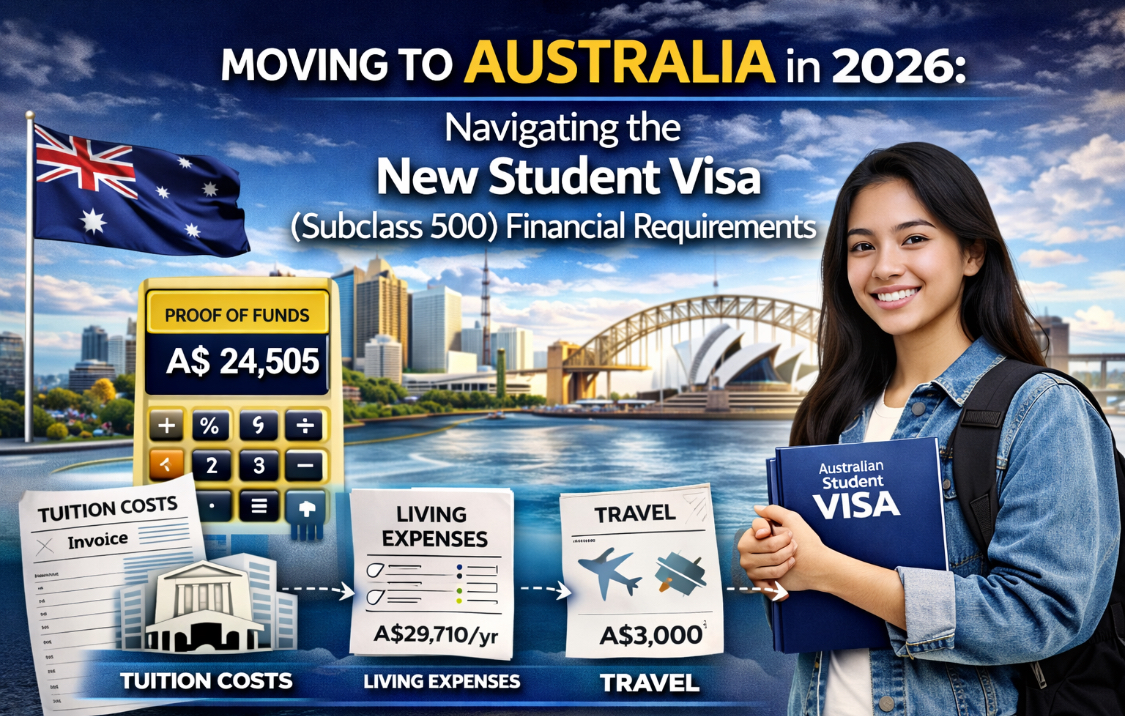
The living cost figure is only one component of what is assessed. What matters is the combined total that reflects your first year in Australia. That total is expected to include tuition, living costs, and travel, all supported by verifiable evidence.
[Total Funds] = (12 Months Tuition) + (Living Costs) + (Travel) + (Dependent Costs)
The structure itself is straightforward. The interpretation is not. Each component is read alongside the others, and inconsistencies are often what trigger deeper review.
- Tuition: Taken directly from the Confirmation of Enrolment (CoE). If part of the fee has been paid, the remaining balance must still be reflected in your available funds.
- Living costs: Based on the AUD 29,710 benchmark. This is not reduced because accommodation may be shared or subsidized.
- Travel: While not always explicitly listed, applications are generally expected to account for return airfare, typically in the range of AUD 2,000 to AUD 3,000.
- Dependents: Added as fixed increments. The Department does not accept approximations here.
There is also an alternative route that appears in some applications — reliance on sponsor income rather than accumulated funds. In this case, the Department expects evidence of consistent annual earnings, typically in the range of AUD 87,856 for a single student, supported by official tax documentation. This is not interchangeable with savings. It is assessed differently and often with more scrutiny.
What becomes clear over time is that the Department is not simply checking whether the total exists. It is assessing whether the total makes sense. A student with no employment history presenting a large balance sourced days before application raises different questions than a student showing gradual accumulation over several years.
There is also a gap between what is required and what is realistic. In cities such as Sydney or Melbourne, rental markets in 2026 have pushed weekly accommodation costs into ranges that were not fully reflected in earlier policy benchmarks. Official material, including the
Study Australia cost guidance, indirectly acknowledges this difference by outlining broader living expectations beyond visa minimums.
For applicants, the implication is simple. Meeting the requirement is necessary. Showing that you can operate comfortably within it is what strengthens the application.
Acceptable Evidence: Passing the “Genuine Access” Test
Most refusals in the current cycle are not linked to insufficient funds. They are tied to how those funds are presented. The Department’s language has shifted toward what it calls “Genuine Access”—a standard that goes beyond visibility. The expectation is that funds are not only available but also immediately usable for tuition, rent, and daily expenses.
The distinction sounds subtle, but in practice it has changed how applications are read. A strong file does not just show numbers. It shows movement, origin, and accessibility in a way that holds up under verification.
The official position is outlined within the broader Genuine Student requirement guidance, where financial capacity is assessed alongside personal circumstances and study intent. That connection is now enforced more strictly than it was even a year ago.
1. Bank Statements and Financial History
Bank statements remain the most common form of evidence, but they are no longer treated as static proof. What matters is the pattern over time. Case officers are increasingly attentive to how funds accumulated, not just where they sit on the day of submission.
- Stability over time: While three months is often referenced informally, a six-month history provides a more consistent narrative. Sudden changes tend to invite closer review.
- Source clarity: Large deposits require explanation. A sale of property, a business payout, or a financial gift must be supported with documentary evidence such as contracts, transfer records, or signed declarations.
- Immediate accessibility: Funds held in fixed deposits or savings instruments must be accompanied by a bank confirmation that they can be liquidated without restriction.
In practice, the most persuasive bank profiles are those that look ordinary. Regular inflows, predictable balances, and gradual accumulation tend to align more naturally with the Department’s expectations than accounts that show sudden, unexplained growth.
2. Education Loans
Loans occupy a different position in assessment. Because they involve institutional review, they are often treated as independently verified evidence of financial capacity. That said, not all loan documents carry equal weight.
- Formal sanction letters: The document should confirm that the loan has been approved, not merely pre-qualified. “In-principle” approvals tend to be insufficient.
- Recognized institutions: The issuing bank must be regulated. Informal lenders or unverified sources are not considered reliable.
- Clear disbursement terms: The letter should specify how and when funds will be released, particularly in relation to tuition payments.
Where loans are used, the Department is effectively relying on the bank’s due diligence. This does not remove scrutiny, but it shifts part of the verification process to an external institution.
3. Sponsored Funds and Family Support
Family sponsorship remains acceptable, but the threshold for credibility has increased. The relationship between the applicant and the sponsor is now examined alongside the financial documents themselves.
Observation from recent applications: Sponsors such as parents or spouses are generally straightforward. More distant relationships—extended relatives or non-family sponsors—require additional explanation, including the nature of the relationship and the reason for financial support.
Income-based sponsorship follows a separate pathway. In those cases, tax returns, employment verification, and salary statements are reviewed to confirm that the sponsor’s income can realistically sustain the applicant’s education.
Consistency is again central. A sponsor whose financial profile does not align with the scale of support being claimed will almost always trigger further review.
4. Scholarships and Partial Funding
Scholarships simplify part of the calculation, but they do not remove it. The Department treats scholarship funding as one component of the total, not a substitute for financial evidence.
The key requirement is clarity. The scholarship letter must state what is covered—tuition, living costs, insurance, or a stipend—and what remains the applicant’s responsibility. Where gaps exist, they must be supported through separate financial evidence.
Applicants who are building a broader funding strategy often combine scholarships with personal or sponsored funds. In that context, exploring additional opportunities such as
fully funded scholarships for international students or structured programs like
Erasmus Mundus can reduce the financial burden that needs to be demonstrated independently.
The principle remains consistent. Every part of the financial structure must connect logically. Scholarship funding reduces what you need to show, but it does not replace the need to demonstrate access to whatever remains.
How Evidence Is Actually Read
What emerges across successful applications is a pattern that is less about documents and more about coherence. Strong submissions present a financial story that aligns across every element—bank records, sponsor information, course costs, and personal background.
Where inconsistencies appear, they tend to compound. A sudden deposit, an unclear sponsor relationship, or a mismatch between claimed income and available funds can shift an application from straightforward processing into extended review.
In the current 2026 climate, the difference between approval and delay often sits in that gap. Not in the presence of funds, but in how convincingly those funds behave as real, accessible resources.
The Real Cost vs. The Required Cost: Understanding the Gap
The figure published by the Department—currently set around AUD 29,710 per year—is often misunderstood as a realistic estimate of living expenses. In practice, it functions as a regulatory baseline. It is designed to test financial readiness, not to reflect actual spending patterns across Australian cities.
This distinction becomes more obvious once students arrive. The official benchmark represents roughly 75% of the national minimum wage, a policy adjustment introduced to reduce financial pressure and limit over-reliance on part-time work. However, market conditions—especially in housing—have continued to shift beyond that baseline.
Data from Study Australia’s cost guidance and university estimates consistently show that actual weekly expenses vary significantly depending on location. Sydney and Melbourne, in particular, operate at a noticeably higher cost level than the national average.
| Expense Category | Typical Weekly Range (AUD) | Context |
|---|---|---|
| Accommodation (Shared) | $250 – $450 | Varies by distance from city centre |
| Food & Groceries | $100 – $180 | Cooking reduces overall cost |
| Transport | $30 – $60 | Student concessions vary by state |
| Utilities & Internet | $25 – $50 | Often bundled in student housing |
When these figures are projected across a full year, the gap between the visa benchmark and lived reality becomes clear. In many cases, students find that their actual expenses exceed the minimum requirement by 15–30%, particularly in high-demand rental markets.
This gap does not invalidate the Department’s requirement. It reinforces its purpose. The benchmark is a floor—an entry condition designed to ensure baseline stability. It is not a guarantee that the amount will be sufficient in every context.
Why This Gap Matters in Applications
Financial evidence is assessed against the benchmark, but credibility is shaped by how realistic the financial plan appears. Applicants who present only the exact required amount, with no margin or explanation, often appear less prepared than those who demonstrate a broader understanding of actual costs.
In recent application cycles, stronger profiles tend to include a small buffer above the official threshold. This does not need to be excessive. Even a modest surplus signals that the applicant has considered exchange rate fluctuations, rental variability, and incidental expenses.
The difference is subtle but important. One approach meets the requirement. The other anticipates the environment.
The Overlooked Cost: Overseas Student Health Cover (OSHC)
One cost that rarely appears in financial discussions—but remains mandatory for every Subclass 500 applicant—is Overseas Student Health Cover (OSHC). Unlike tuition or living expenses, OSHC is not part of the Department’s financial benchmark. However, it is a non-negotiable requirement for visa approval.
According to the official Department of Home Affairs Subclass 500 guidance, applicants must hold adequate health insurance for the entire duration of their stay in Australia. This is typically arranged before visa lodgement and must remain valid throughout the course period.
In practical terms, OSHC introduces an additional financial layer that is easy to underestimate. Annual costs generally range from approximately AUD 600 to AUD 1,000 or more, depending on the provider, level of coverage, and whether dependents are included. For students bringing family members, the cost increases accordingly.
What makes OSHC significant is not just its mandatory status, but its position outside the standard financial calculation. Because it is often paid upfront or bundled into institutional offers, applicants sometimes exclude it from their broader financial planning.
From an assessment perspective, this omission does not usually lead to refusal on its own. However, it can contribute to a wider impression that the applicant has not fully accounted for the real cost of studying in Australia.
Applicants who treat OSHC as part of their total financial structure—rather than a separate administrative requirement—tend to present more complete and realistic financial profiles. It is a small detail, but one that reinforces the overall credibility of the application.
Where Applications Break: Common Financial Mistakes
Patterns across refusal cases are remarkably consistent. They rarely involve dramatic errors. More often, they stem from assumptions—small gaps between what applicants believe is acceptable and what the Department actually expects.
1. Treating the Minimum as a Strategy
Presenting exactly the required amount without context may technically satisfy the rule, but it does not always satisfy the assessment. The Department is not only checking whether the funds exist. It is assessing whether the applicant is financially prepared for the conditions they will face.
A narrow margin leaves no room for variability. That absence of buffer can shift an application into a more cautious review category.
2. Ignoring Financial Narrative
Documents without explanation create friction. A bank statement may show sufficient funds, but without context—how those funds were accumulated, why they are available, how they relate to the applicant’s background—the file remains incomplete.
Strong applications often include a short financial declaration or supporting explanation that connects the documents into a coherent narrative. It does not need to be lengthy. It needs to be clear.
3. Over-reliance on a Single Source
Applications built entirely around one funding source—especially when that source lacks depth or history—tend to attract additional scrutiny. Diversification is not required, but where possible, combining sources (savings, income, scholarship, or loan) can strengthen credibility.
This becomes particularly relevant for applicants whose financial profile depends heavily on sponsorship. In such cases, the sponsor’s financial stability becomes inseparable from the applicant’s own assessment.
4. Misalignment with Personal Circumstances
The Department reviews financial evidence alongside the applicant’s broader profile. Age, employment history, and academic progression all influence how financial documents are interpreted.
An applicant with several years of professional experience but no personal savings may raise questions about financial planning. Similarly, a large financial backing that appears disconnected from the applicant’s background can lead to requests for clarification.
The underlying principle is consistency. Financial evidence should reflect the applicant’s life trajectory, not contradict it.
5. Assuming Documentation Speaks for Itself
One of the more persistent misconceptions is that strong documents eliminate the need for explanation. In reality, the opposite tends to be true. The more complex the financial structure, the more important it becomes to guide the reader through it.
This is particularly relevant in cases involving multiple accounts, transfers across currencies, or layered sponsorship. Without context, even legitimate financial arrangements can appear fragmented.
Practical note: A concise one-page financial summary explaining sources, amounts, and intended use often improves clarity more than additional documentation alone. It allows the case officer to understand the structure without reconstructing it manually.
The pattern across all these cases is not complexity. It is alignment. Applications that present financial evidence as a connected system—rather than isolated documents—tend to move through assessment with fewer interruptions.
A Practical Readiness Check Before You Submit
By the time most applicants reach the final stage of their Subclass 500 submission, the focus is usually on completeness—making sure every document is uploaded and every field is filled. What tends to matter more is internal consistency. The Department is not reviewing documents in isolation. It is reading them as a single file.
A short internal audit before submission often reveals issues that are not obvious at first glance. These are not major errors. They are small misalignments that, when combined, create doubt about whether the financial structure holds under scrutiny.
- • Currency alignment: If funds are held in a local currency, have you calculated the equivalent using a realistic exchange rate on the day of application? Minor fluctuations can affect whether you meet the benchmark.
- • Tuition accuracy: Does the tuition figure in your financial evidence match the amount listed on your Confirmation of Enrolment (CoE), after subtracting any payments already made?
- • Living cost coverage: Is the full annual benchmark accounted for, independent of tuition or travel costs?
- • Dependent additions: If applicable, have all dependent costs been included using the official figures?
- • Source explanation: Can every major amount in your account be traced clearly to its origin without ambiguity?
- • Travel provision: Have you included a realistic allowance for return airfare, typically in the AUD 2,000–3,000 range?
What matters here is not perfection. It is coherence. When every figure aligns with the CoE, the bank record, and the narrative presented in the application, the file becomes easier to assess and less likely to be escalated for additional review.
The 2026 Selection Climate: Why Precision Now Matters More
The policy environment surrounding student visas has become more structured over the past year. One of the more notable shifts is the introduction of Ministerial Direction 115, which reshaped how applications are prioritised and assessed across different risk tiers.
While the Direction itself focuses on processing priority rather than financial thresholds, its effect is indirect but noticeable. Applications that present clear, well-aligned evidence tend to move faster through the system. Files that require interpretation or clarification are more likely to be delayed.
This is not about stricter rules in a formal sense. The financial requirements themselves remain defined by the Department’s published benchmarks. The difference lies in how consistently those requirements are applied across varying applicant profiles.
In the current cycle, financial evidence is no longer treated as a standalone checklist item. It is part of a broader assessment that includes study intent, personal history, and the credibility of the applicant’s overall plan. When those elements reinforce each other, the application reads as stable. When they diverge, the assessment slows down.
Consistency Over Volume
There is a tendency among applicants to compensate for uncertainty by adding more documents. Additional evidence can help, but only when it strengthens the narrative. Excess documentation without clear structure often creates the opposite effect.
Applications that perform well tend to be concise but complete. Each document supports a specific part of the financial story. There are no unexplained gaps, and no elements that contradict the broader profile.
This is particularly relevant for applicants with complex financial arrangements. In those cases, clarity becomes more valuable than quantity. A well-structured explanation supported by key documents is often more effective than a large volume of unconnected files.
Verification Is No Longer Theoretical
Another development that has become more visible in 2026 is the increased use of direct verification. Banks, employers, and sponsors may be contacted to confirm the details provided in the application.
These checks are not applied to every case, but they are frequent enough to shape how applications should be prepared. The implication is straightforward: every figure presented should be defensible in real time.
A sponsor who is unaware of the amount declared, or a bank record that cannot be explained when questioned, introduces risk that is difficult to reverse once the application is under review.
Observed pattern: Applications that anticipate verification—by ensuring sponsors understand the documents and figures submitted—tend to move more smoothly through assessment than those that treat documentation as a one-way submission.
Final Observations
Financial requirements for the Subclass 500 visa have not become complicated in themselves. The figures are published, and the categories are clearly defined. What has changed is the level of alignment expected between those figures and the applicant’s overall profile.
Applicants who approach financial evidence as a structured system—rather than a checklist—tend to avoid the most common points of friction. The difference is rarely in how much is shown. It is in how convincingly that amount behaves as accessible, stable funding for study in Australia.
There is also a broader context that sits behind these requirements. The adjustment of the living cost benchmark was not introduced in isolation. It reflects a wider policy direction aimed at ensuring that students can sustain themselves without excessive reliance on work, particularly during the early stages of their stay.
In that sense, the requirement is not only administrative. It is predictive. It attempts to model whether an applicant will be able to focus on study under real conditions.
For applicants preparing now, the practical takeaway is straightforward. Build your financial evidence in a way that reflects how you will actually live—covering tuition, rent, and daily expenses with a margin that accounts for variation. When that structure is clear, the application becomes easier to assess, and the outcome becomes more predictable.
For the most current requirements and any mid-cycle updates, always refer directly to the official Department of Home Affairs page:
Student Visa (Subclass 500).
Policies can be adjusted without long notice, and official guidance remains the only definitive reference.
Note: This analysis reflects publicly available Department of Home Affairs guidance and observed application patterns as of April 2026. It is intended for informational purposes and does not replace professional migration advice.

Lead Content Strategist at The Global Scholar Guide, specializing in scholarship research, relocation guidance, and international education content.