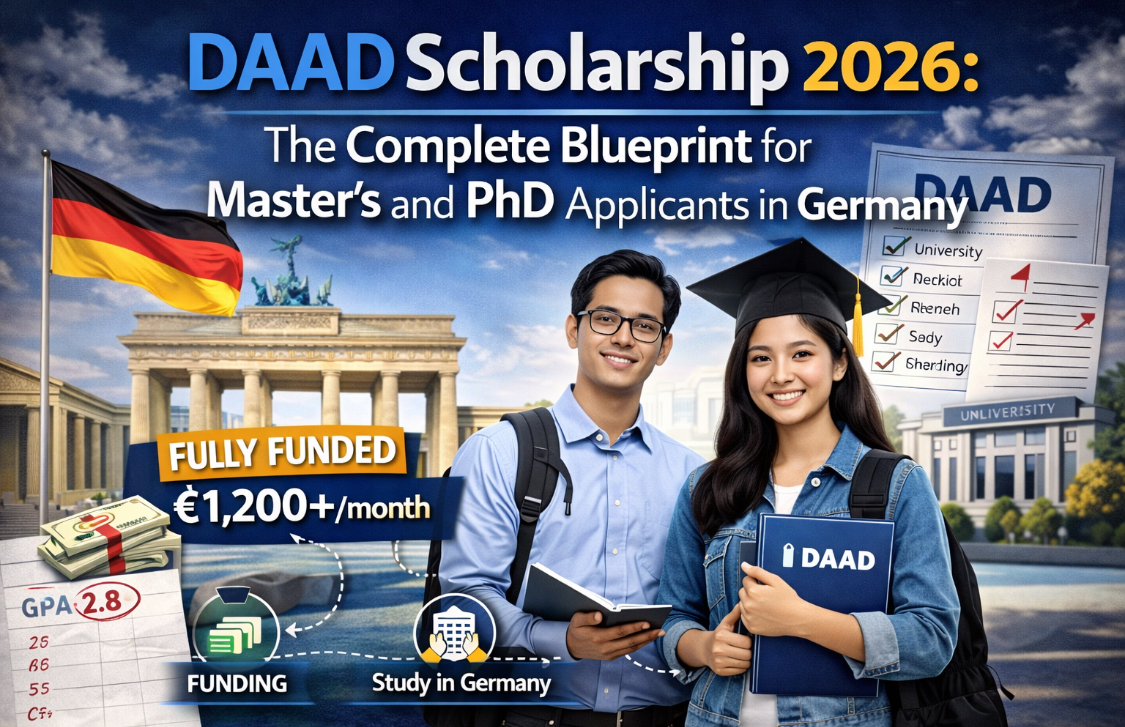
A strategic roadmap for navigating the world’s most prestigious academic funding for the 2026/2027 cycle.
Securing a fully funded Master’s or PhD in Germany is more than an academic milestone; it is a life-altering career pivot. For 2026, the German Academic Exchange Service (DAAD) remains the gold standard for international funding, offering a package that covers everything from monthly stipends and travel to comprehensive health insurance. However, with thousands of brilliant minds competing for a limited number of slots, the difference between a rejection and an award letter usually lies in the technical precision of the application.
This isn’t just another list of requirements. This is a 2026 Blueprint designed to help you navigate the DAAD’s specific preferences, from the rigorous EPOS deadlines to the nuanced demands of a German-style research proposal. Whether you are aiming for a Master’s in all disciplines or a specialized PhD track, this guide breaks down the “why” and “how” behind a successful candidacy.
Also relevant: Can You Get a Full Scholarship with a Low GPA? 5 Proven Strategies
Transversal Sustainability
For the 2026 cycle, DAAD selection committees are placing an unprecedented premium on “Transversal Sustainability.” It is no longer enough to be a top student in your field. Applicants who can demonstrate how their specific research—whether in Law, Music, or Engineering—contributes to the European Green Deal or regional development goals in their home country are seeing significantly higher success rates. We will explore how to weave this “Impact Narrative” into your documents in the sections below.
Before diving into the paperwork, it is vital to consult the official DAAD scholarship database to identify your specific program code, as the “DAAD” is actually an umbrella for dozens of distinct funding tracks.
DAAD Scholarship Benefits: What is on the Table for 2026?
The DAAD doesn’t just pay for your school; they invest in your presence in Germany. Most public universities in Germany charge little to no tuition, so the scholarship focuses on your quality of life and professional integration. Based on the current 2026 framework, here is what the funding typically includes:
| Benefit Category | Master’s Candidates | PhD / Research Grants |
|---|---|---|
| Monthly Stipend | Approx. 934 € | Approx. 1,300 € |
| Health Insurance | Fully Covered | Fully Covered |
| Travel Allowance | Flat-rate (Country specific) | Flat-rate (Country specific) |
| Language Prep | Mandatory 2–6 months | Available / Research-based |
| Research Subsidy | One-time allowance | Annual research grant |
Beyond the finances, the “hidden” value of the DAAD is the Alumni Network. Being a “DAAD Scholar” is a lifelong title in Germany that opens doors to high-level networking events and exclusive research symposiums. For those pursuing development-related courses (EPOS), the benefits often extend to family allowances and rent subsidies if the cost of living in your host city exceeds a certain threshold.
As noted in the official information for applicants, these rates are subject to adjustment based on inflation and federal budget changes—always verify the final award letter details.
Eligibility Criteria: The “Gatekeeper” Phase
The DAAD is famously strict about its formal requirements. If you miss a single technical marker, your application is often filtered out before a human even reads your motivation letter. For 2026, pay close attention to these three core pillars:
- 01.
The 6-Year Rule: Your last academic degree (Bachelor’s or Master’s) must not have been completed more than six years ago at the time of the application deadline. While there are rare exceptions for parental leave or military service, this is a firm cutoff for 95% of applicants. - 02.
Professional Experience: For the EPOS (Development-Related) track, you must prove at least two years of relevant work experience after your Bachelor’s degree. This must be documented with official employer letters. - 03.
Language Proficiency: You do not necessarily need to speak German if your program is in English. However, you must provide a valid IELTS (usually 6.0–6.5) or TOEFL (80+). For German-taught programs, a TestDaF 4 or DSH-2 is standard. Even if your university says it’s not required, the DAAD FAQs confirm a certificate is mandatory for the scholarship application.
The 2026 Application Roadmap: Timing is Everything
Applying for the DAAD is a 12-month marathon. Because deadlines vary wildly between individual universities and the general DAAD portal, you must work backward from your desired start date (usually October 2026).
Strategic Insight: The “Dual-Track” Submission
One of the most common mistakes is not realizing that for many EPOS programs, you apply directly to the university, which then nominates you to the DAAD. For “All Disciplines” Master’s grants, you apply directly via the DAAD Portal. Confusing these two tracks is an instant disqualification.
Critical 2026 Timelines
| Phase | Timing (2025–2026) | Action Item |
|---|---|---|
| Research | April – June 2025 | Identify 3 courses in the EPOS 2026/27 Brochure. |
| Preparation | July – August 2025 | Take IELTS/TOEFL and request recommendation letters. |
| Submission | Sept – Nov 2025 | Submit to University (EPOS) or DAAD Portal (General). |
| Selection | Jan – March 2026 | Shortlisting and (optional) interviews. |
| Arrival | Sept – Oct 2026 | Language course start / University enrollment. |
For PhD candidates, the timeline is slightly different. Most research grants require you to have a Letter of Invitation from a German supervisor before you apply. Finding a supervisor can take 3–6 months alone, so if you are aiming for a 2026 start, your outreach should begin immediately.
The Document Blueprint: Formatting for German Standards
For the 2026 intake, the DAAD portal requires all uploads to be in PDF format. However, the content within those PDFs must follow specific European conventions. Below is the essential checklist and the “pro-tips” that differentiate a standard application from a winning one.
1. The CV (Europass Format)
Do not use a creative or colorful resume. The DAAD selection committee prefers the Europass CV. It is a chronological, clean, and highly structured format that allows reviewers to scan your academic and professional milestones in seconds.
- The Gap Rule: Ensure there are no unexplained gaps in your timeline. If you took six months for independent research or family care, state it.
- Reverse Chronology: Always start with your most recent activity.
- Signature: In Germany, a CV is often considered a formal declaration. Don’t forget to hand-sign and date your CV at the bottom before scanning it.
2. Letters of Recommendation (Academic & Professional)
For Master’s applicants, one academic letter is standard. For EPOS, a professional letter is also required. These must be on official letterhead, signed, and—crucially—recently dated. A recommendation letter from 2022 will likely be rejected for a 2026 application.
Technical Note on Translation:
If your transcripts or certificates are not in English or German, they must be translated by a certified translator. High-resolution scans of both the original and the translation are required.
3. Proof of Employment (The “2-Year” Evidence)
For development-related courses, the DAAD requires proof of at least 24 months of work experience. This document must state your position, your start/end dates, and a brief description of your responsibilities. If you are still employed, the letter should state “to the present.”
| Document | Requirement | 2026 Best Practice |
|---|---|---|
| DAAD Application Form | Generated in Portal | Double-check your 8-digit application ID. |
| University Degree | Certified Copy | Include Diploma Supplement if available. |
| Language Cert | IELTS/TOEFL/TestDaF | Must be valid through late 2025. |
As per the DAAD application process guide, ensure that your name on all documents matches your passport exactly. Small discrepancies in spelling can cause significant delays in the portal’s automated verification system.
The Heart of the Application: Winning Motivation Letters & Research Proposals
The DAAD selection committee reviews thousands of applications with high GPAs. What separates the “A-list” from the rest is a narrative that connects your past achievements to Germany’s current academic strengths and your home country’s future needs. For 2026, you must articulate a “Transversal Impact.”
1. The 2026 Motivation Letter Framework
A standard 1–2 page letter (no longer!) should follow this high-level structure:
- The Hook (The “Why Germany”): Don’t just say Germany is a great country. Mention specific industry leaders, German research institutes (like Fraunhofer or Max Planck), or a specific methodology taught in your chosen course that isn’t available elsewhere.
- The Bridge (Academic & Professional Match): Link your 2+ years of work experience to the modules of the Master’s or PhD. Show that you aren’t just “ready to learn,” but that you have a foundation to contribute to the classroom discussion.
- The Impact (Home Country Re-integration): This is non-negotiable for EPOS. How will your degree solve a specific problem in your home country? Use data. Mention UN Sustainable Development Goals (SDGs).
Sample Excerpt Analysis: What Works
“…While my background in civil engineering has focused on urban expansion in Lagos, the 2026 DAAD EPOS program in ‘Sustainable Energy Systems’ offers the specific circular economy frameworks necessary to transition our grid to decentralized solar—a move that aligns with Nigeria’s 2030 Energy Transition Plan.”
Why this works:
- It names a specific location and problem.
- It mentions a national policy (Energy Transition Plan).
- It uses the “Circular Economy” buzzword relevant to 2026 selection trends.
2. For PhDs: The Research Proposal
If you are applying for a PhD, your proposal is your contract. Unlike some countries where you find a topic after arrival, the DAAD requires a clear roadmap up-front. As per the DAAD guidance on motivation, your PhD proposal must include:
- Clear Problem Statement: What is the gap in current global research?
- Methodology: Will you use qualitative, quantitative, or mixed methods? Be specific about the German labs or archives you intend to use.
- Timeframe: A realistic 36–42 month schedule.
Common Pitfalls to Avoid
Based on 2025 feedback loops, here are the “red flags” that lead to instant rejection:
- AI-Generated Prose: Committees are using advanced detection. If your letter sounds like a dictionary and lacks personal anecdotes, it will be flagged.
- Exceeding Word Counts: Stick to the 2-page limit. Respecting the committee’s time is a sign of professional maturity.
- Ignoring the “Why This University”: Do not send the same letter to three different universities. Mention specific professors or modules unique to each course.
Selection Procedure: The Independent Committee
Once your application passes the formal technical check, it moves to an independent selection committee. These committees are comprised of German university professors and regional experts. They do not look for the “smartest” person on paper; they look for the most purposeful. For the 2026 cycle, they are specifically weighing academic merit (60%) against the potential impact on your home country (40%).
In some cases, particularly for regional programs, you may be invited for a 20-minute interview (often via Webex or at a local DAAD regional office). If shortlisted, be prepared to defend your research proposal or explain why a specific German city (like Bonn, Berlin, or Stuttgart) is the only place your research can thrive.
Honest Trade-offs: The 2026 Competitive Landscape
While the DAAD is a “dream” scholarship, a professional blueprint must address the challenges. Success rates for the most popular programs (like International Health or Renewable Energy) hover between 10% and 15%. To remain realistic, keep these points in mind:
- The Waiting Game: If you apply in October 2025, you may not receive a final “Yes” until February or March 2026. Do not quit your current job until the formal award letter is in your hand.
- The Recency Bias: The DAAD strictly favors those who are actively engaged in their field. If you have been unemployed for a long stretch without a clear academic reason, your chances drop significantly.
- Cost of Living Spikes: While 992 € is a generous stipend, cities like Munich or Hamburg are becoming increasingly expensive. The DAAD may provide a rent subsidy, but you must be prepared to budget strictly.
Conclusion: Your 2026 Action Plan
The 2026/2027 academic cycle in Germany is more than a degree; it is a strategic alignment with the future of global development and research. To succeed, stop viewing the DAAD as a “prize” and start viewing it as a partnership. Germany provides the funding; you provide the expertise and the impact.
Take it Further: The Ultimate Chevening Scholarship Guide: Winning the 2,800-Hour Rule and the Four-Essay Strategy
Next Steps:
- Download the 2026/27 EPOS Deadlines PDF to mark your calendar.
- Draft your Europass CV today—leave no gaps.
- Refine your “Impact Narrative” around the themes of sustainability and regional growth.
For the most current updates on specific program calls, always refer to the DAAD Applicant Information Portal and cross-reference with your chosen university’s international office.

Lead Content Strategist at The Global Scholar Guide, specializing in scholarship research, relocation guidance, and international education content.