
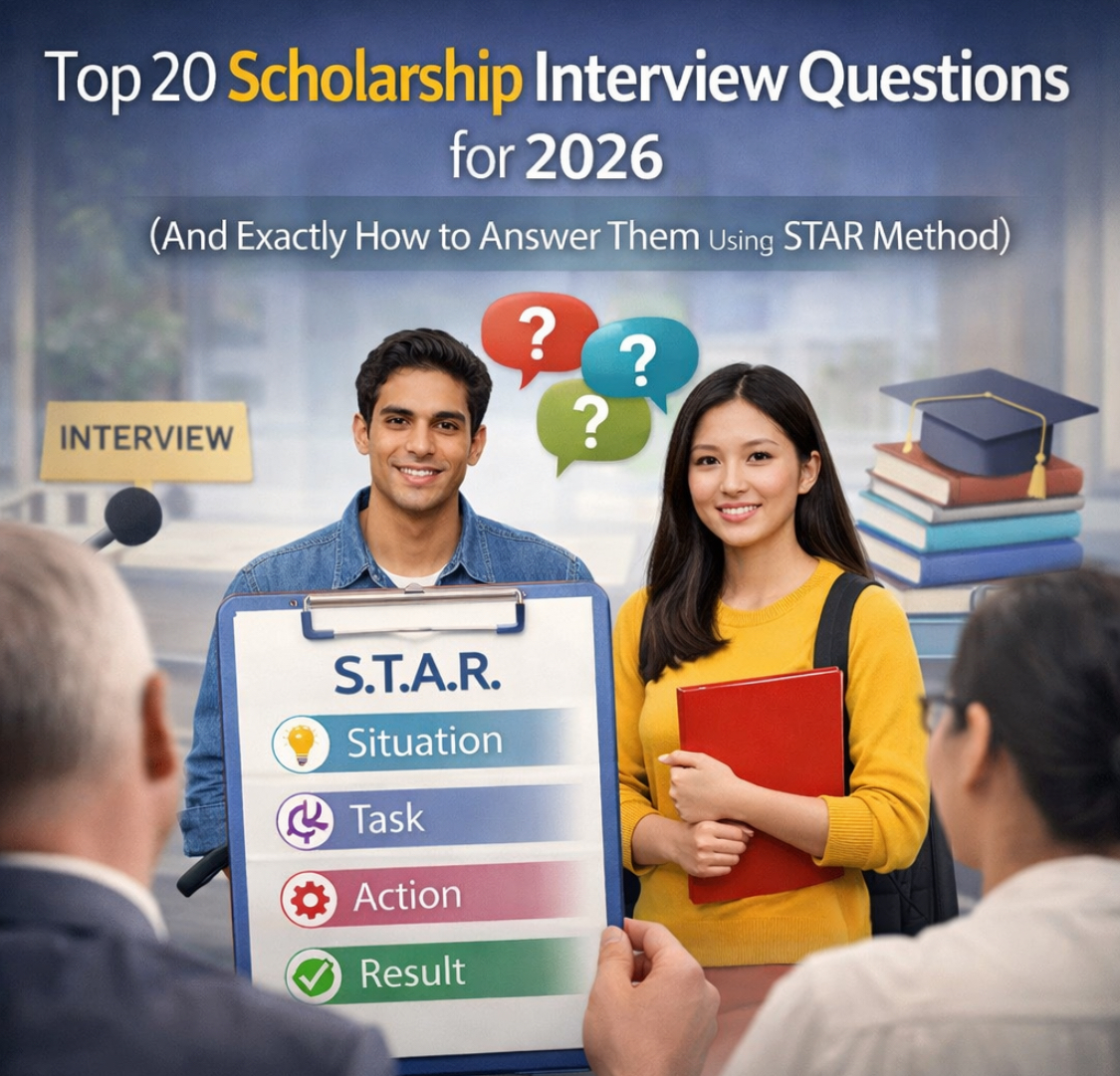
In the 2026 scholarship landscape—whether you are eyeing Chevening, DAAD, Fulbright, or Erasmus Mundus—the interview is no longer a formality. It is a high-stakes assessment of your leadership, resilience, and vision. While your essays got you through the door, your ability to articulate your story will determine if you walk out with a fully-funded award.
The most common reason brilliant candidates fail is not a lack of achievement, but a lack of structure. This guide breaks down the 20 most frequent scholarship interview questions and provides a blueprint for answering them using the STAR Method—a technique that turns abstract claims into undeniable evidence of your potential.
A Note on Authenticity for 2026:
Panels are increasingly trained to spot “AI-generated fluff” or overly rehearsed, generic answers. While the templates below provide a winning structure, you must populate them with your real-life experiences. Use this guide to organize your thoughts, not to replace your voice.
Mastering the STAR Method: Your Secret Weapon
For behavioral questions (those starting with “Tell me about a time…”), the STAR Method is the gold standard. It ensures you don’t ramble and that you hit the points the panel is scoring you on:
- S – Situation: Set the scene briefly (10-15 seconds). What was the context?
- T – Task: What was the specific challenge or responsibility you faced?
- A – Action: The most important part. What specifically did you do? Use “I” statements, not “we.”
- R – Result: What was the outcome? Use numbers or quantifiable impact where possible.
In the sections below, we apply this logic to the questions that define the 2026 interview cycle.
Incase you missed it: The 5 Cheapest Cities for International Students: Europe & North America
Phase 1: The Personal Narrative & Motivation
The first five minutes of your interview are about alignment. The panel wants to see if your personality and goals match the values of the awarding body.
1. Tell us about yourself.
Why they ask: To see how you prioritize information and to break the ice. They aren’t looking for your life story; they want a professional “elevator pitch.”
“I am a [Your Profession/Field] with a passion for [Specific Interest]. Over the last three years, I have focused on [Key Achievement], which led me to realize that to solve [Problem in Home Country], I need the advanced training offered by this scholarship. Outside of work, I advocate for [Volunteering/Hobby], which keeps me grounded in my community’s needs.”
2. Why do you deserve this scholarship?
The Approach: Don’t focus on “need.” Focus on return on investment (ROI). You are a vehicle for the scholarship’s goals.
Winning Angle: Highlight that you have the academic foundation to succeed and the social commitment to ensure the funding benefits more than just yourself.
3. Why did you choose this specific program or course?
Why they ask: To ensure you’ve done your homework. 2026 panels for DAAD or Erasmus Mundus look for “academic fit.”
“I chose this Master’s because of the specific module on [Module Name] and the opportunity to work with [Professor/Research Group]. Unlike other programs, this one bridges the gap between [Subject A] and [Subject B], which is exactly what my career in [Your Field] requires.”
4. Why this country for your studies?
Context: Crucial for Chevening (UK) or Fulbright (USA). They want “Cultural Ambassadors,” not just students.
Tip: Mention a specific aspect of the country’s industry or academic history that is superior to others in your field.
5. What are your career goals? (Short, Medium, and Long-Term)
The Approach: Use the SMART framework (Specific, Measurable, Achievable, Realistic, Timely). Panels love candidates who can visualize their 10-year impact.
- Short-term: Graduating and implementing a specific skill.
- Medium-term: Reaching a management or specialist role in your home country.
- Long-term: Influencing policy or leading a major national/international project.
Phase 2: The “Big Three” — Leadership, Influence, and Networking
In 2026, scholarship panels aren’t just looking for smart students; they are looking for future influencers. These behavioral questions require you to prove your soft skills through past actions. This is where the STAR Method becomes mandatory.
6. Tell me about a time you demonstrated leadership.
The STAR Blueprint: Avoid the mistake of thinking leadership requires a “Manager” title. Focus on a time you identified a problem and took initiative.
Sample Answer (STAR):
Situation: Last year, my university’s volunteer group was struggling with a 40% drop in student participation.
Task: As a senior member, I needed to revitalize the group to ensure our community projects didn’t fail.
Action: I organized a digital town hall to listen to student concerns and subsequently launched a mobile-friendly signup portal.
Result: Participation rebounded by 60% within two months, and we successfully launched three new local initiatives.
7. Describe a situation where you influenced or motivated others.
Why they ask: Especially common in Chevening interviews. They want to see empathy and persuasion, not force.
Tip: Pick a story where there was initial resistance. Show how you listened to the “opposing” side and found common ground to move the project forward.
8. Tell me about a time you built or used a professional network.
Context: Scholarship bodies are “Alumni Networks.” They want to know you will be an active, contributing member who can leverage connections for social good.
Sample Result: “…by connecting with a local NGO via LinkedIn, I was able to secure pro-bono legal advice for our student startup, saving us over $2,000 in setup costs.”
9. What is your greatest strength?
The Approach: Don’t just list an adjective. Provide a 30-second “mini-STAR.” If your strength is adaptability, briefly mention a specific time you pivoted during a crisis.
10. What is your greatest weakness?
The Winning Strategy: Be honest, but choose a weakness that is fixable. More importantly, focus on the Action you are taking to improve it. For example, if you struggle with public speaking, mention the workshops or Toastmasters sessions you are currently attending.
Pro-Tip: Panels in 2026 are wary of the “perfectionist” weakness. It sounds cliché. Instead, try “I sometimes find it difficult to delegate when I am passionate about a project, but I am learning to use project management tools like Trello to track my team’s progress more effectively.”
Phase 3: Resilience, Conflict, and Global Impact
In 2026, the global educational climate prizes resilience above almost all else. Panels want to know that when things get difficult in a foreign country, you won’t give up. They also need to see that their “investment” in you will eventually flow back to your community.
11. Tell me about a challenge or failure you faced and what you learned.
The STAR Blueprint: Do not choose a “fake” failure (e.g., “I worked too hard”). Choose a genuine setback and focus 70% of your answer on the Learning and Growth.
Situation: During my final year project, I underestimated the complexity of the data set, leading to a missed preliminary deadline.
Task: I had to recover the lost time without compromising the quality of the research.
Action: I requested a 48-hour extension, stayed in the lab overnight to re-code the analysis, and sought a peer-review from my supervisor to ensure accuracy.
Result: I submitted the project on time, receiving an ‘A’ grade. More importantly, I learned to build 20% “buffer time” into every project timeline I’ve managed since.
12. How do you handle teamwork or conflict?
Why they ask: International classrooms are melting pots. They need to know you are culturally sensitive and professional under pressure.
The Strategy: Describe a time you disagreed with a colleague but prioritized the objective over your ego. Show that you listen first and speak second.
13. How will your home country or community benefit from your studies?
The Approach: This is the “Billion Dollar Question.” Be specific. Don’t just say “I will help people.” Say “I will use my training in Renewable Energy to consult on rural electrification projects in [Your Region], aiming to reduce local energy costs by 15%.”
14. What does leadership mean to you?
Why they ask: To see your philosophical alignment with the scholarship. For 2026, servant leadership and inclusive leadership are the most respected answers.
Tip: Avoid defining leadership as “giving orders.” Define it as “empowering others to achieve a shared goal.”
15. Tell me about a time you took initiative on a project.
The Logic: Initiative is the hallmark of a self-funded-mentality scholar. Show them you don’t wait for instructions to fix something that is broken.
The 2026 “Home Benefit” Reality Check:
Programs like the DAAD EPOS and Chevening have strict mandates to support developing nations. If your answer to Question 13 sounds like you plan to stay in the host country forever, you will likely be disqualified. Your impact must be rooted in your home community.
Phase 4: The Closing Strategy — Winning the “Tie-Breaker”
The final few questions are designed to test your confidence and your plan for 2026. If the panel is torn between two equally qualified candidates, your response to “Why should we choose you?” is your chance to break the tie.
16. What are your plans if you don’t receive this scholarship?
Why they ask: To test your resilience and the “seriousness” of your goals. They want to see that your career isn’t dependent on this money, but rather that this money accelerates a mission you are already on.
“While this scholarship is my primary choice due to its [Specific Benefit], my goal to improve [Issue in Home Country] remains unchanged. If I am not selected, I will apply for a part-time role to self-fund my first year while exploring other financial aid options, as my commitment to this field is long-term.”
17. Do you have any questions for us?
The Trap: Never say “No.” It signals a lack of curiosity. Ask questions that show you are already thinking about your time as a scholar.
Best Questions to Ask: “What qualities do successful scholars in this program usually share?” or “How does the alumni network support scholars once they return to their home countries?”
18. Why should we choose you over other candidates?
The Approach: This is a summary pitch. Reiterate three key points: Your academic readiness, your leadership evidence (STAR), and your specific plan for impact.
19. How do you plan to contribute to our alumni network?
The Logic: As highlighted in official Chevening guidance, networking is a two-way street. Mention a skill you can share—like mentoring younger scholars or organizing local policy workshops.
20. Is there anything else you would like to tell us?
The Strategy: Use this to “save” anything you forgot to mention. If you didn’t get to talk about a major achievement earlier, now is the time to briefly link it to the scholarship’s values.
Quick-Reference: 2026 Interview Strategy Table
| Category | Question Type | Recommended Technique |
|---|---|---|
| Introductory | Personal Background / Goals | Elevator Pitch (60-90 sec) |
| Behavioral | Leadership, Failure, Conflict | STAR Method |
| Strategic | Why Us? / Why Now? | Researched Alignment |
Final Checklist for 2026 Candidates
- Mock Record: Record yourself answering Question 7 and Question 11. Watch for “um” and “uh” habits.
- The 20% Rule: Ensure no more than 20% of your STAR answer is the “Situation.” Spend the bulk of your time on the “Action.”
- Check Your Tech: For virtual interviews, test your lighting and audio 24 hours in advance.
- Alumni Research: Look up 2024/2025 scholars on LinkedIn. What are they doing now? Mentioning their success shows deep research.
Sources & Disclaimer: This guide was compiled from 2025–2026 interview feedback from Chevening, DAAD, and Erasmus Mundus applicants. Sample answers are templates—your authentic story is what will ultimately win the panel over. For official guidelines, always refer to the specific scholarship portal (e.g., daad.de or chevening.org).
Read also: How to Find Student Accommodation in Munich
Frequently Asked Questions: 2026 Scholarship Interviews

Lead Content Strategist at The Global Scholar Guide, specializing in scholarship research, relocation guidance, and international education content.