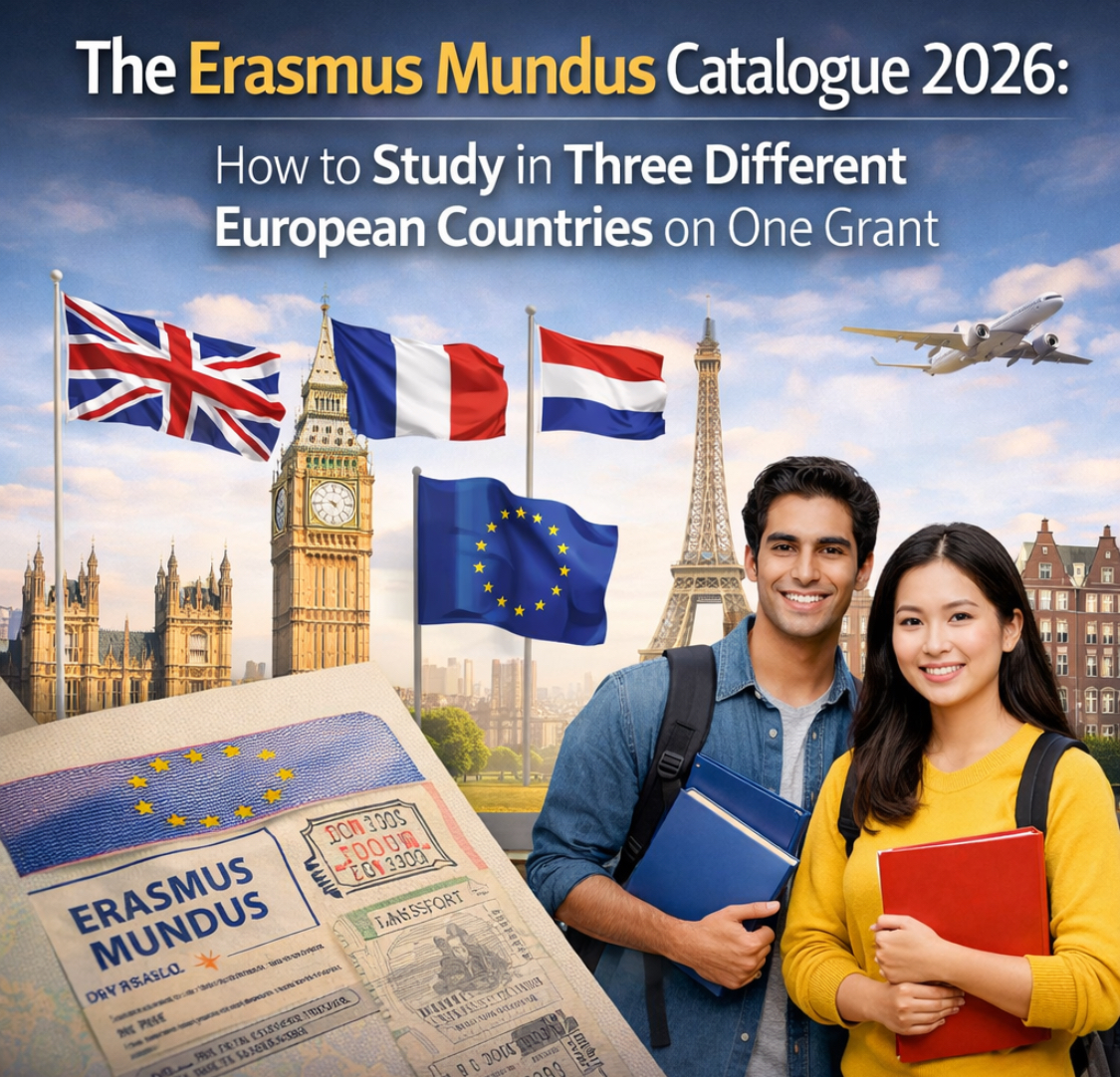
Imagine waking up for your first semester in a historic lecture hall in Montpellier, moving to a cutting-edge research lab in Ghent for your second, and finishing your thesis while overlooking the Baltic Sea in Tallinn. This isn’t a travel itinerary; it is the academic reality of the Erasmus Mundus Joint Masters (EMJM). For the 2026 academic cycle, the newly updated catalogue offers a rare gateway to earning a prestigious degree while living across three or more European borders—all funded by a single, comprehensive grant.
The Erasmus Mundus initiative is the European Union’s flagship for high-level integrated study. Unlike traditional exchange programs, these are full degree programs designed and delivered by a consortium of elite universities. For 2026, the official Erasmus Mundus Catalogue has been refreshed with programs spanning everything from Artificial Intelligence and Cybersecurity to Sustainable Energy and Performing Arts.
A Note on 2026 Competitiveness:
While the opportunity is life-changing, it is exceptionally competitive. Thousands of global applicants vie for a limited number of scholarship slots per program. Success requires more than just good grades; it demands a strategic understanding of how mobility periods function and a highly tailored application. This guide is based on the 2026 Erasmus+ framework—always cross-check specific consortium websites as deadlines and requirements update progressively throughout the year.
In this guide, we dive deep into the 2026 Catalogue mechanics, explaining how the “three-country” model works in practice, the exact breakdown of the “One Grant” financial package, and the step-by-step process to secure your spot in one of the world’s most mobile classrooms.
Also relevant: Top 10 Fully Funded Scholarships for International Students
What Is the Erasmus Mundus Catalogue 2026?
The official Erasmus Mundus Catalogue is more than just a list; it is a live database of all active Erasmus Mundus Joint Masters (EMJM) programs funded under the 2021–2027 Erasmus+ framework. Every year, the European Education and Culture Executive Agency (EACEA) updates this tool to include newly funded consortia and re-selected programs that have proven their academic excellence.
In 2026, the catalogue features over 200 programs. The beauty of this tool lies in its filters—you can search by field of study, specific participating countries (like “Germany” or “Spain”), or even by ECTS credits (60, 90, or 120). This year, as highlighted by industry observers like Scholars Avenue, there is a distinct push toward high-demand tech and sustainability sectors.
2026 Trending Disciplines
While you can find programs in the humanities and social sciences, the 2026 funding cycle has prioritized several “future-proof” fields. If your background aligns with these, your chances of finding multiple relevant programs increase:
| Field of Study | Key 2026 Programs to Watch |
|---|---|
| Digital & Tech | Artificial Intelligence, Cybersecurity (CYBERSURE), and Big Data Management (BDMA). |
| Health & Life Sciences | Marine Biotechnology, Precision Medicine (BeinPM), and Pharmaceutical Materials Science (BIOPHAM). |
| Sustainability | Sustainable Energy, European Forestry (MSc EF), and Environmental Engineering. |
| Social Action | International Humanitarian Action (NOHA) and Security & Strategic Studies (IMSISS). |
Pro-tip: When browsing the catalogue, don’t just look at the title. Click through to the program’s dedicated website. That is where you will find the “Mobility Path,” which details exactly which universities you will move between each semester.
Studying in Three Countries: The “Mobility Path” Explained
The defining characteristic of an Erasmus Mundus Joint Master (EMJM) is its integrated curriculum. You do not simply choose a university; you join a consortium. A consortium is a group of at least three high-level universities from different countries that have designed a single, unified syllabus.
In practice, this means your two-year degree is split into “mobility periods.” As noted by the Erasmus+ 2026 Programme Guide, all students must complete at least two study periods in two countries different from their country of residence. However, most prestigious programs in the 2026 Catalogue are designed with a three-country track:
A Typical 2026 Mobility Example:
- Semester 1 (Fundamentals): University of Montpellier, France.
- Semester 2 (Specialization): Ghent University, Belgium.
- Semester 3 (Advanced Research/Internship): University of Tartu, Estonia.
- Semester 4 (Thesis): Any partner city or an associated industrial partner worldwide.
Joint vs. Multiple Degrees
One of the most common questions for 2026 applicants is: “Which university’s name is on my diploma?” The answer depends on the consortium’s structure, but you will receive one of two high-authority credentials:
- Joint Degree: A single diploma issued on behalf of at least two higher education institutions in the consortium. It is the ultimate symbol of European academic integration.
- Multiple Degrees: Two or more national diplomas issued by the institutions where you spent your mobility periods.
The Logistics Reality:
While the “One Grant” simplifies your finances, mobility adds administrative layers. You may need to navigate different visa requirements for each country, though most EU Member States offer streamlined “student mobility” rules for those already holding an EU residence permit from their first host country.
Explore: The Ultimate Chevening Scholarship Guide: Winning the 2,800-Hour Rule and the Four-Essay Strategy
The Full Benefits: What Does “Fully Funded” Actually Mean?
The Erasmus Mundus grant is often cited as the “Gold Standard” of international scholarships. It is designed so that your academic focus remains entirely on your studies and cross-border research, rather than part-time jobs or financial stress. For the 2026/2027 intake, the scholarship has been streamlined into a monthly unit cost model that covers almost every conceivable expense.
| Benefit Component | Coverage Details (2026/2027) |
|---|---|
| Participation Costs | 100% Covered. This includes all tuition fees, library access, and mandatory lab fees across all partner universities. |
| Monthly Subsistence | €1,400 per month for the full duration (up to 24 months). This covers rent, food, and local transport. |
| Travel & Installation | Included in the unit cost. Some programs offer an advance payment of €1,000–€2,400 to help with initial flights and visas. |
| Health Insurance | Full European coverage. Comprehensive accident and sickness insurance for the entire 2-year period. |
According to the official Erasmus+ Individual Opportunity portal, the total value of the scholarship over two years can exceed €35,000 to €45,000 depending on the participation costs of your specific consortium.
The “Hidden” Perks of the Grant
Beyond the bank transfers, being an Erasmus Mundus scholar in 2026 provides access to a powerful ecosystem that a standard Master’s degree cannot match:
- The Alumni Network (EMA): You join a global community of over 50,000 former scholars who hold leadership positions in the EU, UN, and Fortune 500 companies.
- Language Grants: Many consortia provide extra funding or free intensive courses for the languages of your mobility countries (e.g., German, French, or Estonian).
- Visa Assistance: While you pay for the visa, the consortium provides a “Scholarship Award Letter” which is a high-authority document that virtually guarantees visa approval in most EU jurisdictions.
A Transparent Weakness:
The stipend is generous but fixed. If your mobility track takes you to high-cost cities like Zurich, Paris, or Copenhagen, you will need to budget carefully. €1,400 goes much further in Lisbon or Warsaw than it does in Oslo. Always research the cost of living for your specific mobility cities before you depart.
How to Apply: The 2026 Roadmap
The application window for the 2026/2027 intake generally opens in October 2025 and closes between January and March 2026. Unlike other scholarships where you apply to a central body, for Erasmus Mundus, you apply directly to the consortium of your chosen program.
The 5-Step Submission Process:
- Shortlist via the Catalogue: Identify up to three programs that align with your career. While the Erasmus Mundus Association (EMA) notes that the official “limit of 3” rule was relaxed in recent years, most experts advise sticking to 3 high-quality applications rather than 10 generic ones.
- Gather Core Documents: You will need your Bachelor’s degree (or a certificate of enrollment if you graduate by August 2026), official transcripts, and a valid Passport.
- Standardized Testing: Most programs require an IELTS (6.5+) or TOEFL (90+). For 2026, many consortia are also accepting Duolingo English Test scores—check each program’s specific “Admission” page for confirmation.
- The Motivation Letter (LOM): This is the heart of your application. Do not just list your grades; explain how the specific mobility path (e.g., moving from Italy to Portugal) benefits your research goals.
- Recommendation Letters: You typically need two academic references. In 2026, some programs now use automated portals where your professors upload letters directly.
Success Tips & Common Pitfalls
According to 2026 success stories shared via Scholars Avenue, the students who win the grant are those who demonstrate “Intercultural Resilience.”
- Tailor, Don’t Copy: Using the same Motivation Letter for two different programs is the fastest way to a rejection. Each consortium has different “buzzwords” and focus areas.
- The 12-Month Residency Rule: For some programs, if you have lived or worked in Europe for more than 12 months in the last five years, you may be classified under a different scholarship category. Read the fine print!
- Check “Re-funded” Status: In the 2026 Catalogue, look for programs labeled as “Newly Selected.” These often have a fresh batch of scholarship slots and may be slightly less saturated than decades-old programs.
Final Verdict
The Erasmus Mundus Catalogue 2026 represents the pinnacle of international education. It offers more than just a Master’s degree; it offers a high-mobility lifestyle, a multi-national professional network, and the financial freedom of a “One Grant” system. While the competition is fierce and the logistics of moving across three countries are real, the payoff is a career that knows no borders. Start your research in the catalogue today—your European journey is only one application away.
Recommended: MEXT Scholarship: How to Pass the Japanese Embassy Interview (Complete Blueprint)
Sources & Disclaimer: Information is based on the 2026 Erasmus+ framework and the official EACEA Catalogue. Application deadlines, scholarship amounts, and program availability are subject to change by individual university consortia. Always verify details on the official program website before submitting.

Lead Content Strategist at The Global Scholar Guide, specializing in scholarship research, relocation guidance, and international education content.